


TL;DR:
- A personalized herbal supplement routine involves choosing quality-certified products and introducing one herb at a time. Tracking responses and consulting healthcare providers help reduce risks and identify effective treatments. Most benefits emerge after several weeks of consistent use with professional oversight.
An herbal supplement routine is a personalized, evidence-informed plan to use plant-based products safely and effectively for overall health and wellness. The term “herbal supplement” covers a wide category of products, from capsules and powders to liquid extracts, teas, and dissolvable strips. Herbal supplements are not regulated like medicines, meaning they receive no pre-market FDA safety or efficacy review. That single fact changes everything about how you should approach building your daily herbal routine. Done right, a structured plant-based supplement guide gives you a clear framework to get real benefits while keeping risk low.
What does a solid herbal supplement routine guide require?

Before you open a single bottle, you need a foundation. Skipping this step is the most common reason people end up frustrated or, worse, dealing with side effects they never saw coming.
The first thing to get straight is product quality. Labels like “USP Verified” and “ConsumerLab.com Approved Quality” indicate that a product has been independently tested for purity and accurate labeling. These certifications matter because the supplement market has a real mislabeling problem. Choosing a certified brand is not a luxury. It is a basic safety step.
The second thing is understanding what labels can and cannot tell you. By law, herbal supplement labels cannot claim to treat, cure, or prevent any disease. If a product makes those claims, that is a red flag. Labels also cannot substitute for professional advice on dosing or interactions.
Here is what you need before you start:
- A healthcare provider consultation. Talk to your doctor or pharmacist before adding any herb to your routine, especially if you take prescription medications.
- A list of your current medications. Herbs can interact unpredictably with drugs, and your provider needs the full picture.
- A quality-certified product. Look for USP Verified, ConsumerLab.com, or NSF International seals.
- A symptom log or health journal. Tracking your baseline makes it much easier to spot changes once you start.
- Baseline health markers. For longer-term use, ask your provider about checking liver, kidney, and electrolyte levels before you begin.
Pro Tip: Research your chosen herb using sources like Johns Hopkins Medicine, MedlinePlus, or Colorado State University Extension before your provider appointment. You will ask better questions and get more useful answers.
| Prerequisite | Why it matters |
|---|---|
| Healthcare provider consult | Catches drug interactions and contraindications before they become problems |
| Quality certification check | Reduces risk of adulteration or mislabeled ingredients |
| Symptom and health log | Creates a baseline so you can detect changes accurately |
| Label literacy | Helps you recognize unsupported claims and follow dosing correctly |
| Medication list review | Allows your provider to flag known herb-drug interaction risks |
How do you build your daily herbal routine step by step?
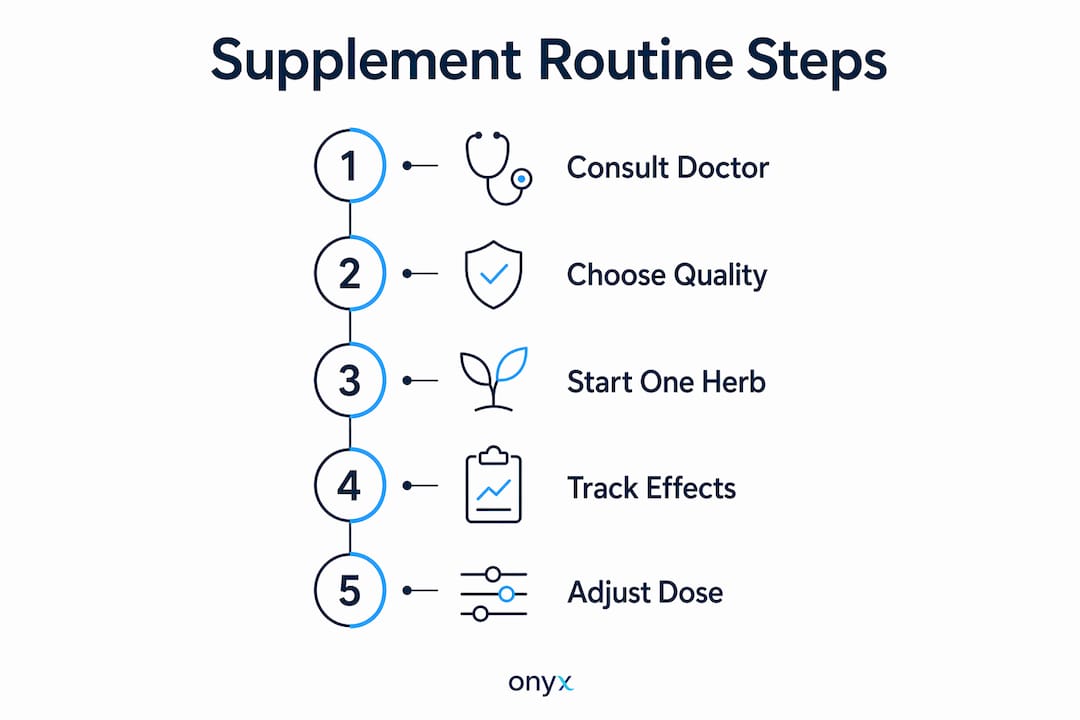
The most reliable approach is also the most patient one. Start one supplement at a time and introduce it gradually over 2–3 weeks before adding anything else. This is not overcaution. It is the only way to know which herb is helping or causing a problem if something changes.
- Choose one herb aligned with a specific goal. If you want digestive support, start there. If sleep is the priority, focus on that. Picking one goal keeps your routine clear and your results measurable.
- Follow label dosing exactly. Never exceed recommended doses, even if you feel no effect in the first week. Higher doses do not always mean better results, and some herbs become risky at elevated amounts.
- Track your response for 2–3 weeks. Note energy levels, digestion, sleep quality, mood, and any new symptoms in your health journal. Be specific. “Felt off” is not useful. “Mild nausea 30 minutes after taking capsule on an empty stomach” is.
- Communicate with your healthcare provider. Share your log at your next appointment. If you notice anything unusual, such as a rash, nausea, or fatigue, contact your provider before continuing.
- Adjust timing and form based on your response. Some herbs absorb better with food. Others work well as teas or tinctures rather than capsules. Dissolvable strips, like those from Onyxwellness, offer fast absorption without water, which suits people who struggle with pills or want a more convenient format.
- Add a second herb only after the first is stable. Wait until you have a clear, consistent response before layering in another supplement. Multi-ingredient routines are harder to troubleshoot.
Pro Tip: Morning is often the best time to take adaptogens like ashwagandha or ginseng, since they support energy and focus. Calming herbs like valerian or chamomile work better in the evening. Timing your herbs to your goals makes a real difference.
For a deeper look at building this kind of structured approach, the step-by-step herbal guide from Onyxwellness walks through the process with practical detail.
What are the most common challenges with herbal routines?
Even well-planned routines run into problems. Knowing what to watch for keeps you from abandoning a routine that just needs a small adjustment, or from continuing one that is actually causing harm.
- Side effects you attribute to something else. Headaches, digestive upset, and fatigue are easy to blame on stress or diet. If a symptom appears within days of starting a new herb, the herb is the first suspect. Stop it and see if the symptom resolves.
- Herb-drug interactions. Herbs can interact unpredictably with medications, and the absence of known interaction data does not mean the combination is safe. St. John’s Wort, for example, is well-documented to reduce the effectiveness of several prescription drugs.
- Product variability. Two bottles of the same herb from different brands can contain very different amounts of active compounds. Sticking with certified brands reduces this risk significantly.
- The “natural equals safe” myth. The “natural” label does not guarantee safety. Black cohosh, for instance, showed acceptable safety in clinical trials but has been linked to liver injury in post-marketing reports. Resources like LiverTox track exactly these kinds of real-world safety signals.
- Overuse and dose creep. More is not better. Liver injury is a known risk with high doses or multi-ingredient supplements. If you feel like your current dose is not working, consult your provider before increasing it.
Understanding product transparency is part of solving the variability problem. The Onyxwellness article on supplement transparency covers how to evaluate brands honestly.
How do common herbal supplements compare for your wellness goals?
Matching the right herb to your specific goal is the core skill in any natural remedy guide. The table below gives you a practical starting point.
| Herb | Primary use | Common forms | Key safety note |
|---|---|---|---|
| Turmeric (curcumin) | Inflammation, joint support | Capsule, powder, extract | High doses may affect blood thinners |
| Echinacea | Immune support, short-term cold relief | Capsule, tea, tincture | Not recommended for autoimmune conditions |
| Ginseng (Panax) | Energy, mental focus, adaptogen | Capsule, extract, tea | May interact with blood pressure medications |
| Ashwagandha | Stress response, sleep quality | Capsule, powder, strip | Avoid in thyroid conditions without guidance |
| Valerian root | Sleep onset, relaxation | Capsule, tea, tincture | May cause drowsiness; avoid with sedatives |
| Milk thistle | Liver support | Capsule, extract | Generally well-tolerated; consult if on statins |
Each of these herbs has a different safety profile and a different ideal user. Turmeric is one of the most studied, but it is not a free pass. Echinacea works well for short-term immune support but is not designed for continuous daily use. Ginseng is a strong adaptogen, but it can raise blood pressure in sensitive people. The right choice depends on your health history, your current medications, and your specific goal. A provider conversation is the only way to get that right.
For people interested in mushroom-based supplements, which overlap with the herbal category, the Onyxwellness guide on gummy mushroom benefits covers the risk and reward picture clearly.
Key Takeaways
A safe and effective herbal supplement routine requires quality-certified products, one-at-a-time introduction, healthcare provider collaboration, and honest tracking of your body’s response.
| Point | Details |
|---|---|
| Start with one herb | Introduce a single supplement over 2–3 weeks before adding another to isolate effects. |
| Choose certified products | Look for USP Verified or ConsumerLab.com seals to reduce mislabeling risk. |
| Consult your provider | Share your full medication list and symptom log with a doctor or pharmacist before starting. |
| Track everything | A health journal is your best tool for spotting both benefits and early warning signs. |
| “Natural” is not automatically safe | Post-market reports on herbs like black cohosh show that clinical trial safety does not always predict real-world outcomes. |
Why I think most people approach herbal supplements backwards
Most people pick an herb first and ask questions later. They see turmeric trending, buy a bottle, and figure they will sort out the details as they go. I get it. The appeal of a natural solution is real, and the barrier to entry feels low.
The problem is that this approach turns your body into a side effect lottery. You have no baseline, no tracking system, and no way to know if what you are feeling is the herb working or the herb causing harm. I have seen people take five supplements at once and then spend months trying to figure out why they feel worse.
The approach that actually works is the boring one. One herb. Two to three weeks. A written log. A provider in your corner. It feels slow, but it is the only method that gives you real information. Clinical evidence on herbs like ashwagandha and ginseng is genuinely promising, but that evidence was built on controlled conditions. Your routine needs the same discipline, even at a smaller scale.
The other thing I would push back on is the idea that herbal supplements are a replacement for medical care. They are a complement to it. The best results I have seen come from people who treat their provider as a partner, not an obstacle. Bring your supplement list to every appointment. Ask about interactions. Use resources like NHS SPS guidance to prepare informed questions. That combination of personal experimentation and clinical oversight is where the real results live.
— Chris
Onyxwellness products built for your daily herbal routine
Onyxwellness brings Ayurvedic-inspired herbal formulas into a format that fits real life. The Digestive + Gut Health Strips deliver plant-based digestive support through fast-absorbing, sugar-free dissolvable strips. No water needed, no pills to swallow. For people building a sleep-focused routine, the Sleep Strips combine calming herbal ingredients in the same convenient format. Both products are designed to slot cleanly into a structured daily routine, making consistency easier to maintain. If you want to see the full range of natural supplement options, the Onyxwellness collection covers everything from bone support to iron to cognitive focus strips.
FAQ
What is an herbal supplement routine?
An herbal supplement routine is a structured, personalized plan to use plant-based supplements safely for specific health goals. It includes product selection, dosing schedules, symptom tracking, and regular healthcare provider check-ins.
How do I know if an herbal supplement is safe to take?
Look for quality certifications like USP Verified or ConsumerLab.com Approved Quality, and consult your doctor or pharmacist before starting, especially if you take prescription medications.
Can herbal supplements interact with my medications?
Yes. Herbs can interact unpredictably with medications, and the absence of known interaction data does not confirm safety. Always share your full supplement list with your healthcare provider.
How long does it take to see results from herbal supplements?
Most herbs require consistent use over several weeks before effects become clear. Introducing one supplement at a time over a 2–3 week window gives you the clearest picture of what is working.
Are “natural” herbal supplements always safe?
No. Natural does not mean risk-free. Herbs like black cohosh have shown liver toxicity in real-world reports despite positive clinical trial results. Dosing, product quality, and individual health history all affect safety.