


TL;DR:
- Natural supplements can help fill specific nutritional gaps or support certain health conditions with proper guidance. However, they are not safe substitutes for whole foods, and quality, safety, and interactions require careful consideration. Consulting a healthcare provider and verifying product quality are essential before adding supplements to your routine.
Natural supplements are worth considering when your diet leaves specific nutritional gaps, when a clinical condition creates a genuine deficiency, or when targeted evidence supports their use for your situation. They are not magic pills, and they are not substitutes for whole foods. But for the right person, at the right dose, with the right guidance, they can make a real difference.
Here is what the evidence actually says:
- They fill gaps, not replace meals. As NIH registered dietitian Carol Haggans puts it, “They’re intended to supplement the diet,” not treat disease.
- Certain groups have documented needs: older adults, vegans, pregnant women, and people with malabsorption conditions like Crohn’s disease or celiac disease.
- Some have strong clinical backing: folic acid for birth defect prevention, the AREDS formula for macular degeneration, calcium and vitamin D for bone health.
- “Natural” does not mean safe. Ephedra, kava, and comfrey have all caused serious harm despite being plant-based.
- The FDA does not pre-approve supplements for safety or efficacy before they reach store shelves.
- Drug interactions are real. St. John’s wort, for example, interferes with the metabolism of many prescription medications.
- A healthcare provider should guide your choices, including dosage, timing, and whether you need a supplement at all.
What does the clinical evidence actually show?
The honest answer is: it depends entirely on which supplement and which condition. The AREDS formula (vitamins C and E, zinc, copper, lutein, and zeaxanthin) has solid evidence for slowing age-related macular degeneration. Folic acid has decades of data supporting its role in reducing neural tube defects. Psyllium fiber genuinely helps people who cannot meet the National Academy of Medicine’s fiber targets through diet alone.
But the picture gets murkier fast. A study published in the Journal of the American College of Cardiology found that four of the most commonly used supplements (multivitamins, vitamin D, calcium, and vitamin C) did not protect against cardiovascular disease. Echinacea failed to show benefit against the common cold in several major trials. Ginkgo, studied in a trial of more than 3,000 older adults, showed no effect on preventing dementia or cognitive decline.
| Supplement | Target Condition | Evidence Strength |
|---|---|---|
| Folic acid | Neural tube defect prevention | Strong |
| AREDS formula | Age-related macular degeneration | Strong |
| Vitamin D + calcium | Bone health in osteoporosis | Moderate |
| Vitamin B12 | Deficiency in vegans, older adults | Strong for at-risk groups |
| Psyllium fiber | Cholesterol, constipation | Moderate |
| Multivitamins | General disease prevention | Weak |
| Echinacea | Common cold prevention | Weak |
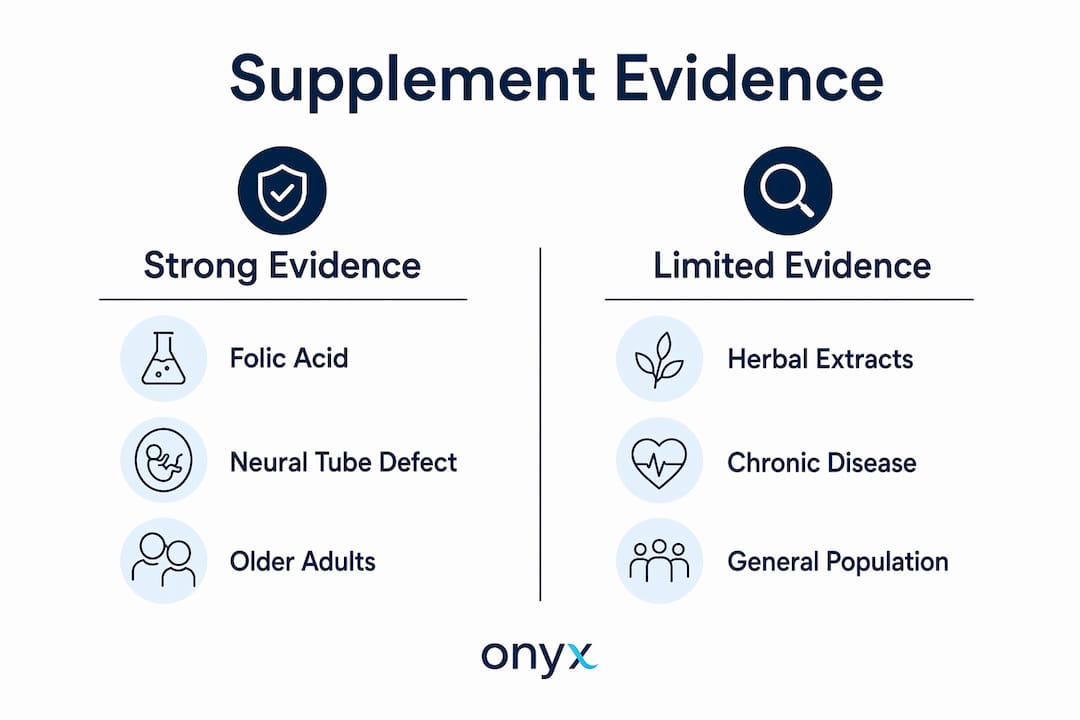
Specific groups with documented deficiencies, such as older adults who absorb vitamin B12 less efficiently, or vegans who get no dietary B12 at all, have the clearest clinical rationale for supplementing. For everyone else, the evidence is thinner than the marketing suggests.
Safety risks you need to know before you start
“Natural” is not a synonym for harmless. The FDA banned ephedrine alkaloid supplements in 2004 after 155 deaths were linked to them. Kava has been associated with severe liver damage. Comfrey, once sold widely as a digestive aid, contains compounds that can cause irreversible liver injury.
Common risks include:
- High-dose toxicity: Too much vitamin A causes liver damage and birth defects; excess iron causes nausea and organ damage; high-dose vitamin E has been linked to increased stroke risk.
- Drug interactions: Vitamin K interferes with blood thinners; St. John’s wort reduces the effectiveness of many prescription drugs; high-dose vitamin B6 taken long-term can cause nerve damage.
- Contamination: Poorly manufactured products may contain heavy metals, pesticides, or undisclosed pharmaceutical compounds.
- Surgical risks: Some supplements increase bleeding risk or alter anesthesia response.
- Stacking dangers: Taking many supplements simultaneously multiplies interaction risks in ways that are difficult to predict.
Statistic callout: The FDA banned ephedrine alkaloids from dietary supplements in 2004 following 155 linked deaths, making it one of the most consequential supplement safety actions in U.S. history.
The safest approach is to treat supplements with the same scrutiny you would apply to any medication. More is not better, and the upper intake levels for nutrients like calcium, iron, zinc, and vitamins A, B6, C, and D exist for good reason.

How to choose a supplement you can actually trust
The word “natural” on a label is a marketing claim, not a regulated term. It tells you nothing about purity, potency, or safety. Because supplements are not evaluated by the FDA before they go to market, the burden of quality verification falls on you.
Steps to identify trustworthy products:
- Look for third-party verification from USP (U.S. Pharmacopeia), NSF International, or ConsumerLab. These organizations test for label accuracy, contaminants, and potency.
- Read the Supplement Facts panel carefully. Check the form of each ingredient (e.g., vitamin D3 vs. D2) and the dose against clinically studied amounts.
- Avoid products with excessive health claims. Phrases like “cures anxiety” or “burns fat fast” are red flags; supplements cannot legally claim to treat or cure disease.
- Research the manufacturer. Look for companies that follow FDA current Good Manufacturing Practices (cGMP).
- Cross-check with NIH resources. The NIH Office of Dietary Supplements publishes fact sheets on individual ingredients with evidence summaries.
Onyxwellness addresses this directly by prioritizing transparency in its ingredient sourcing and formulation. If you want to explore natural wellness products with clearly stated ingredients, that is a reasonable starting point for your research.
How the FDA actually regulates supplements in the U.S.
Dietary supplements occupy a regulatory gray zone. The FDA oversees them under food law, not drug law, which means manufacturers do not need to prove their products are safe or effective before selling them. The Dietary Supplement Health and Education Act (DSHEA), passed in 1994, set this framework and significantly limits the FDA’s pre-market authority.
What the FDA can and cannot do:
- Can require: Accurate labeling, cGMP compliance, and reporting of serious adverse events.
- Cannot require: Pre-market safety or efficacy testing before a product reaches shelves.
- Can act post-market: The FDA can remove a product after it has been shown to cause harm, as it did with ephedra.
- Cannot verify claims proactively: Structure/function claims (e.g., “supports immune health”) do not require FDA approval, only a disclaimer.
The NIH Office of Dietary Supplements and the National Center for Complementary and Integrative Health (NCCIH) fill part of this gap by funding independent research and publishing consumer-facing evidence summaries. But the core responsibility for evaluating what you put in your body remains yours.
Why talking to your doctor about supplements matters more than you think
Most people never mention their supplements to their doctors. That silence can be genuinely dangerous. Supplements can alter how medications work, affect lab test results, and complicate surgical procedures in ways your provider needs to know about.
Questions worth asking your healthcare provider:
- Do I actually have a deficiency that warrants this supplement?
- What dose is appropriate for my age, weight, and health status?
- Does this interact with any of my current medications?
- How long should I take it, and how will we know if it’s working?
- Are there food sources that could address this need instead?
The NIH provides a free tool called My Dietary Supplement and Medicine Record that lets you log every supplement and medication in one place. Bringing that record to appointments gives your provider the full picture. Blood tests can confirm whether a deficiency is real before you spend money on something you may not need.
Does “natural” really mean better? The placebo effect and nutrient synergy
Here is something the supplement industry rarely advertises: your body often cannot tell the difference between a natural and a synthetic molecule once it is absorbed. Studies show that many synthetic and natural forms of the same nutrient are processed similarly in the body, which undercuts the assumption that plant-derived automatically means superior.
The placebo effect is also a genuine factor. As Dr. Manson at Harvard notes, “People feel healthier if they do something they believe makes them healthy.” That is not nothing, but it is also not the same as a measurable clinical benefit. Naturalness bias, the tendency to trust products labeled “natural” over those that are not, is a documented psychological phenomenon that supplement marketers exploit.
Whole foods have something isolated supplements genuinely cannot replicate: nutritional synergy. Vitamins, minerals, fiber, and phytonutrients in food work together in ways that boost absorption and effectiveness. An isolated vitamin C capsule does not carry the flavonoids, water content, and fiber that come with an orange. That complexity matters for balancing diet and supplements effectively.
Pro Tip: Before adding a supplement, ask whether a dietary change could address the same gap. If the answer is yes and the change is realistic for you, start there.
Common myths about natural supplements, corrected
A few persistent misconceptions deserve a direct response.
Myth: More is always better. False. Vitamins A, B6, D, and E all have upper intake levels beyond which they cause harm, not benefit. Exceeding those levels is a real risk, not a theoretical one.
Myth: Herbal supplements are gentle and side-effect-free. Ephedra, kava, and comfrey prove otherwise. Plant origin does not determine safety profile.
Myth: If it’s sold in a store, the FDA approved it. The FDA does not evaluate supplements before they go to market. Presence on a shelf is not a safety endorsement.
Myth: Supplements can prevent or cure disease. By law, they cannot make that claim, and the clinical evidence for most disease-prevention applications is weak. They supplement the diet; they do not replace medicine.
Myth: Natural and synthetic supplements work differently in the body. For most nutrients, the body processes natural and synthetic forms similarly once absorbed.
Drug and supplement interactions you should not ignore
Some of the most clinically significant supplement interactions involve medications that millions of Americans take daily. St. John’s wort is the most studied example: it activates liver enzymes that speed up the breakdown of drugs including antidepressants, birth control pills, HIV medications, and blood thinners, reducing their effectiveness to potentially dangerous levels.
Other interactions worth knowing:
- Vitamin K reduces the effectiveness of warfarin and other anticoagulants.
- High-dose fish oil can increase bleeding risk, especially before surgery.
- Calcium interferes with the absorption of certain antibiotics and thyroid medications when taken at the same time.
- Magnesium can reduce the absorption of some antibiotics.
- Iron binds to several medications, including levothyroxine, reducing their absorption.
The natural role of ingredients in your body is not always predictable when combined with pharmaceuticals. Disclosing every supplement you take to every provider, including dentists and pharmacists, is the only way to catch these interactions before they cause a problem.
Try Onyxwellness Strips for Targeted Natural Support
Onyxwellness brings Ayurvedic-inspired formulas into a format built for real life: sugar-free, dissolvable strips that absorb fast without water. Whether you are looking for digestive and gut health support, a probiotic and metabolism boost, or beauty and collagen support, each strip is formulated with clearly stated ingredients and no unnecessary fillers. Explore the full range at Onyxwellness.
Key Takeaways
Natural supplements serve a real purpose for specific groups, but clinical evidence, quality verification, and provider guidance determine whether they help or harm.
| Point | Details |
|---|---|
| Supplements fill gaps, not diets | They are intended to supplement food, not replace the nutrient complexity of whole meals. |
| Evidence is condition-specific | Folic acid, AREDS formula, and vitamin B12 for deficient groups have strong backing; multivitamins for general prevention do not. |
| “Natural” does not mean safe | The FDA banned ephedrine alkaloids after 155 linked deaths; kava and comfrey carry serious liver risks. |
| FDA does not pre-approve supplements | Products reach shelves without safety or efficacy review; third-party certifications like USP and NSF are your best quality check. |
| Provider disclosure prevents harm | Drug interactions from St. John’s wort, vitamin K, and high-dose fish oil can be serious; your full supplement list belongs in every medical record. |
FAQ
Why use natural supplements if diet can cover most needs?
For most healthy adults, a varied diet does cover nutritional needs. Supplements become clinically useful for specific groups: vegans lacking B12, older adults with reduced absorption, pregnant women needing folic acid, and people with conditions like celiac disease or osteoporosis.
Are natural supplements safe to take every day?
Most are safe at recommended doses, but safety depends on the specific supplement, your health status, and any medications you take. High doses of vitamins A, B6, D, and E can cause harm, and some herbal supplements carry serious risks regardless of dose.
How do I know if a natural supplement is high quality?
Look for third-party verification from USP, NSF International, or ConsumerLab, which test for label accuracy, potency, and contaminants. The FDA does not evaluate supplements before they are sold, so third-party testing is your most reliable quality signal.
Can natural supplements interact with prescription medications?
Yes. St. John’s wort reduces the effectiveness of many drugs including antidepressants and birth control. Vitamin K interferes with blood thinners. Always disclose every supplement to your healthcare provider before starting or changing anything.
What is the difference between natural and synthetic supplements?
For most nutrients, the body processes natural and synthetic forms similarly once absorbed. The clinical benefit depends on the form, dose, and bioavailability of the specific compound, not simply whether it came from a plant or a lab.