


TL;DR:
- Mental clarity is a temporary neurological state influenced by sleep, hydration, stress, and exercise. Prioritizing these biological inputs enhances focus, decision-making, and overall cognitive performance. Consistent habits and minimal reactive busyness are key to maintaining optimal mental clarity daily.
Mental clarity is defined as a transient neurological state in which your mind operates with sharp focus, clear judgment, and minimal cognitive friction, enabling better decisions and greater productivity. It is not a personality trait you either have or lack. Research from Harvard Medical School shows that exercise increases BDNF, a protein scientists call “brain fertilizer” because it promotes neuron growth and synaptic connectivity. Understanding why prioritize mental clarity matters starts with recognizing that your cognitive performance is directly shaped by sleep quality, hydration, stress levels, and physical movement. This article gives you the science and the practical tools to take control of all four.

Why prioritize mental clarity in your daily life?
Mental clarity is the foundation beneath every productive hour you put in. Without it, you are not thinking strategically. You are reacting. Executives without prioritization systems outsource their decisions to noise, producing cognitive fatigue and reactive thinking instead of focused, meaningful work. That pattern is not limited to the boardroom. It shows up every time you feel scattered, forgetful, or mentally exhausted by noon.
The importance of mental clarity goes beyond productivity. Clear thinking supports emotional balance, better relationships, and more deliberate choices throughout the day. When your prefrontal cortex is operating without interference from chronic stress or fatigue, you process information faster and make fewer impulsive decisions. That is the real competitive advantage, and it is available to anyone willing to invest in the right biological inputs.
What causes fluctuations in mental clarity?
Mental clarity fluctuates because it depends on biological systems that change hour by hour. Sleep is the most powerful lever. During deep sleep, the brain’s glymphatic system flushes out metabolic waste products that accumulate during waking hours. Skip or shorten that process and you wake up with a cognitive deficit that no amount of coffee fully corrects.
Hydration is the second lever, and most people underestimate it. Losing just 1%–2% of body water impairs attention and working memory. The good news is that rehydration can restore cognitive function within hours, making it one of the fastest fixes available.
Chronic stress creates a third problem. When the amygdala stays in a heightened state, it suppresses the prefrontal cortex, the brain region responsible for logic, planning, and impulse control. You literally cannot think as clearly when you are stressed. Beyond lifestyle factors, underlying conditions like thyroid disorders and anxiety disorders also contribute to persistent mental fog, and those warrant medical evaluation.
Here is a quick summary of the main biological drivers:
- Sleep quality: Glymphatic clearance during deep sleep removes cognitive waste
- Hydration status: Even mild dehydration degrades attention and working memory
- Cortisol levels: Chronic stress suppresses the prefrontal cortex
- Physical activity: Exercise boosts BDNF, promoting synaptic growth critical for high-level thinking
- Underlying health conditions: Thyroid dysfunction and anxiety disorders amplify mental fog
“Mental clarity is not a fixed trait. It is a biological output that shifts based on what you feed, move, rest, and stress your body with each day.”
How does mental clarity differ from mindfulness and cognitive focus?
These three terms get used interchangeably, but they describe distinct things. Mental clarity is a transient neurological state. Mindfulness is a practice. Cognitive focus is an outcome. Confusing them leads to misguided strategies.
Mindfulness works by regulating the amygdala, reducing the chronic stress tone that blocks logical thinking. It rebuilds connectivity between emotional and decision-making brain centers. So mindfulness supports mental clarity, but it is not the same thing. You can be mindful and still have brain fog from poor sleep.
Cognitive focus, on the other hand, is what you experience when mental clarity is present and you direct it at a task. Clarity is the prerequisite. Focus is the result. Mental health is a broader concept covering your overall psychological well-being over time, not a moment-to-moment cognitive state.
| Concept | What it is | How it relates to clarity |
|---|---|---|
| Mental clarity | Transient neurological state | The core state this article addresses |
| Mindfulness | A practice or skill | Supports clarity by calming the amygdala |
| Cognitive focus | A performance outcome | Enabled by mental clarity, not the same as it |
| Mental health | Overall psychological well-being | Broader context; poor mental health impairs clarity |
Pro Tip: If you practice mindfulness but still feel foggy, check your sleep and hydration first. Mindfulness cannot override a dehydrated or sleep-deprived brain.
How to achieve mental clarity: practical strategies that work
The benefits of mental clarity are real, but they require consistent inputs. Here are the strategies with the strongest evidence behind them.
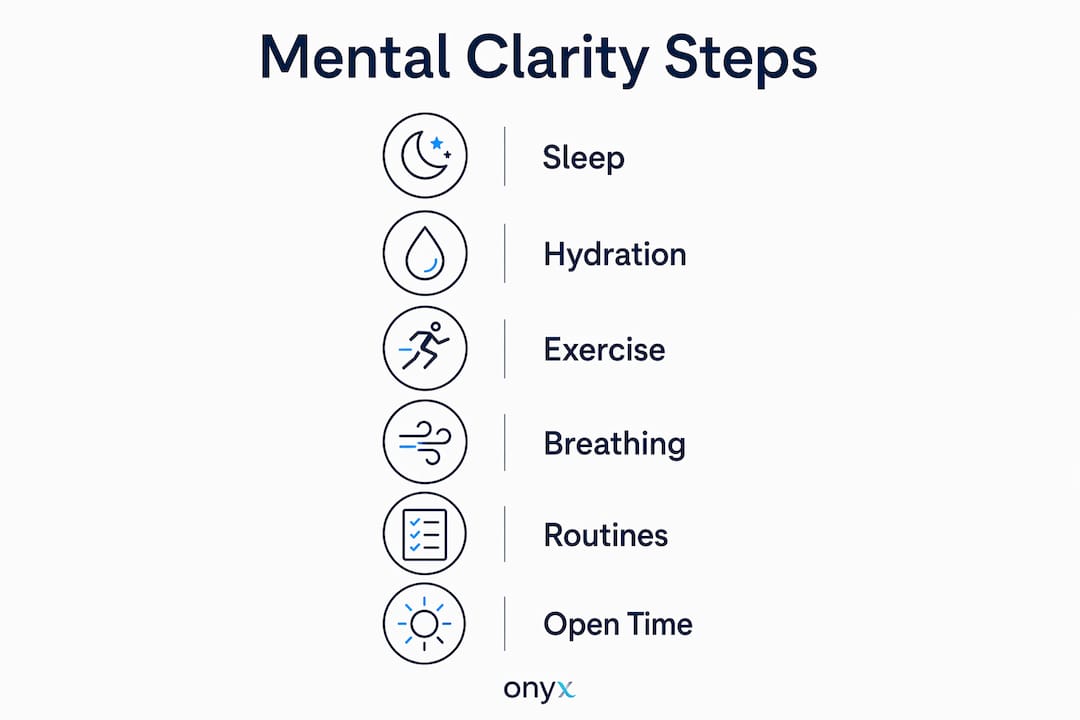
1. Prioritize sleep above everything else
A consistent sleep schedule is the single most effective mental clarity exercise you can build. Aim for 7–9 hours and keep your wake time fixed, even on weekends. Sleep and movement improvements produce noticeable cognitive gains within 1–2 weeks. That timeline is faster than most people expect, which makes it a strong motivator to start.
2. Hydrate before you caffeinate
Drink 400–500ml of water first thing in the morning before reaching for coffee. Caffeine is a mild diuretic, and starting your day dehydrated compounds the cognitive deficit you already carry from sleep. Rehydration improves cognition within hours, so the timing matters.
3. Exercise for at least 150 minutes per week
Regular moderate aerobic exercise over six months increases brain volume and lowers cognitive decline risk by 33%–38%. You do not need a gym. A brisk 30-minute walk five days a week qualifies. The BDNF increase from aerobic activity is the mechanism behind those gains, and it accumulates over time.
4. Use focused breathing for acute clarity
When you need mental clarity fast, a five-minute focused breathing session activates the parasympathetic nervous system and dials down amygdala activity. Pair it with a 10-minute walk and 400ml of water, and you can restore clarity in under 15 minutes. Think of this as your emergency reset button.
5. Build decision-neutral routines
Decision fatigue is real. Every small choice you make throughout the day draws from the same cognitive resource pool. Automating routine decisions, such as what to eat for breakfast or when to exercise, preserves mental energy for work that actually requires it. Productivity systems like the Pomodoro Technique work partly because they remove the decision of when to take a break.
6. Protect open time daily
Open time without agenda allows the brain’s Default Mode Network to synthesize information and generate original thinking. Blocking even 20–30 minutes of unscheduled time each day is not laziness. It is a biological requirement for genuine mental clarity. Filling every minute with tasks or screens is the fastest way to feel busy but mentally dull.
Pro Tip: Try Ayurvedic mental clarity strategies alongside these lifestyle habits. Traditional herbal approaches like ashwagandha and brahmi have been used for centuries to support cognitive calm and focus.
What challenges get in the way of sustained mental clarity?
Knowing the strategies is one thing. Sticking with them is another. These are the most common obstacles and how to work around them.
- Digital overload: Constant notifications fragment attention and prevent the deep focus that mental clarity enables. Turning off non-essential notifications during focused work blocks is one of the most effective mental clutter fixes available.
- Chronic multitasking: The brain does not actually multitask. It switches rapidly between tasks, and each switch carries a cognitive cost. Single-tasking with time blocks produces better output and less fatigue.
- The willpower myth: Many people believe mental clarity is a matter of trying harder. It is not. Clarity is a biological output. Willpower cannot override a sleep-deprived or dehydrated brain. Fixing the inputs is the only reliable path.
- Emotional fatigue: Unresolved stress and emotional strain consume prefrontal cortex resources. Mindfulness techniques like body scans and breath awareness directly address this by reducing amygdala reactivity.
- Unrealistic expectations: People often abandon clarity-building habits because they expect immediate results. Sleep and exercise improvements take 1–2 weeks to show up cognitively. Staying consistent through that window is where most people quit.
The fix is not more discipline. It is better systems. Build routines that make the right inputs automatic, and mental clarity becomes the default rather than the exception.
Key takeaways
Mental clarity is a biological output, not a personality trait, and it improves predictably when you invest in sleep, hydration, exercise, and structured downtime.
| Point | Details |
|---|---|
| Clarity is biological, not fixed | Sleep, hydration, and cortisol levels determine your cognitive state each day. |
| Exercise is the strongest long-term tool | 150 minutes of aerobic exercise per week lowers cognitive decline risk by 33%–38%. |
| Hydration works fast | Rehydrating after even mild dehydration restores attention and working memory within hours. |
| Open time is not optional | Unscheduled downtime activates the Default Mode Network, which is required for original thinking. |
| Systems beat willpower | Automating routine decisions preserves cognitive resources for meaningful, focused work. |
Mental clarity is the foundation, not the finish line
I have spent years watching people chase productivity tools, apps, and supplements while ignoring the basics. The honest truth is that most cognitive struggles trace back to three things: not enough sleep, not enough water, and too much reactive busyness with no recovery time built in.
What changed my perspective was realizing that mental clarity is not something you achieve once. It is something you maintain through daily inputs. The days I feel sharpest are not the days I tried harder. They are the days I slept well, moved my body, and protected at least some unscheduled time to let my brain breathe.
Small, consistent investments in biological inputs compound faster than most people expect. Two weeks of better sleep and daily walks produces a measurable cognitive shift. That is not a long time to wait for a meaningful return.
I also think supplements have a legitimate supporting role when the fundamentals are in place. Adaptogenic herbs like ashwagandha, lion’s mane mushroom, and brahmi have real evidence behind them for cognitive support. Onyxwellness builds products around exactly these ingredients, and I find them most useful as a complement to good habits rather than a replacement for them. Explore natural cognitive support strategies if you want to understand what the research actually says before adding anything to your routine.
The difference between reactive busyness and focused, meaningful work is not talent. It is clarity. And clarity is something you can build.
— Chris
Support your mental clarity with Onyxwellness
The lifestyle strategies in this article work best when your body has the right support underneath them. Onyxwellness makes it easier to stay consistent with the biological inputs that mental clarity depends on.

The Sleep Strips are formulated with natural Ayurvedic ingredients to support deep, restorative sleep, the single most powerful lever for cognitive recovery. The Energy Strips provide clean daytime focus without the crash that comes from heavy caffeine loading. And if a late night has left you foggy and dehydrated, the Hangover Strips are designed for fast recovery. All three dissolve instantly without water, so they fit the kind of modern, on-the-go lifestyle where mental clarity matters most. Browse the full range at Onyxwellness and find what fits your routine.
FAQ
What is mental clarity, exactly?
Mental clarity is a transient neurological state characterized by sharp focus, clear judgment, and low cognitive friction. It is determined by biological inputs like sleep, hydration, and stress levels, not by personality or willpower.
How quickly can you improve mental clarity?
Rehydration can restore attention and working memory within hours. Consistent sleep and exercise improvements produce noticeable cognitive gains within 1–2 weeks, according to research on recovery protocols.
What are the best mental clarity exercises?
The most effective mental clarity exercises include aerobic movement like brisk walking, focused breathing sessions, and structured open time with no agenda. These directly address the biological drivers of cognitive performance.
Why is mental clarity essential for productivity?
Mental clarity enables the prefrontal cortex to function without interference from chronic stress or fatigue. Without it, thinking becomes reactive rather than strategic, which reduces output quality and increases decision errors.
Can supplements support mental clarity?
Supplements like lion’s mane mushroom, ashwagandha, and brahmi have evidence supporting cognitive calm and focus. They work best as a complement to strong sleep, hydration, and exercise habits rather than as a standalone fix.