


Take creatine every day. That single habit matters more than whether you swallow it at 7 AM or right after your last set. Consistency is the primary driver of results because creatine works by saturating your muscles over days and weeks, not by spiking performance in a single dose.
Here’s what that looks like in practice:
- Training days: Take 3–5 g of creatine monohydrate before, during, or after your workout. Close to exercise is a reasonable convenience choice, but the window is wide.
- Rest days: Take the same 3–5 g at any point during the day, ideally with a meal.
- Loading (optional): If you want faster saturation, take ~20 g/day split into four doses for 5–7 days, then drop to maintenance.
Safety note: Creatine is well tolerated in healthy adults. If you have kidney disease, take nephrotoxic medications, or use stimulants like Vyvanse, talk to your clinician before starting.
Key Takeaways
Daily creatine dosing, not precise timing, is the primary driver of muscle saturation and the performance benefits that follow.
| Point | Details |
|---|---|
| Consistency beats timing | Take 3–5 g every day; missing the “perfect” window by hours has no meaningful effect. |
| Loading is optional | ~20 g/day for 5–7 days saturates muscles in about one week; maintenance alone takes 3–4 weeks. |
| Post-workout has a slight edge | Some studies suggest post-exercise dosing is marginally better, but evidence is mixed and limited. |
| Safety check first | Healthy adults tolerate creatine well; those with kidney disease or on certain medications should consult a clinician. |
| Onyxwellness makes it easy | HydraCore Creatine combines creatine and electrolytes in one scoop for pre- or post-workout convenience. |
Table of Contents
- What the research actually says about creatine timing
- How creatine absorption works and why it matters for timing
- Practical dosing: loading vs. maintenance and how to schedule both
- Three simple timing plans you can actually stick with
- Safety, side effects, and when to talk to your doctor
- Key studies at a glance
- The case for keeping it simple
- Onyxwellness creatine products worth adding to your routine
- Sources
- FAQ
What the research actually says about creatine timing
The honest answer: the evidence is mixed, and the effect of precise timing is probably small. Several narrative reviews and systematic summaries find no consistent, clinically meaningful advantage to taking creatine at a specific moment relative to exercise. That said, a handful of studies do suggest a modest post-workout edge.
The 2021 narrative review in Sports Medicine (PMC) is the most cited summary on this question. Its conclusion: emerging evidence leans toward post-exercise creatine being slightly more beneficial than pre-exercise, but methodological limitations, including small samples, mixed protocols, and the absence of direct intramuscular creatine measurements, prevent any firm recommendation.
A separate Frontiers in Sports and Active Living review reinforces that creatine reliably increases muscle mass and strength across age groups during resistance training. Where the literature gets murky is in head-to-head timing comparisons, where long-term outcomes between pre- and post-workout groups tend to converge.
One recent randomized crossover pilot trial adds an interesting wrinkle. In a small study of 11 participants, acute creatine ingestion before resistance training produced greater strength performance than ingestion during or after the session. The authors themselves flag this as exploratory, and an n of 11 cannot carry a firm recommendation. Still, it’s a data point worth knowing.
Bottom line on the evidence:
- Post-workout timing shows a possible small edge in some studies, but it is not consistent across the literature.
- Pre-workout acute dosing may benefit same-session strength, based on limited pilot data.
- Long-term muscle and strength gains appear similar regardless of timing when daily dosing is maintained.
- Strength of evidence for any specific timing window: limited to moderate.
How creatine absorption works and why it matters for timing
Creatine saturates your muscles over days to weeks, not in the hour before a workout. That’s the most important kinetic fact for setting realistic expectations about timing.
After you swallow a 5 g dose, plasma creatine peaks roughly 1–2 hours later and stays elevated for about 4 hours. Absorption of creatine monohydrate is close to 100%, so very little is wasted regardless of when you take it.
Three mechanisms explain why exercising near peak plasma creatine is at least theoretically attractive:
- Exercise-induced hyperemia: Blood flow to working muscles increases sharply during training, which may enhance creatine delivery to muscle cells at the moment they need it most.
- Na⁺-K⁺ pump activity: Muscle contraction upregulates transport proteins that help pull creatine into cells.
- Insulin-mediated uptake: Co-ingestion of carbohydrates or carbohydrates plus protein stimulates insulin release, which augments skeletal muscle creatine accumulation.
Here’s the practical catch: once your muscles are saturated, which takes about one week with loading or three to four weeks on maintenance, exercise-induced hyperemia becomes marginally important. The transport advantage is real but probably small in someone who has been dosing consistently. For a beginner in the first week of supplementation, timing near a workout may offer a slightly larger relative benefit.
Practical dosing: loading vs. maintenance and how to schedule both
The two-phase approach most sports nutrition guidelines follow is straightforward.
| Phase | Daily Dose | Duration | Time to Saturation |
|---|---|---|---|
| Loading (optional) | ~20 g split into 4 doses | 5–7 days | ~1 week |
| Maintenance | 3–5 g once daily | Ongoing | 3–4 weeks (without loading) |
Loading speeds saturation; maintenance sustains it. Neither phase requires precise timing to work. Most people who skip loading simply wait a few extra weeks before noticing strength and recovery changes.
How to schedule on workout days vs. rest days:
- Workout days: Take your 3–5 g dose within 30–90 minutes before or after training. Either window works. Pairing it with your pre-workout meal or post-workout shake is the most practical approach for most people.
- Rest days: Take it with any meal. Morning with breakfast or evening with dinner both work equally well. The goal is simply not to skip a day.
Mixing tips to reduce GI upset:
- Stir creatine into 8–12 oz of water, juice, or a carbohydrate-containing sports drink.
- Adding it to a protein shake gives you the insulin-mediated uptake benefit described above.
- If you experience bloating, split a 5 g dose into two 2.5 g doses taken at different meals.
- Avoid dry-scooping. Creatine dissolves slowly; give it 30–60 seconds of stirring.
Pro Tip: Mixing creatine with a carbohydrate-rich drink, like orange juice or a sports drink, can modestly increase muscle uptake compared to water alone, thanks to the insulin response carbs trigger.
Three simple timing plans you can actually stick with
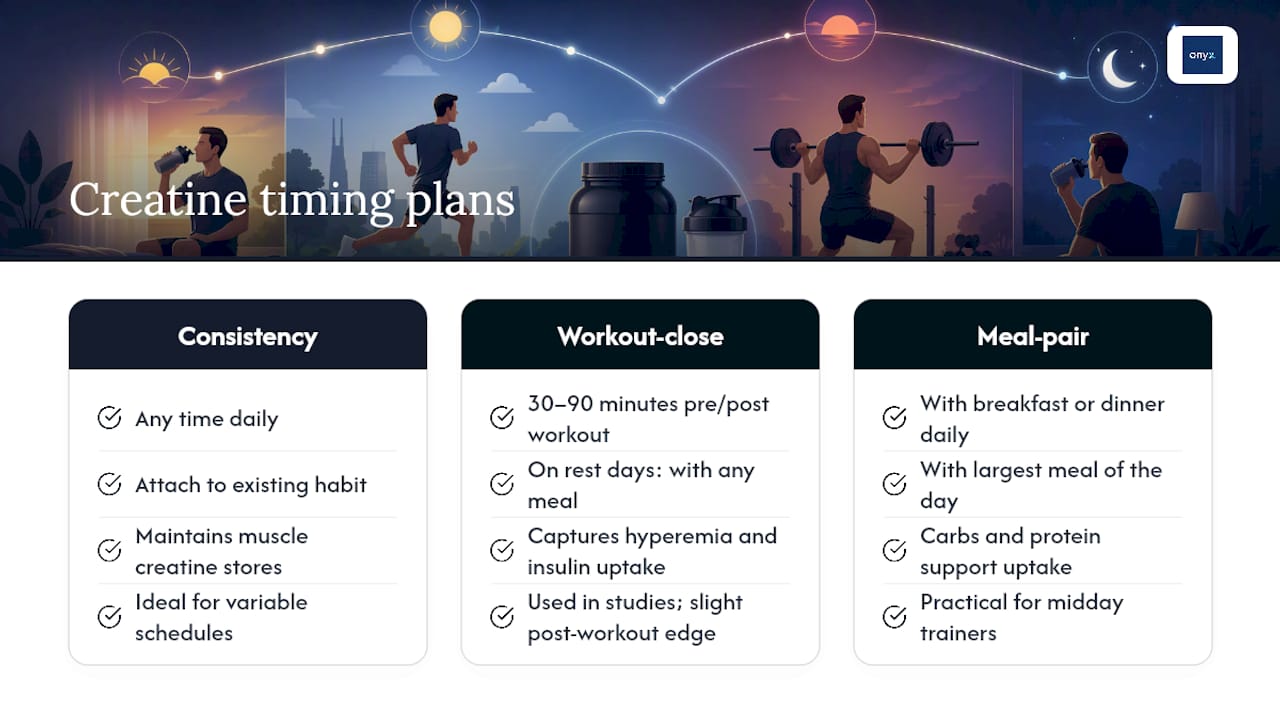
Pick the plan that fits your life. The best creatine timing strategy is the one you repeat every day without thinking about it.
1. Consistency-first (any time, daily) Take 3–5 g at the same time every day, attached to a habit you already have: morning coffee, lunch, or your evening wind-down. No workout required. This plan is ideal if your schedule varies or you train at irregular hours. It works because muscle creatine stores stay elevated as long as you dose daily, regardless of the clock.
2. Workout-close (30–90 minutes pre- or post-exercise) On training days, take your dose within 30–90 minutes before or after your session. On rest days, take it with any meal. This plan captures the theoretical hyperemia and insulin-uptake benefits without requiring rigid scheduling. It’s the approach most commonly used in studies that found a slight post-workout edge, and it’s a reasonable default for anyone who already has a pre- or post-workout nutrition routine.
3. Meal-pair (with breakfast or dinner, every day) Take creatine with your largest meal of the day, whether that’s breakfast or dinner. The food provides carbohydrates and protein, both of which support uptake. This plan is especially practical for people who train at midday and don’t want to time supplements around their gym session. For women looking for additional guidance on building a creatine habit, EmpowerFit Women’s creatine guide covers habit-building strategies worth reading.
Pro Tip: Set a daily phone alarm labeled “creatine” at the same time you take your first dose. After two weeks, the habit is automatic and you stop needing the reminder.
Safety, side effects, and when to talk to your doctor
Creatine has one of the strongest safety records of any sports supplement. Decades of clinical research confirm it is well tolerated in healthy adults, and Houston Methodist clinicians note that concerns about kidney damage in healthy people are not supported by the evidence.
Common side effects and how to handle them:
- Water weight gain: Expect a 2–4 lb increase in the first week or two. This is creatine drawing water into muscle cells, not fat gain.
- Bloating or GI discomfort: Usually dose-related. Split your dose, take it with food, and drink an extra glass of water.
- Muscle cramps: Rare and often linked to inadequate hydration. Increasing daily water intake and pairing creatine with electrolytes, like potassium and magnesium, can help. See Onyxwellness’s guide on potassium magnesium aspartate for more on that combination.
When to consult a clinician before starting:
- Pre-existing kidney or liver disease
- Taking nephrotoxic medications (NSAIDs used daily, certain antibiotics)
- Using stimulant medications such as Vyvanse or Adderall
- Pregnant or breastfeeding
Houston Methodist also recommends choosing third-party tested products to verify label accuracy and avoid contaminants. This is general information, not a substitute for medical advice. Confirm current guidance with your healthcare provider.
Key studies at a glance
| Study / Review | Design | Main Finding | Key Limitation |
|---|---|---|---|
| PMC 2021 narrative review | Narrative review of timing RCTs | Post-workout creatine may offer a slight edge; evidence mixed | Small samples, no intramuscular creatine measures |
| Frontiers 2022 review | Narrative/systematic review | Creatine reliably increases mass and strength; timing effects unclear long-term | Heterogeneous protocols across included trials |
| Nutrients 2025 pilot RCT | Randomized crossover, n=11 | Pre-exercise creatine improved acute strength vs. during/after | Very small sample; exploratory only |
| Healthline synthesis | Clinical guidance summary | Consistency matters more than timing; maintenance dose 3–5 g/day | Aggregated, not primary research |
Consistent findings: Creatine monohydrate increases muscle mass and strength during resistance training across age groups. Safety in healthy adults is well established.
Research gaps: Most timing trials use small samples. Few measure intramuscular phosphocreatine directly. Women and older adults are underrepresented. Long-term timing comparisons beyond 12 weeks are rare.
The case for keeping it simple
There’s a version of the creatine timing debate that gets more attention than it deserves. Fitness forums treat pre- vs. post-workout dosing like a high-stakes decision, but the research doesn’t support that level of precision. The studies that found a post-workout edge are interesting, not definitive. The pilot trial showing a pre-workout acute strength benefit had 11 participants.
What the evidence does support, clearly and consistently, is this: daily dosing works. Muscle saturation is what drives the strength and recovery benefits, and saturation is a function of cumulative intake over weeks, not the 60-minute window around a single session. The anabolic window for creatine is far wider than for protein. Missing a dose by a few hours is irrelevant. Missing a day occasionally is fine. Missing a week is where you start losing ground.
The practical implication is that the best timing strategy is the one that removes friction. If post-workout is easiest because you already mix a shake, do that. If morning coffee is your anchor habit, add creatine there. The mechanism supports both. The evidence doesn’t strongly prefer either.
Onyxwellness creatine products worth adding to your routine
Getting your daily 3–5 g of creatine doesn’t need to be complicated. Onyxwellness’s HydraCore Creatine hydration powder combines creatine with electrolytes in a single scoop, so you’re covering hydration and muscle saturation at the same time. Mix it into water or juice pre- or post-workout, or stir it into your morning drink on rest days.

For those who prefer a straightforward creatine monohydrate option, the NovaCore Creatine Ritual delivers a clean maintenance dose you can pair with any meal or shake. If you’re building out a fuller supplement routine, Onyxwellness also offers Digestive + Gut Health Strips, Probiotic + Metabolism Strips, and Sleep Strips for gut comfort, metabolism support, and recovery. Browse the full creatine and muscle-building collection to find the format that fits your routine.
Sources
- Timing of Creatine Supplementation around Exercise: A Real Concern? - PMC
- When to Take Creatine on Workout and Rest Days | Healthline
- Creatine: How Does It Work, Is It Safe & When Should You Take It? - Houston Methodist
- Creatine O’Clock: Does Timing of Ingestion Really Influence Muscle Mass and Performance? - Frontiers
- Acute Creatine Ingestion Before Resistance Training Enhances Strength Performance More than Ingestion During or After Training: A Randomized Crossover Pilot Trial
FAQ
Why did I gain weight after starting creatine?
A 2–4 lb weight increase in the first week or two is normal. Creatine draws water into muscle cells, so the scale goes up without any change in body fat.
What should you avoid while taking creatine?
Avoid taking creatine alongside daily high-dose NSAIDs or other nephrotoxic medications without medical clearance, and stay well hydrated. Dry-scooping and skipping water intake are the two most common causes of GI discomfort.
What should you not mix creatine with?
There are no absolute contraindications for mixing creatine with common supplements. Caffeine in very high doses has been studied as a potential antagonist in older research, though current evidence is not conclusive. Avoid combining creatine with medications that stress the kidneys without first consulting your provider.
Can I take creatine while on Vyvanse?
Creatine and Vyvanse (lisdexamfetamine) are not known to interact directly, but stimulant medications can raise heart rate and blood pressure, and both can affect hydration. Talk to your prescribing clinician before adding creatine to your routine if you take any stimulant medication.
Does creatine cause hair loss?
The hair loss concern stems from a single small study that found elevated DHT levels after creatine loading. No clinical trial has directly linked creatine supplementation to measurable hair loss, and this claim is widely considered a nutrition myth without strong supporting evidence.