


TL;DR:
- Muscle recovery involves a structured, multi-phase biological process that repairs tissue, reduces inflammation, and restores glycogen stores. It progresses through inflammation, regeneration, and remodeling phases, which must be properly supported with nutrition, sleep, and training management to optimize progress. Soreness, such as DOMS, is a symptom and does not indicate complete recovery, which relies on consistent habits and monitoring performance instead.
Muscle recovery is defined as the biological process that repairs damaged tissue, resolves inflammation, and replenishes glycogen stores after exercise. It is not passive rest. Your muscles go through a coordinated, multi-phase repair sequence that, when supported correctly, produces stronger, more resilient tissue. Understanding this process means you stop guessing about rest days and start making decisions that actually move your fitness forward. This guide covers the phases of recovery, the role of nutrition and sleep, and the practical techniques that separate athletes who plateau from those who keep progressing.
What is muscle recovery? the biological phases explained
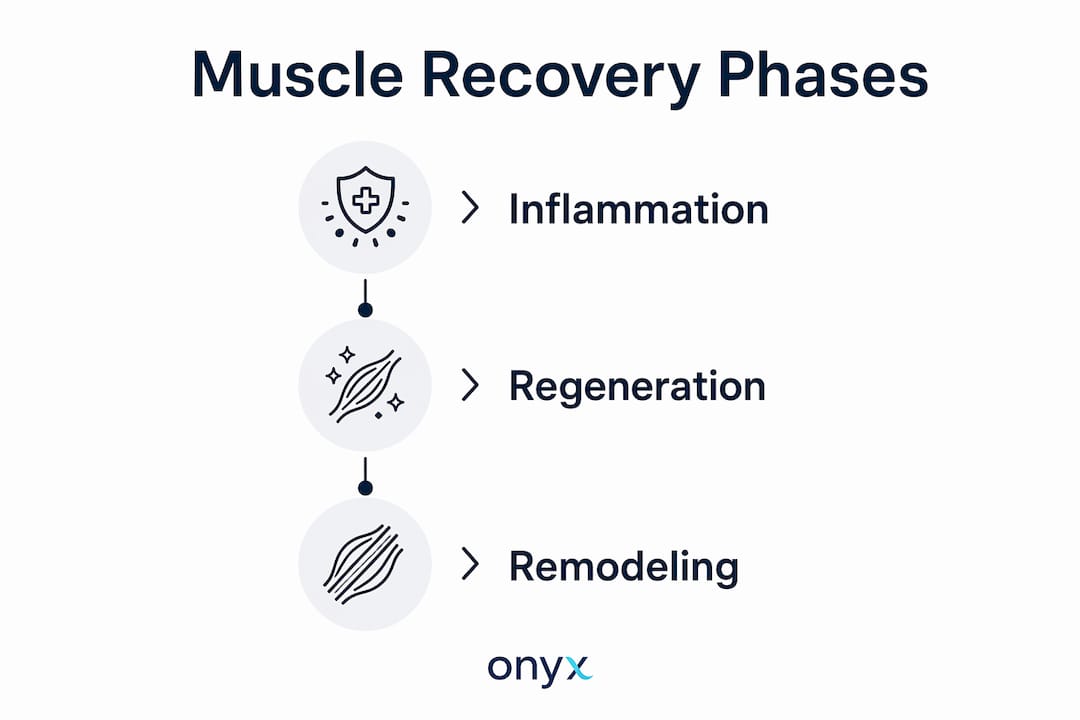
Muscle healing proceeds through three overlapping phases before tissue reaches full maturity: inflammation, regeneration, and remodeling. Each phase has a distinct job, and skipping ahead is not biologically possible.
Phase 1: Inflammation (Days 1–3). Immediately after intense exercise, microscopic tears form in muscle fibers. Immune cells called neutrophils flood the area within hours, clearing cellular debris. Macrophages follow, releasing signaling proteins that recruit repair cells. This inflammatory response is not the enemy. It is the starting gun for everything that follows.
Phase 2: Regeneration (Days 3–21). Satellite cells, which are muscle stem cells sitting dormant along fiber walls, activate and fuse to damaged fibers. This is where muscle protein synthesis drives actual fiber repair and, with sufficient stimulus, hypertrophy. The regeneration phase is where your training adaptations are physically built.
Phase 3: Remodeling (Weeks 3–12+). New fibers mature, connective tissue reorganizes, and the repaired muscle integrates into the surrounding structure. Disruptions to the inflammatory-to-reparative immune cell transition at this stage impair repair quality and delay full recovery.
| Phase | Primary Function | Approximate Duration |
|---|---|---|
| Inflammation | Debris clearance, immune signaling | Days 1–3 |
| Regeneration | Fiber repair, satellite cell activation | Days 3–21 |
| Remodeling | Tissue maturation, connective tissue reorganization | Weeks 3–12+ |
Pro Tip: Timing your next hard training session before the remodeling phase is underway is one of the most common reasons lifters stall. Track performance output, not just soreness, to gauge readiness.
How do DOMS and recovery differ?
Delayed onset muscle soreness, known as DOMS, is a symptom. Full muscle recovery is a process. Confusing the two leads to bad training decisions in both directions: either training through genuine tissue damage or resting unnecessarily when your muscles are already repaired.
DOMS peaks 1–3 days after intense or unfamiliar exercise and typically resolves within five days. The soreness reflects the inflammatory phase of repair, not the extent of damage. A beginner doing their first squat session will feel more soreness than an experienced lifter doing the same volume, even though the experienced lifter may be doing more total work.
The critical distinction: recovery can proceed despite soreness persisting. Protein synthesis, glycogen repletion, and nervous system adaptation continue on their own timeline. Soreness fading is not the finish line for recovery.
Here is how to manage DOMS without derailing your training:
- Hydrate consistently. Dehydration amplifies the perception of soreness and slows waste removal from muscle tissue.
- Use active recovery. Light walking, cycling, or swimming increases blood flow without adding meaningful mechanical stress.
- Prioritize sleep. The majority of growth hormone release occurs during deep sleep, accelerating the regeneration phase.
- Avoid aggressive anti-inflammatory use. High doses of NSAIDs like ibuprofen can blunt the inflammatory phase and interfere with long-term adaptation.
- Return to movement. DOMS does not require halting training entirely; normal fading patterns indicate healthy recovery is underway.
Pro Tip: If soreness is still severe after seven days or is localized to a joint rather than a muscle belly, that is a signal to consult a sports medicine professional. Healthy DOMS lives in the muscle, not the joint.
What role do nutrition and hydration play in recovery?
Nutrition is the raw material your body uses to execute every phase of muscle repair. Without adequate protein, carbohydrates, and fluids, the biological machinery described above runs at a fraction of its capacity.
Combining proteins and carbohydrates at a 3:1 or 4:1 ratio post-exercise is the evidence-backed standard for recovery nutrition. Carbohydrates replenish muscle glycogen, which powers your next session. Protein supplies amino acids for muscle protein synthesis. Together, they create a recovery environment that neither can produce alone.
Effective recovery nutrition is multifactorial. Focusing on a single nutrient or supplement consistently underperforms compared to a balanced approach. This is worth repeating because the supplement industry profits from the opposite message.
| Nutrient | Role in Recovery | Food and Supplement Examples |
|---|---|---|
| Protein | Supplies amino acids for fiber repair and synthesis | Chicken, eggs, Greek yogurt, whey, BCAAs |
| Carbohydrates | Replenishes glycogen stores for energy | Rice, oats, bananas, sweet potato |
| Electrolytes | Restores fluid balance and nerve function | Sodium, potassium, magnesium |
| Creatine | Improves strength recovery and reduces fatigue over weeks | Creatine monohydrate supplements |
| Antioxidants | Reduces oxidative stress from exercise | Vitamins C and E, berries, leafy greens |
Creatine enhances training quality and muscle adaptation but does not directly reduce soreness. Consistent use over several weeks improves strength recovery and helps you return to baseline performance faster. That is a meaningful benefit, but it works on a longer timeline than most people expect.
For a deeper look at how natural ingredients support this process, the natural sports nutrition guide from Onyxwellness covers protein and carbohydrate strategies grounded in evidence. You can also explore what creatine does for muscle recovery and hydration in more detail.
Pro Tip: Aim to consume your post-workout protein and carbohydrate meal within 60–90 minutes of finishing your session. The anabolic window is real, even if it is wider than old-school gym culture suggested.
How critical is sleep for muscle recovery and growth?
Sleep is the single most underrated recovery tool available to you, and it costs nothing. The research is not ambiguous on this point.
Short sleep of about 5.5 hours reduces muscle protein synthesis and net muscle gain compared to 8 hours of sleep. The mechanism is hormonal. Restricted sleep increases protein breakdown, lowers IGF-1 signaling, and reduces activity in the mTOR pathway, which is the primary cellular driver of muscle hypertrophy. Less sleep means less muscle, even with identical training and nutrition.
The hormonal cascade you cannot fake
During N3 deep sleep, the pituitary gland releases the majority of your daily growth hormone output. Growth hormone directly stimulates satellite cell activity and muscle protein synthesis. Cortisol, the stress hormone that breaks down muscle tissue, drops to its lowest levels during this same window. Cutting sleep short compresses this recovery window and shifts the hormonal balance toward breakdown rather than repair.
Practical sleep strategies for athletes
Consistent sleep timing matters as much as total duration. Your body’s hormonal release patterns are tied to circadian rhythm, not just hours logged. Going to bed at 11 p.m. and waking at 7 a.m. produces better recovery than sleeping the same 8 hours on a shifting schedule.
Keep your room cool, dark, and free of screens for 30 minutes before bed. Caffeine has a half-life of roughly 5–6 hours, so an afternoon coffee at 3 p.m. still has meaningful effects at 9 p.m. These are not new ideas, but they are the ones most consistently ignored by people who then wonder why their recovery feels incomplete.
Pro Tip: If your schedule limits nighttime sleep, a 20-minute nap between noon and 3 p.m. can partially restore alertness and support afternoon hormonal recovery without disrupting nighttime sleep architecture.
What practical recovery techniques actually enhance healing?
Beyond nutrition and sleep, several daily practices meaningfully support the repair process. The key is consistency over intensity. Recovery is not a single action. It is a set of habits that compound over weeks and months.
Here are the recovery practices worth building into your routine:
- Active recovery sessions. Low-intensity movement like walking, light cycling, or yoga on rest days increases blood flow to recovering muscles. Better circulation accelerates waste removal and nutrient delivery without adding mechanical stress.
- Structured cooldowns. Spending 5–10 minutes after training at reduced intensity helps your cardiovascular system transition and begins clearing lactate from muscle tissue.
- Consistent stretching and mobility work. Static stretching post-workout and dynamic mobility work on rest days maintain range of motion, which is one of the performance metrics coaches use to assess recovery readiness.
- Training load management. Balancing training stress with recovery capacity through sleep, nutrition, and workload management is the primary lever for long-term progress. Supplements are secondary. This hierarchy matters because most people invert it.
- Hydration throughout the day. Muscle tissue is roughly 75% water. Even mild dehydration impairs protein synthesis and increases perceived soreness. Aim for consistent fluid intake, not just a large amount post-workout.
- Supplement support where appropriate. Products like iron strips from Onyxwellness support energy and repair by maintaining iron levels, which are critical for oxygen delivery to recovering muscle tissue.
Prioritizing recovery capacity through adequate sleep, nutrition, and managing training load forms the foundation before adding supplements. This is not a knock on supplements. It is the correct order of operations.
Key takeaways
Muscle recovery is an active, multi-phase biological process that requires consistent nutrition, adequate sleep, and smart training management to produce real adaptation and performance gains.
| Point | Details |
|---|---|
| Recovery has three phases | Inflammation, regeneration, and remodeling each serve a distinct function and cannot be skipped. |
| DOMS is not recovery | Soreness is a symptom of the inflammatory phase; full recovery continues even after soreness fades. |
| Nutrition ratio matters | A 3:1 or 4:1 carbohydrate-to-protein ratio post-workout supports glycogen replenishment and muscle protein synthesis. |
| Sleep drives hormonal repair | Sleeping 8 hours versus 5.5 hours produces measurably higher IGF-1 signaling and mTOR pathway activity. |
| Supplements are secondary | Build sleep, nutrition, and load management first; then layer in creatine, BCAAs, or other targeted support. |
Why most people get recovery backwards
I have watched a lot of dedicated athletes spend serious money on recovery supplements while sleeping six hours a night and eating inconsistently. The supplements do not fail them. The foundation does. And no amount of creatine or BCAAs compensates for a hormonal environment that is chronically tilted toward breakdown.
The most useful shift I have seen in my own approach is tracking recovery through performance metrics rather than soreness. If your squat is back to baseline weight and your range of motion is normal, you are recovered. If you are still sore but hitting those numbers, train. If the numbers are down but the soreness is gone, something else is limiting you, and it is usually sleep or accumulated training load.
The other mistake worth naming directly: treating recovery as something you do after training rather than something you plan around training. The athletes who make the most consistent progress are the ones who schedule their recovery with the same intentionality they bring to their workouts. Rest days are not wasted days. They are when the adaptation you trained for actually gets built.
A functional nutrition approach that addresses the full picture, including gut health and micronutrient status, consistently outperforms any single-supplement strategy. The body recovers as a system, not as a collection of isolated processes.
— Chris
How Onyxwellness supports your recovery routine
If you are building a recovery routine grounded in evidence, the right products make the process easier to sustain.

Onyxwellness offers a range of Ayurvedic-inspired supplement strips designed for fast absorption without water, fitting naturally into a post-workout or pre-sleep routine. The Iron Strips support energy and muscle repair by maintaining iron levels critical for oxygen delivery during the recovery process. For gut health and nutrient absorption, which directly affects how well your body uses recovery nutrition, the Digestive + Gut Health Strips offer targeted support in a format built for modern schedules. Explore the full range at Onyxwellness and find the products that fit your recovery goals.
FAQ
What is muscle recovery in simple terms?
Muscle recovery is the biological process your body uses to repair damaged muscle fibers, restore glycogen, and resolve inflammation after exercise. It proceeds through three phases: inflammation, regeneration, and remodeling.
How long does muscle recovery take after a workout?
Basic soreness resolves within 3–5 days for most people, but full tissue remodeling can take weeks to months depending on training intensity and individual recovery capacity.
Does soreness mean your muscles are still recovering?
Not necessarily. Recovery proceeds even when soreness persists, and soreness is not required for muscle growth. Performance metrics like strength and range of motion are more reliable indicators of recovery status.
What helps muscle recovery the most?
The most impactful factors are sleep quality, post-workout nutrition with adequate protein and carbohydrates, hydration, and matching training load to your recovery capacity before adding supplements.
Is creatine good for muscle recovery?
Creatine improves strength recovery and reduces fatigue with consistent use over several weeks, but it does not directly reduce soreness. It works best as part of a complete recovery nutrition plan.