


TL;DR:
- Functional mushrooms contain bioactive compounds that provide health benefits like immune support and cognitive enhancement. They are non-psychoactive, legally regulated dietary ingredients, distinct from culinary and psychedelic mushrooms. Consistent use and transparent labeling are essential for safe and effective supplementation.
Functional mushrooms are defined as non-psychedelic fungi containing bioactive compounds that deliver targeted physiological health benefits beyond basic nutrition. These are not the button mushrooms on your pizza, and they are not the psilocybin-containing species making headlines in clinical psychiatry. Functional mushrooms, including Reishi, Lion’s Mane, Cordyceps, Turkey Tail, and Chaga, are recognized by the FDA as legal dietary ingredients. Their benefits span immune modulation, cognitive support, energy metabolism, and stress resilience, all driven by measurable bioactive chemistry. If you are curious about medicinal mushrooms and where the real science begins, this is the place to start.
What is a functional mushroom, exactly?
A functional mushroom is any fungal species consumed primarily for its therapeutic bioactive compounds rather than its flavor or nutritional calories. The Functional Mushroom Council defines this category by the presence of compounds like beta-glucans, triterpenes, and antioxidants that produce measurable effects in the body. That distinction matters because it separates functional species from the thousands of edible mushrooms grown purely for culinary use.

The term “medicinal mushrooms” is the older, more established industry phrase for the same category. Both terms refer to the same group of fungi. Wellness brands tend to use “functional mushrooms” because it signals science-backed utility without implying pharmaceutical claims. You will see both terms used interchangeably across research papers, supplement labels, and health publications.
Humans share a closer evolutionary and genetic relationship with fungi than with plants. That biological closeness partly explains why fungal compounds interact so effectively with human immune receptors and cellular pathways. Traditional medicine systems in China, Japan, and India have used these species for thousands of years, and modern research is now catching up with the mechanisms behind those practices.
What bioactive compounds make functional mushrooms effective?
The health properties of functional mushrooms come from a specific set of chemical classes. Understanding these compounds helps you read supplement labels critically and choose products that actually deliver what they promise.
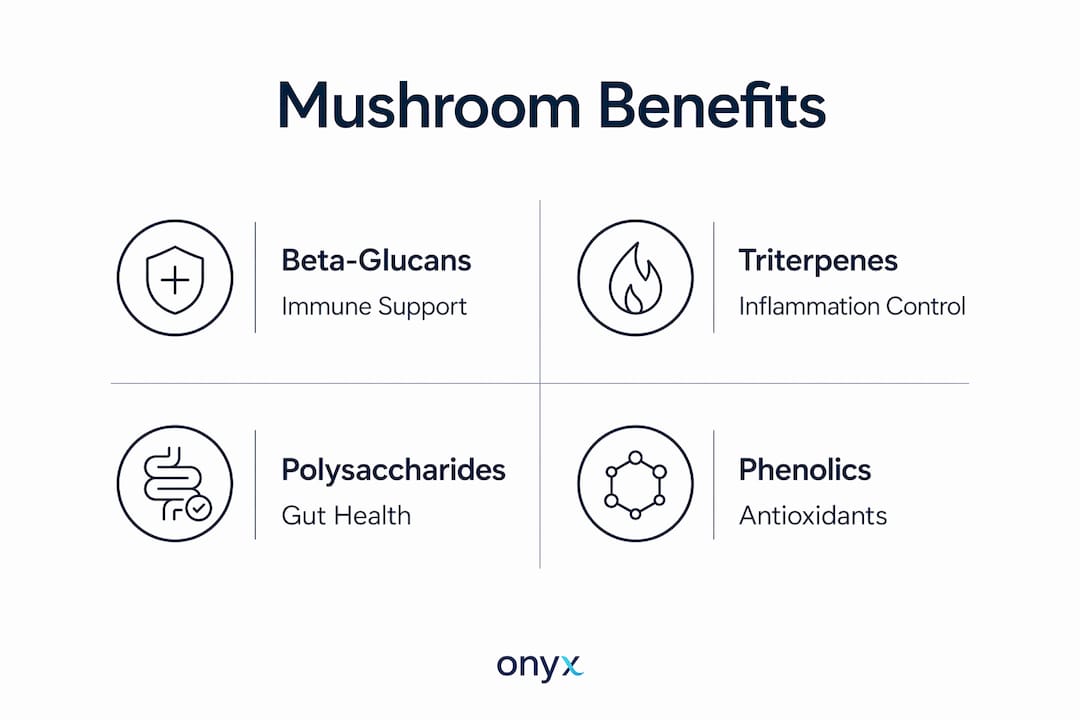
- Beta-glucans: These polysaccharides bind to receptors on immune cells, activating a process called immunomodulation. They do not simply “boost” immunity. They help regulate it, which is more useful for long-term health than a blunt stimulant effect.
- Triterpenes and terpenoids: Found in high concentrations in Reishi, these compounds show anti-inflammatory and liver-protective activity in experimental studies. Reishi’s bitter taste comes directly from its triterpene content.
- Phenolic compounds: These act as antioxidants and anti-inflammatory agents. Phenolic compounds and triterpenoids vary significantly by species and extraction method, which is why two products labeled “Reishi extract” can have very different effects.
- Ergothioneine and glutathione: These are antioxidants found in mushrooms at levels rarely matched by plant foods. Ergothioneine in particular has attracted research attention for its potential role in cellular protection.
- Ergosterol: A sterol that converts to vitamin D2 when exposed to UV light. Mushrooms are one of the few non-animal sources of this precursor.
Polysaccharides and phenolic compounds support immune function, modulate inflammation, and contribute to gastrointestinal health, according to experimental and clinical studies. The key variable is concentration. Fruiting body extracts generally contain higher levels of these active compounds than mycelium grown on grain substrates.
Pro Tip: When reading a supplement label, look for the beta-glucan percentage listed as a specific number, not just “mushroom extract.” A product without disclosed beta-glucan content gives you no way to verify potency.
How do functional mushrooms differ from culinary and psychedelic mushrooms?
This is the question that trips up most people new to the category. The three mushroom types share a kingdom but serve completely different purposes.
| Category | Primary purpose | Key compounds | Legal status |
|---|---|---|---|
| Culinary mushrooms | Flavor and nutrition | Protein, fiber, vitamins | Legal food ingredient |
| Functional mushrooms | Targeted health benefits | Beta-glucans, triterpenes, antioxidants | Legal dietary supplement (FDA regulated) |
| Psychedelic mushrooms | Altered consciousness | Psilocybin | Controlled substance in most US states |
Culinary mushrooms like Portobello, cremini, and oyster varieties are nutritious foods. They contain fiber, B vitamins, and some beta-glucans, but not in the concentrated therapeutic amounts found in functional species. Psychedelic mushrooms contain psilocybin, a controlled substance with no overlap in chemistry or effect with functional species. Confusing the two categories is not just a knowledge gap. It can be a legal and safety issue.
Functional mushrooms are non-psychoactive and legally regulated by the FDA as dietary ingredients. That regulatory status provides a meaningful safety floor that wild-harvested mushrooms do not. Toxic species like Amanita phalloides (the “death cap”) are responsible for the majority of fatal mushroom poisonings worldwide. Proper species identification is critical, which is why commercial, regulated supplements are a far safer option than foraging.
The fruiting body versus mycelium distinction also matters here. The fruiting body is the visible mushroom cap and stem. The mycelium is the underground root-like network. Both contain bioactive compounds, but fruiting bodies typically carry higher concentrations of the therapeutic compounds that define functional mushrooms.
What are the main types of functional mushrooms and their benefits?
Each functional mushroom species has a distinct bioactive profile and a different body of clinical evidence behind it. Here is what the research actually shows.
- Lion’s Mane (Hericium erinaceus): Best known for cognitive and nerve support. It stimulates nerve growth factor (NGF) synthesis, which supports neuronal health. Smaller randomized controlled trials show benefits for memory and mild cognitive impairment. The evidence for focus and vitality is promising, though larger human trials are still needed.
- Reishi (Ganoderma lucidum): Classified as an adaptogen, meaning it helps the body manage stress responses. Clinical studies support its use for fatigue reduction, sleep quality, and immune regulation. Reishi’s triterpene content is the primary driver of its anti-inflammatory effects. You can read more about Reishi’s specific benefits in dedicated research.
- Cordyceps (Cordyceps sinensis and Cordyceps militaris): Linked to energy metabolism and aerobic stamina. Cordyceps increases adenosine triphosphate (ATP) production, the molecule your cells use for energy. Athletes and active adults are the primary audience for this species.
- Turkey Tail (Trametes versicolor): The most clinically validated functional mushroom. Turkey Tail has Phase III oncology clinical trial data supporting its use as an adjunct to cancer treatment, specifically through its polysaccharide-K (PSK) compound. This is the species with the strongest human evidence base.
- Chaga (Inonotus obliquus): High in antioxidants and popular in wellness culture, but Chaga lacks strong human clinical evidence. Most of its data comes from in vitro and animal studies. It is not a species to rely on for specific health outcomes yet.
- Shiitake (Lentinula edodes): Contains lentinan, a beta-glucan with documented immune-modulating effects. Shiitake also provides meaningful amounts of B vitamins and zinc, making it a bridge between culinary and functional categories.
The honest picture is that health claims on most mushroom labels significantly outpace existing clinical evidence. Turkey Tail stands apart with robust trial data. Lion’s Mane and Reishi have smaller but credible randomized trials. Cordyceps has good mechanistic evidence and some human data. Chaga and many others are still largely in the early research phase.
How can you use functional mushrooms safely and effectively?
Getting results from functional mushrooms requires consistency and product quality. Here is a practical framework for integrating them into your routine.
- Choose your format based on your lifestyle. Functional mushrooms come as powders, capsules, liquid extracts, teas, gummies, and dissolvable strips. Powders work well in coffee or smoothies. Gummies and strips offer pre-measured doses with no preparation required, which makes daily consistency easier.
- Prioritize fruiting body extracts. Mycelium grown on grain often contains mostly starch filler and lower beta-glucan concentrations than fruiting body extracts. Look for products that specify “fruiting body” on the label and list a beta-glucan percentage.
- Use them daily, not occasionally. Daily, consistent use produces gradual and cumulative benefits, similar to a multivitamin regimen. Taking a mushroom supplement once a week will not produce the same effect as daily use over several weeks.
- Check for drug interactions before starting. Functional mushrooms interact with anticoagulants, immunosuppressants, and diabetes medications. If you take any of these, consult a healthcare professional before adding mushroom supplements. This is not a theoretical risk. It is a documented pharmacological concern.
- Start with a lower dose and monitor your response. Side effects like nausea, GI discomfort, and dry mouth are generally mild but real. Starting low gives your body time to adjust and helps you identify any sensitivity before committing to a full dose.
The gut-brain connection is also relevant here. Functional mushrooms support gut microbiome health through their prebiotic fiber content, and a healthier gut environment can amplify the cognitive and mood benefits you are seeking from species like Lion’s Mane and Reishi.
For a deeper look at selecting safe, high-quality products, the guide on mushroom gummy safety covers what to look for on labels and what red flags to avoid.
Pro Tip: If a product does not list its beta-glucan content or disclose whether it uses fruiting body or mycelium, treat that as a red flag. Reputable brands are transparent about their active compound concentrations.
Key Takeaways
Functional mushrooms deliver real, measurable health benefits through specific bioactive compounds, but product quality and daily consistency determine whether you actually experience those benefits.
| Point | Details |
|---|---|
| Definition matters | Functional mushrooms are defined by bioactive compounds like beta-glucans, not by flavor or psychoactive effects. |
| Turkey Tail leads in evidence | Turkey Tail has Phase III clinical trial data; Lion’s Mane and Reishi have smaller but credible human trials. |
| Label transparency is critical | Look for fruiting body sourcing and a disclosed beta-glucan percentage before buying any supplement. |
| Drug interactions are real | Consult a healthcare professional if you take anticoagulants, immunosuppressants, or diabetes medications. |
| Consistency drives results | Daily use over weeks produces cumulative benefits; occasional use does not replicate that effect. |
What I have learned after years of watching this category grow
The functional mushroom space is one of the most exciting areas in natural wellness, and also one of the most overhyped. I have watched brands slap “Lion’s Mane” on a product containing mostly grain starch and charge a premium for it. That kind of thing erodes trust in a category that has genuine science behind it.
Here is what I keep coming back to: the biology is real. Beta-glucan immunomodulation is not marketing language. It is a documented mechanism with receptor-level evidence. Turkey Tail’s PSK compound has been used alongside cancer treatment in Japan for decades, backed by serious clinical trials. That is not nothing. That is meaningful.
What I tell people is this: treat functional mushrooms the way you treat any supplement. Expect gradual, cumulative support, not overnight transformation. Choose products from brands that disclose their bioactive content. And recognize that humans have co-evolved with fungi for so long that our genetic relationship with fungi is closer than our relationship with plants. There is something worth respecting in that.
The pitfall I see most often is people buying the cheapest option they can find, getting no results, and concluding that mushrooms do not work. Usually, the product did not work. The category still does.
— Chris
Onyxwellness functional mushroom supplements worth knowing about
Onyxwellness brings together the science of functional mushrooms and the convenience of modern delivery formats, without the guesswork of sourcing and dosing on your own.
The Mushroom Focus Strips dissolve instantly without water, making daily cognitive support as simple as it gets. For broader immune and wellness coverage, the Mushroom Extract Complex Gummies combine multiple standardized mushroom extracts in one daily gummy. If stress relief and better sleep are your priority, the Reishi Relax Gummies deliver Reishi’s adaptogenic benefits in a format you will actually look forward to taking. All three products reflect Onyxwellness’s commitment to transparent formulation and quality you can verify.
FAQ
What is a functional mushroom in simple terms?
A functional mushroom is a fungal species consumed for its bioactive compounds, like beta-glucans and triterpenes, that support immunity, cognition, energy, or stress resilience beyond basic nutrition.
Are functional mushrooms the same as medicinal mushrooms?
Yes. “Medicinal mushrooms” is the older scientific term and “functional mushrooms” is the more common wellness industry term. Both refer to the same category of bioactive-rich fungal species.
Do functional mushrooms have psychedelic effects?
No. Functional mushrooms are non-psychoactive and are regulated by the FDA as legal dietary ingredients. They contain no psilocybin and produce no altered-consciousness effects.
Which functional mushroom has the strongest clinical evidence?
Turkey Tail has the most robust human evidence, including Phase III clinical trial data for its PSK compound used as a cancer treatment adjunct. Lion’s Mane and Reishi have smaller but credible randomized controlled trials.
Can functional mushrooms cause side effects?
Yes. Reported side effects include nausea, GI discomfort, dry mouth, and allergic reactions. These are generally mild. People taking anticoagulants, immunosuppressants, or diabetes medications should consult a healthcare professional before use.