


Taking vitamin D3 and K2 together is one of the more well-reasoned supplement pairings in wellness today. D3 raises the calcium available in your bloodstream, and K2 helps direct that calcium into bone rather than soft tissue and arteries. If you already take a moderate D3 dose and eat plenty of leafy greens or fermented foods, you may not need to add much K2. But if you’re on a higher D3 dose, get limited sun, or rarely eat K2-rich foods, pairing the two makes practical sense.
The NIH Office of Dietary Supplements treats vitamin D primarily through the lens of bone health, deficiency correction, and safe intake ranges, and many clinicians use a serum 25(OH)D target of 40 to 60 ng/mL as a reasonable optimization goal rather than just avoiding outright deficiency. Where the evidence gets murkier is cardiovascular outcomes. Bone benefits are the strongest, most consistent part of the D3 plus K2 story. Heart-related claims lean more on cohort data and biological plausibility than on large randomized trials.
-
- Bone mineralization and calcium routing: well-supported, especially in postmenopausal women
- Vascular calcium management: biologically plausible, backed mostly by observational data
- Deficiency correction (immune, mood, muscle function): strong when you’re actually low
- Cardiovascular event reduction: promising signal, not yet proven in rigorous trials
For readers who want a convenient way to get both nutrients in one dose, Onyxwellness’s Bone Support Strips are formulated around this exact pairing.
Key Takeaways
Vitamin D3 combined with K2 supports bone mineralization through well-documented mechanisms, while cardiovascular benefits remain biologically plausible but not yet confirmed by conclusive trial evidence.
| Point | Details |
|---|---|
| Bone health is the strongest evidence | Trials in postmenopausal women show improved bone markers and slower density decline with D3 plus MK-7. |
| Cardiovascular evidence stays mixed | Cohort data like Rotterdam is promising, but a 2026 post-hoc analysis found no conclusive proof K2 changes D3’s heart effects. |
| Match K2 to your D3 dose | Maintenance dosing runs 1,000 to 2,000 IU D3 with 90 to 120 mcg MK-7; higher D3 warrants higher K2. |
| Take with fat, test after 8 to 12 weeks | Absorption requires dietary fat, and rechecking 25(OH)D confirms whether your dose is working. |
| Check interactions before starting | Anyone on warfarin or with kidney disease should consult a clinician before adding K2. |
| Onyxwellness offers a convenient format | Bone Support Strips deliver D3 and MK-7 in a fast-dissolving strip designed to pair with meals. |
Table of Contents
- Vitamin D3 K2 Benefits: What the Research Actually Shows
- How D3 and K2 Work Together in Your Body
- Vitamin D3 and K2 Dosage and Timing Guidance
- Safety, Interactions, and Who Needs Medical Supervision
- Who Actually Benefits From Adding K2 to D3
- Why We Built Bone Support Strips Around This Research
- Vitamin D3 K2 Benefits for Teeth and Enamel Strength
- Can D3 and K2 Improve Insulin Sensitivity?
- Vitamin D3 K2 Benefits for Skin and Sun Protection
- What Actually Matters Here
- Get D3 and K2 in One Convenient Daily Strip
- Sources
- FAQ
Vitamin D3 K2 Benefits: What the Research Actually Shows
Separating what’s proven from what’s promising matters here, because supplement marketing tends to flatten both into the same confident sentence. The research doesn’t support that flattening, and you deserve to know which claims rest on solid ground.
Bone health is where the combination has its best data. A three-year randomized trial in postmenopausal women found that MK-7 supplementation improved bone turnover markers and slowed the age-related decline in bone mineral density at the lumbar spine and femoral neck. That’s a meaningful finding for a population where fracture risk climbs sharply after menopause, and it’s the kind of result that holds up whether you’re looking at surrogate markers or actual density scans.
Cardiovascular effects are where things get more interesting, and more uncertain. The Rotterdam Study, a long-running prospective cohort, found that people with higher dietary K2 intake had lower cardiovascular mortality and less aortic calcification over years of follow-up. That’s a real signal worth taking seriously. But a 2026 post-hoc analysis examining whether baseline vitamin K status changes how vitamin D supplementation affects bone or cardiovascular markers found the evidence too heterogeneous to draw firm conclusions, and called for more trials before anyone claims co-supplementation reliably improves heart outcomes.
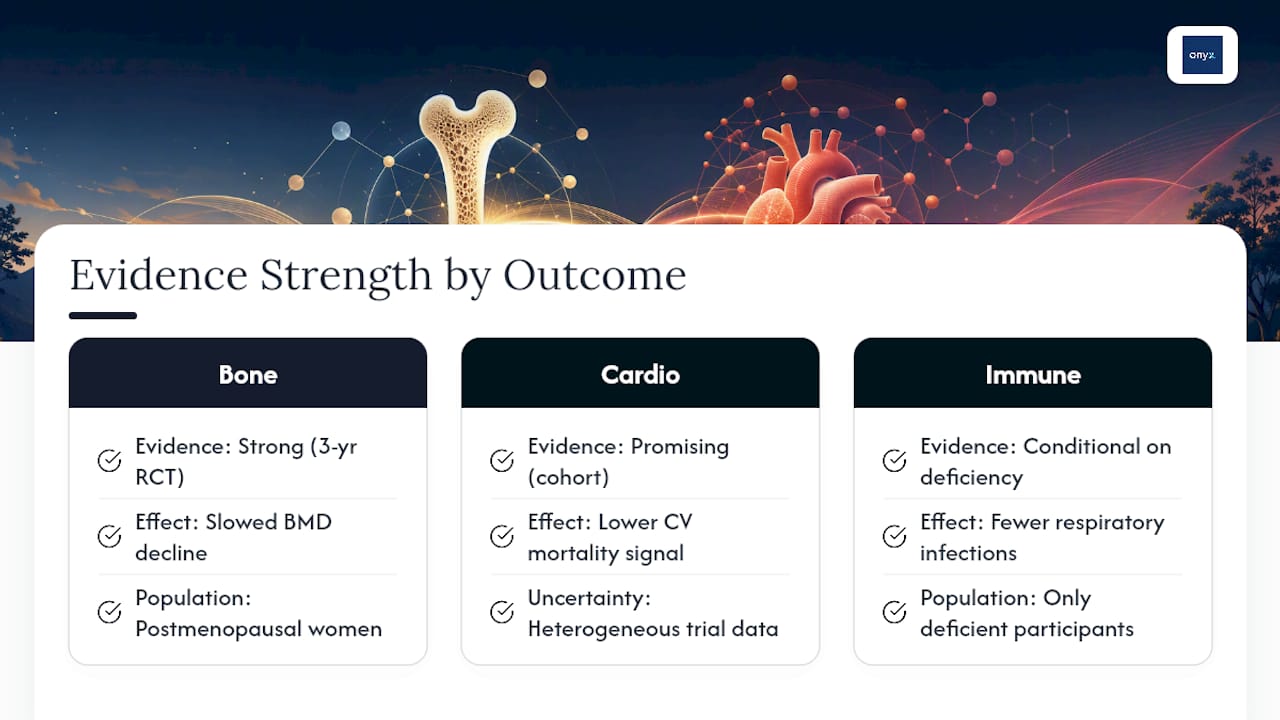
Immune function benefits mainly show up in people who were deficient to begin with. Meta-analyses of randomized trials link vitamin D supplementation to a reduced risk of acute respiratory infections, but almost entirely in participants whose baseline levels were low. If your vitamin D is already adequate, you likely won’t notice much immune difference from supplementing further.
Mood, cognition, and testosterone benefits follow a similar pattern: mechanistically plausible, supported by some subgroup data, but most pronounced when you’re correcting an actual deficiency rather than optimizing an already-sufficient level.
The honest summary: the bone case is strong, the cardiovascular case is a promising work in progress, and most of the other claimed benefits depend heavily on whether you were deficient before you started.
How D3 and K2 Work Together in Your Body
D3, or cholecalciferol, gets converted in your liver and kidneys into 25-hydroxyvitamin D, the form that increases how much calcium your intestines absorb from food. Without adequate D3, your body absorbs a fraction of the calcium it otherwise could, no matter how much calcium-rich food you eat.
Here’s where K2 comes in. Menaquinones (the K2 family) act as a cofactor for an enzyme process called gamma-carboxylation, which activates two proteins:
- Osteocalcin, which binds calcium into bone matrix
- Matrix Gla-protein (MGP), which inhibits calcium deposits from forming in artery walls
Without enough K2, both proteins stay in an inactive form and can’t do their jobs properly, regardless of how much calcium is circulating.
Not all K2 behaves the same way. MK-7 has a longer half-life and produces more stable blood levels than MK-4, which is why most modern formulations and clinical studies favor MK-7 at doses of 90 to 200 mcg daily, according to the NIH’s vitamin K factsheet. MK-4 clears faster and typically requires more frequent, higher dosing to maintain the same effect.
One caveat worth sitting with: mechanism isn’t the same as guaranteed outcome. Knowing that K2 activates osteocalcin tells you why the pairing makes sense biologically. It doesn’t tell you how much clinical benefit a specific person will get, which depends on baseline nutrient status, age, kidney function, and genetics.
Vitamin D3 and K2 Dosage and Timing Guidance
Getting the dose and timing right matters more than most people assume. Take these nutrients incorrectly and you blunt their effectiveness even if the label says the right numbers.
- Maintenance dosing: 1,000 to 2,000 IU of D3 paired with 90 to 120 mcg of MK-7 covers most healthy adults with moderate sun exposure and a reasonably varied diet.
- Corrective dosing: if you’re deficient or your practitioner recommends higher D3 (up to 4,000 IU, the tolerable upper intake level per NIH), pair it with a higher K2 dose, generally 100 to 200 mcg.
- Take with a fat-containing meal. Both D3 and K2 are fat-soluble, and absorption drops significantly without dietary fat present. A morning meal with eggs, avocado, or olive oil works fine.
- Stay consistent. Daily dosing at roughly the same time outperforms sporadic large doses, particularly for K2, where steady serum levels matter more than any single peak.
- Retest 25(OH)D after 8 to 12 weeks of starting or adjusting your dose, aiming for the 40 to 60 ng/mL range many practitioners use as an optimization target.
Pro Tip: Pair your D3/K2 routine with adequate magnesium, since magnesium acts as a cofactor your body needs to activate vitamin D in the first place. Our guide to calcium, magnesium, and vitamin D walks through how these three nutrients interact.
Safety, Interactions, and Who Needs Medical Supervision
The D3/K2 pairing is generally well-tolerated, but a few interactions deserve real attention, not a footnote.
- Warfarin and other anticoagulants: K2 works through the same vitamin K pathway that warfarin blocks, so adding K2 can interfere with your anticoagulation control. Talk to your prescribing clinician before starting K2 if you’re on blood thinners, and never adjust your warfarin dose on your own.
- Hypercalcemia risk: the tolerable upper intake level for D3 sits at 4,000 IU per day for most adults. Going well beyond that without supervision raises the risk of excess calcium in the blood, with symptoms like nausea, excessive thirst, and confusion.
- Kidney disease and pregnancy: both conditions change how your body handles calcium and vitamin D, and warrant a conversation with your doctor before starting a combined regimen.
- Watch for red flags: unexplained gastrointestinal upset, frequent urination, unusual weakness, or a personal history of kidney stones are reasons to stop and get labs drawn rather than push through.
Oral K2 toxicity is rare in the research literature, but “rare” isn’t the same as “risk-free” when you’re also on medications that interact with the same pathway.
Who Actually Benefits From Adding K2 to D3
Not everyone needs to stack K2 onto their D3 routine. It comes down to your dose, your diet, and your risk profile.
- Higher priority: anyone taking more than 2,000 IU of D3 daily, postmenopausal women, people with limited dietary K2 intake, and those with existing cardiovascular risk factors.
- Lower priority: people who get regular sun exposure and eat K2-rich foods regularly, such as natto or aged cheeses like Gouda, may already have adequate levels without supplementing.
- Your next move: get your serum 25(OH)D tested, take an honest look at your diet, and if you’re on anticoagulants or manage kidney disease, loop in your clinician before adding anything new.
Why We Built Bone Support Strips Around This Research
Chris here, on behalf of Onyxwellness: our formulation approach starts with what the evidence actually supports, not what sounds good on a label. The Bone Support Strips pair D3 with MK-7 in a fast-dissolving format designed to fit into a meal-based routine, since absorption depends on dietary fat being present.
- Convenient, no-water dosing that fits a consistent daily habit
- Formulated with MK-7 for stable, steady serum levels
- Transparent about what it is: a supplement, not a medical treatment
We’d rather you test your levels and talk to a clinician about anticoagulants or kidney concerns than guess. That’s not a disclaimer we bury. It’s how we think supplementation should work.
Vitamin D3 K2 Benefits for Teeth and Enamel Strength
Dental health rarely gets mentioned alongside bone density, but the same calcium-routing mechanism applies to your teeth. Osteocalcin and related Gla-proteins that K2 activates aren’t limited to bone tissue. They also play a role in dentin formation, the mineral layer beneath tooth enamel that gives teeth their structural strength.
Vitamin D3 supports this process indirectly by ensuring enough calcium and phosphate circulate for mineralization to happen in the first place. Deficiency in either nutrient has been associated with higher rates of tooth decay and weaker enamel in observational research, though the trial evidence specific to supplementation and cavity prevention is thinner than the bone density literature. This is a case where the mechanism is well understood, but rigorous dental-specific trials haven’t caught up to the theory yet.
That said, the practical takeaway doesn’t change much from the bone health guidance already covered. If you’re correcting a D3 deficiency, you’re likely supporting dental mineralization at the same time, simply because the two systems draw from the same calcium and vitamin K pathways. There’s no separate “dental dose” of D3 or K2 that differs from what already supports your skeleton. Think of your teeth as bone’s close cousin in this story, benefiting from the same nutrient routing without requiring a different regimen.
If you have a personal or family history of enamel issues or frequent cavities, mention your vitamin D status to your dentist at your next checkup. It’s a low-effort conversation that connects two areas of health people rarely think to link.
Can D3 and K2 Improve Insulin Sensitivity?
Vitamin D receptors show up in pancreatic beta cells and insulin-responsive tissue throughout the body, which is why researchers have long suspected a connection between vitamin D status and metabolic health. Observational studies consistently link low vitamin D levels with higher rates of insulin resistance and metabolic syndrome, though correlation isn’t causation, and plenty of confounding factors (obesity, lower activity levels, less outdoor time) travel alongside low vitamin D anyway.
Where K2 enters this conversation is less established. Some smaller studies suggest K2 may play a role in supporting insulin secretion, but the evidence base here is considerably thinner than what exists for vitamin D and metabolic markers. It would be overstating things to call K2 a metabolic intervention. It’s more accurate to say researchers are still working out whether K2’s role is meaningful on its own or simply travels alongside broader dietary patterns that happen to include more vitamin K.
If you already have metabolic syndrome, prediabetes, or insulin resistance, correcting a vitamin D deficiency is a reasonable piece of a broader management plan, but it’s not a substitute for the interventions your doctor is already likely recommending, like dietary changes, movement, and monitoring blood glucose. Adding K2 on top of D3 in this context follows the same logic laid out in the dosing section: it supports the calcium and bone side of the equation regardless of what happens with insulin sensitivity, so there’s little downside to including it if you’re already taking D3 for metabolic reasons.
Vitamin D3 K2 Benefits for Skin and Sun Protection
Your skin actually produces vitamin D3 when exposed to UVB rays, which means your skin health and your vitamin D status are connected from the start, not as an afterthought. Vitamin D receptors are present throughout skin cells, where they appear to support skin barrier function and play a role in how skin cells respond to stress, including UV exposure.
Some research points to vitamin D playing a protective role against UV-related skin damage, potentially through its influence on skin cell turnover and repair processes. This doesn’t mean vitamin D supplements act as sunscreen. They don’t, and no amount of oral D3 should replace topical sun protection on days with meaningful UV exposure. What the research does suggest is that adequate vitamin D status may support the skin’s own repair mechanisms after sun exposure occurs, a supporting role rather than a preventive shield.
K2’s connection to skin health is more indirect, largely tied to its broader anti-inflammatory properties rather than any skin-specific mechanism that’s been well studied on its own. If K2 helps manage inflammation systemically, it’s plausible that benefit extends to skin health generally, but this is an area where mechanism outpaces direct trial evidence considerably.
For readers specifically focused on skin, hair, and nail support alongside their D3/K2 routine, Onyxwellness’s Hair, Skin and Nails Strips target that need directly, rather than relying on D3/K2 to do double duty as a skin supplement.
What Actually Matters Here
The bone case for D3 plus K2 is genuinely strong, and I don’t think that gets said clearly enough in most coverage of this topic. What gets overstated is the cardiovascular angle. Observational cohorts like Rotterdam paint a compelling picture, but the 2026 post-hoc analysis is a useful reality check: heterogeneous evidence, no conclusive support yet for K2 modifying D3’s cardiovascular effects. That gap between what’s marketed and what’s proven is where a lot of supplement skepticism, fair skepticism, comes from.
Where I’d push back on conventional advice is the assumption that everyone needs high-dose K2 regardless of their D3 intake. If you’re taking a modest, maintenance-level D3 dose and eating a reasonably varied diet, the urgency to add K2 drops considerably. The people who should prioritize this pairing are the ones taking meaningful D3 doses, postmenopausal women managing bone density, and anyone whose diet genuinely lacks K2-rich foods.
My honest take: test first, dose deliberately, and treat the Bone Support Strips as a convenient way to execute a plan you’ve already thought through, not a substitute for thinking it through.
— Chris
Get D3 and K2 in One Convenient Daily Strip
Most D3/K2 combinations on the market come in capsules that require water and a routine you have to remember. Onyxwellness took a different approach: a fast-dissolving strip that fits into the fat-containing meal you’re already eating, with no pills to swallow and no water required.
The Bone Support Strips are built for readers who’ve read this far and want a straightforward, evidence-minded way to get both nutrients without guessing on ratios or juggling separate bottles. If skin, hair, and nail support are also on your radar, the Hair, Skin and Nails Strips round out a broader wellness routine. For a deeper look at how these nutrients fit alongside calcium and magnesium, our guide to natural supplementation is worth a read.
Ready to start? Browse the full Bone Support Strips product page to check the current formulation and add it to your daily routine.
Sources
- Vitamin D — Health Professional Fact Sheet (NIH ODS)
- Post-hoc analysis on vitamin D supplementation and vitamin K status (Frontiers in Nutrition, 2026)
FAQ
Can you take vitamin K2 and D3 every day?
Yes, daily dosing is standard and generally more effective than sporadic large doses, since K2 in particular relies on steady serum levels rather than occasional peaks.
Should I take D3 plus K2 in the morning or at night?
Timing matters less than pairing the dose with a fat-containing meal, so choose whichever meal in your day reliably includes some dietary fat.
What is taking vitamin D3 and K2 good for?
The combination primarily supports bone mineralization by increasing calcium absorption (D3) and directing that calcium into bone rather than arteries (K2), with emerging but less conclusive evidence for cardiovascular support.
Does vitamin K2 reduce belly fat?
There’s no solid evidence that K2 directly reduces belly fat; its research base centers on bone and vascular calcium management, not fat loss or body composition.
How much vitamin K2 should I take with vitamin D3?
A common maintenance range is 90 to 120 mcg of MK-7 alongside 1,000 to 2,000 IU of D3, with higher D3 doses generally paired with 100 to 200 mcg of K2.