


What is vitamin A 10000 IU and is it safe?
A 10,000 IU vitamin A supplement sits right at the Tolerable Upper Intake Level (UL) established for adults, which means it is the highest daily dose considered safe before adverse effects become a real concern. That is not a reason to panic, but it is a reason to pay attention.
To put the number in context: the RDA for adult men is 900 mcg RAE (3,000 IU) and for adult women is 700 mcg RAE (2,330 IU). A 10,000 IU supplement delivers 3,000 mcg RAE, which equals 333% of the daily value. That gap between the RDA and a 10,000 IU dose is not trivial, and it shapes every decision you should make about whether this dose is right for you.
Statistic callout: The UL for vitamin A in adults is 3,000 mcg RAE (10,000 IU) per day. Long-term intake at or above this level raises the risk of liver damage, joint pain, hair loss, and reproductive harm.
Because vitamin A is fat-soluble, your body stores what it does not immediately use, mostly in the liver. Unlike water-soluble vitamins that flush out daily, excess vitamin A accumulates. That storage mechanism is what makes chronic high-dose supplementation genuinely risky rather than just theoretically cautious.
Who might legitimately need this dose? People with confirmed vitamin A deficiency, certain malabsorption conditions like cystic fibrosis, or those under a clinician’s care for specific eye diseases such as xerophthalmia. For most healthy adults eating a varied diet, 10,000 IU daily is more than the body needs.
Key dosage facts at a glance:
- 10,000 IU of preformed vitamin A equals 3,000 mcg RAE (using the conversion of 1 IU = 0.3 mcg RAE)
- The adult UL is generally considered to be 3,000 mcg RAE daily for men and women aged 19 and older
- The RDA is typically about 900 mcg RAE for men and 700 mcg RAE for women
- Pregnant women aged 14–18 have a lower UL of 2,800 mcg RAE (9,333 IU)
- Signs of toxicity include nausea, dizziness, blurred vision, headache, and in chronic cases, liver damage and bone loss
- High-dose vitamin A is only recommended under medical supervision, especially during pregnancy
Top vitamin A 10000 IU supplements available in the US
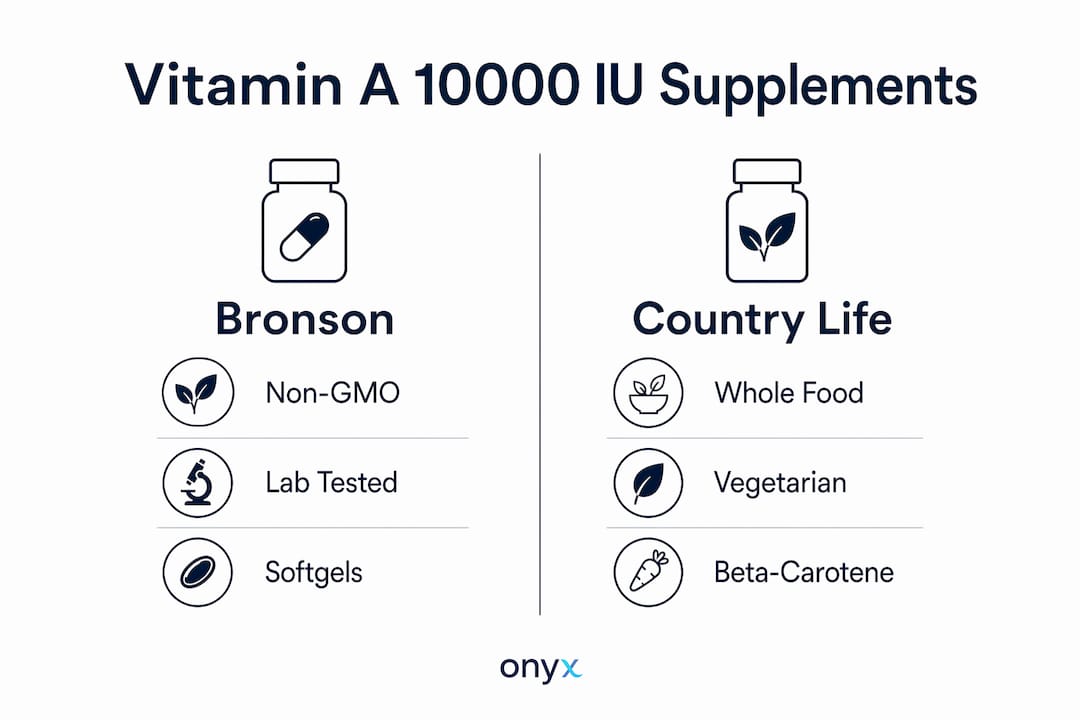
Two products consistently appear in the US market for this specific dose: Bronson Vitamin A 10000 IU and Country Life Vitamin A 10000 IU. Both deliver the same IU amount but differ meaningfully in formulation approach, quality certifications, and who they suit best.
| Product | Formulation | Form | Purity and quality | Bioavailability | Best for |
|---|---|---|---|---|---|
| Bronson Vitamin A 10000 IU | Retinyl palmitate softgel | Softgel | Non-GMO, lab-tested | High (preformed retinol) | Adults wanting a verified, purity-focused softgel |
| Country Life Vitamin A 10000 IU | Retinyl palmitate | Softgel | Quality-focused brand | High (preformed retinol) | Adults prioritizing bioavailability and brand reliability |
Bronson Vitamin A 10000 IU stands out for its Non-GMO certification and third-party lab testing, two markers that matter when you are taking a supplement at the upper limit of safe daily intake. The softgel format delivers retinyl palmitate, the preformed version of vitamin A that the body absorbs directly without any conversion step. Bronson has built a long track record in the US supplement market, and its purity focus makes it a practical choice for adults who want confidence in what they are actually swallowing.
Country Life Vitamin A 10000 IU also uses retinyl palmitate, which means absorption is direct and predictable. Country Life is a well-established brand with a reputation for quality formulations, and this product suits adults who prioritize bioavailability and want a reliable name behind the label. Neither product uses beta-carotene at this dose, which is worth noting: beta-carotene is the safer precursor form because the body self-regulates its conversion, but at 10,000 IU, both of these products deliver preformed retinol.
Key differentiators to keep in mind:
- Bronson carries explicit Non-GMO and lab-testing credentials, which adds a layer of accountability
- Country Life’s formulation emphasizes bioavailability through retinyl palmitate, the most absorbable form
- Both are softgels, which aids absorption since vitamin A is fat-soluble and dissolves well in an oil-based capsule
- Neither product is appropriate for pregnant women without direct medical guidance given the dose
- Price and value are comparable across both; neither sits in a premium tier that is hard to justify
How to choose and safely use a vitamin A 10000 IU supplement
The first question to ask before buying any high-dose vitamin A supplement is whether you actually need it. A blood test measuring serum retinol levels, ordered by your doctor, is the only reliable way to confirm deficiency. Self-diagnosing based on symptoms like night blindness or dry skin is understandable, but it is not a substitute for lab confirmation.

Once you know your baseline, total daily vitamin A intake from all sources must be counted together. Your multivitamin, fortified breakfast cereal, cod liver oil, and a standalone 10,000 IU supplement can stack up fast. Clinicians check for retinol activity equivalents across all sources precisely because cumulative overdosing is a real and underappreciated risk, one that can lead to bone degradation and liver strain before you notice any obvious symptoms.
Pro Tip: Always read supplement labels for the form of vitamin A listed. “Retinyl palmitate” or “retinyl acetate” means preformed vitamin A that counts fully toward your UL. “Beta-carotene” converts at a regulated rate and carries a much lower toxicity risk. If your label lists both, add the retinol portion to your daily total first.
Duration matters as much as dose. Taking 10,000 IU daily for a short corrective period under medical supervision is a very different situation from taking it indefinitely as a general wellness supplement. Most nutrition experts recommend periodic reassessment, typically every three to six months, to confirm that supplementation is still warranted.
Practical safety tips:
- Confirm vitamin A deficiency with a blood test before starting a 10,000 IU dose
- Add up all vitamin A sources daily, including food, multivitamins, and fortified products
- Take fat-soluble supplements like vitamin A with a meal containing dietary fat for best absorption
- Avoid combining high-dose vitamin A with other retinoid medications without physician approval
- Pregnant women and those planning pregnancy should not exceed the lower UL without direct medical oversight
- People with liver disease should avoid high-dose preformed vitamin A entirely
- Schedule a follow-up with your doctor after 90 days of supplementation to reassess need
Understanding vitamin A: types, metabolism, and health implications
Vitamin A in supplements comes in two fundamentally different forms, and the distinction shapes both how well it works and how safely you can use it.
Preformed vitamin A (retinyl palmitate, retinyl acetate) is the active form. Your body absorbs it directly from the gut, and it goes straight to work. The liver stores what is not immediately needed, which is efficient but also where toxicity risk lives. Both Bronson and Country Life use retinyl palmitate at the 10,000 IU dose.
Provitamin A carotenoids (primarily beta-carotene) require conversion in the intestinal wall before the body can use them. Crucially, that conversion is self-regulated: when your body has enough vitamin A, it simply converts less beta-carotene. That feedback loop is why beta-carotene supplements are considered far safer against toxicity, even at higher doses. For people who want vitamin A support without the ceiling risk, a beta-carotene supplement is worth discussing with a clinician.
IU to mcg RAE conversion
| Vitamin A form | Dose in IU | Conversion factor | Dose in mcg RAE |
|---|---|---|---|
| Retinyl palmitate | 3,000 IU | 0.3 mcg RAE per IU | 900 mcg RAE (adult male RDA) |
| Retinyl palmitate | 2,330 IU | 0.3 mcg RAE per IU | 700 mcg RAE (adult female RDA) |
| Retinyl palmitate | 10,000 IU | 0.3 mcg RAE per IU | 3,000 mcg RAE (adult UL) |
| Beta-carotene (food) | Varies | 0.05 mcg RAE per IU | Self-regulated conversion (qualitative; not a fixed UL) |
The conversion for preformed vitamin A is straightforward: 1 IU of retinol equals 0.3 mcg RAE. Beta-carotene from food converts at a much lower rate, which is one reason dietary sources of vitamin A carry essentially no toxicity risk.
What vitamin A actually does in the body
Vitamin A supports three major physiological systems. In the eyes, it is a structural component of rhodopsin, the pigment that enables low-light vision. Deficiency causes night blindness, one of the earliest and most recognized clinical signs. For immune function and vision, vitamin A maintains the integrity of mucosal barriers in the respiratory and digestive tracts, the body’s first line of defense against pathogens. It also regulates cell differentiation, which affects skin health, wound healing, and reproductive function.
Dietary sources compared to supplemental forms:
- Beef liver: one of the richest natural sources of preformed vitamin A
- Eggs and dairy: moderate preformed vitamin A content
- Sweet potatoes, carrots, spinach: rich in beta-carotene (provitamin A)
- Fortified foods: cereals, milk, and some plant-based beverages often contain added retinol
- Cod liver oil: high in preformed vitamin A, often combined with vitamin D
One practical point: if you eat liver regularly or consume cod liver oil alongside a 10,000 IU supplement, you can exceed the UL without realizing it. Dietary sources count toward your total, and preformed vitamin A from animal foods adds up quickly.
What do experts say about high-dose vitamin A supplementation?
The clinical consensus on routine high-dose vitamin A supplementation is cautious. The NIH Office of Dietary Supplements and Mayo Clinic both emphasize that 10,000 IU requires medical supervision, particularly for pregnant individuals, where excess intake is directly linked to fetal malformations. This is not a theoretical concern; it is a well-documented teratogenic risk at doses above the pregnancy UL.
Expert consensus callout: Routine high-dose vitamin A supplementation is discouraged without confirmed medical need. The NIH notes that long-term intake at the UL of 3,000 mcg RAE (10,000 IU) risks liver damage, bone loss, and reproductive harm.
Where does 10,000 IU have a legitimate clinical role? Deficiency correction is the clearest case. In populations with confirmed deficiency, supplementation at this level can restore night vision, support immune competence, and reduce susceptibility to infections. Research published in PMC also documents therapeutic use of retinyl palmitate in specific clinical protocols, including for eye diseases like xerophthalmia in adults.
For healthy adults with adequate dietary intake, the evidence does not support 10,000 IU as a general wellness dose. The body’s storage capacity means that daily supplementation at the UL leaves no margin for dietary vitamin A, fortified foods, or other supplements that also contain retinol.
Key expert consensus points:
- 10,000 IU daily is the adult UL, not a recommended therapeutic dose for general use
- Pregnant women face a lower UL and should not use this dose without direct physician guidance
- Liver disease patients should avoid high-dose preformed vitamin A entirely
- Beta-carotene is the preferred supplemental form for people without confirmed deficiency
- Medication interactions are real: vitamin A can interact with retinoid drugs (isotretinoin, acitretin) and certain cholesterol medications
- Symptoms of chronic toxicity include headache, nausea, bone pain, hair loss, and elevated liver enzymes
- If toxicity is suspected, stop supplementation and consult a physician promptly
For anyone exploring supplement alternatives beyond standard vitamin A products, understanding the difference between preformed retinol and carotenoid precursors is the most important starting point.
Key Takeaways
A 10,000 IU vitamin A supplement sits at the adult UL and delivers real benefits for deficiency correction and immune and eye support, but only when used with medical guidance and careful monitoring of all dietary sources.
| Point | Details |
|---|---|
| Dose equals the adult UL | 10,000 IU delivers 3,000 mcg RAE, the maximum safe daily intake for adults per NIH guidelines. |
| Form determines toxicity risk | Retinyl palmitate (preformed) counts fully toward the UL; beta-carotene self-regulates and carries far lower risk. |
| All sources must be counted | Multivitamins, fortified foods, and cod liver oil add to your daily total and can push intake above the UL unintentionally. |
| Pregnancy requires extra caution | Pregnant women aged 14–18 have a UL of 2,800 mcg RAE (9,333 IU); exceeding it raises the risk of fetal harm. |
| Onyxwellness wellness strips | Onyxwellness offers complementary wellness strips for digestive, bone, and sleep support as part of a broader health routine. |
A more honest take on vitamin A supplementation
There is a gap between how 10,000 IU vitamin A supplements are often marketed and what the clinical evidence actually supports. You will see labels and product pages that frame this dose as a straightforward “eye and immune support” supplement, as if the UL designation were just a formality. It is not.
The UL exists because the liver’s storage capacity for retinol is finite, and chronic excess does real damage. What gets underplayed in most supplement conversations is how quickly dietary sources stack on top of a 10,000 IU pill. A serving of beef liver, a fortified cereal, and a multivitamin can collectively add another 2,000–3,000 IU before you even open the supplement bottle. That cumulative picture is what clinicians track, and it is what most supplement buyers never think to calculate.
The beta-carotene distinction is also worth more attention than it usually gets. If your goal is general vitamin A support rather than correcting a confirmed deficiency, a beta-carotene supplement is genuinely safer, not just marginally so. The body’s self-regulated conversion means you cannot realistically overdose on beta-carotene from supplements the way you can with retinol. That is a meaningful difference, and it is one the supplement industry has little incentive to highlight when selling high-potency retinol products.
None of this means 10,000 IU vitamin A supplements are inherently dangerous or that Bronson and Country Life are selling something irresponsible. Both are legitimate products for the right person in the right situation. The right situation just requires a blood test, a conversation with your doctor, and an honest accounting of everything else you eat and supplement. That is not a high bar, but it is one worth clearing before you commit to a daily dose at the UL.
Onyxwellness has a different approach to daily wellness support
If you are building a broader wellness routine alongside responsible vitamin supplementation, Onyxwellness offers something most supplement brands do not: fast-absorbing, sugar-free dissolvable strips that bring Ayurvedic-inspired ingredients into a format designed for real daily life.
Rather than stacking another capsule on top of your vitamin A regimen, Onyxwellness strips target the systems that often need the most support alongside high-dose supplementation. The Digestive + Gut Health Strips support the gut lining that vitamin A itself helps maintain, making them a natural complement to any supplement routine. For those concerned about bone health, a known consideration with long-term high-dose vitamin A use, the Bone Support Strips offer targeted mineral support in the same convenient format. And if recovery and rest are part of your wellness picture, the Sleep Strips deliver fast-acting support without water, fillers, or a handful of pills. Explore the full vitamins and supplements range to find what fits your routine.
FAQ
Is 10,000 IU too much vitamin A?
For most healthy adults, 10,000 IU sits at the Tolerable Upper Intake Level, the maximum daily dose before adverse effects become likely. It is not automatically harmful, but it requires medical supervision and careful accounting of all dietary vitamin A sources.
What are the benefits of vitamin A 10,000 IU?
At this dose, vitamin A can support night vision, immune barrier function, and skin cell turnover, particularly in people with confirmed deficiency. For adults with adequate dietary intake, the clinical benefit of supplementing at 10,000 IU is limited and the risk of excess rises.
What is the maximum vitamin A per day in IU?
The adult UL is 3,000 mcg RAE, which equals 10,000 IU of preformed vitamin A daily. Pregnant women aged 14–18 have a lower UL of 9,333 IU according to available data.
What is 10,000 IU of vitamin A in mcg?
Using the standard conversion of 1 IU of retinol = 0.3 mcg RAE, 10,000 IU of preformed vitamin A equals 3,000 mcg RAE. That is 333% of the daily value for adult men and significantly exceeds the typical daily value for adult women.
Who should avoid high-dose vitamin A supplements?
Pregnant women, people with liver disease, and anyone taking retinoid medications such as isotretinoin should avoid 10,000 IU vitamin A without direct physician guidance. The risk of fetal harm, liver toxicity, and drug interactions at this dose is well-documented by both the NIH and Mayo Clinic.