


TL;DR:
- Natural ingredients from plants and minerals can provide measurable health benefits when properly formulated.
- However, their effectiveness depends on concentration, quality, and scientific validation, not just their natural origin.
Natural ingredients are substances derived from plants, minerals, and other natural sources that deliver bioactive compounds with measurable therapeutic and cosmetic benefits when properly formulated. The role of natural ingredients in modern wellness is significant, but it is also frequently misunderstood. Polyphenols from green tea, hyaluronic acid from microbial fermentation, and mineral adsorbents like zeolites each perform specific, clinically studied functions. Understanding what these ingredients actually do, and what they cannot do, is the difference between a wellness routine that works and one that just sounds good on a label.
What measurable benefits do natural ingredients provide?
Natural ingredients deliver real, documented results when the right compound reaches the right target at the right concentration. The science behind them is not folklore. It is peer-reviewed and increasingly precise.

Oral hyaluronan has demonstrated statistically significant improvements in skin hydration and elasticity in randomized, double-blind clinical trials. That level of evidence puts it in the same conversation as many prescription actives.
Plant polyphenols, found in extracts from green tea, pomegranate, and grape seed, provide antioxidant protection by neutralizing free radicals generated by UV exposure and environmental pollution. Radical scavenging capacities for plant polyphenols range from 95 to 140 mg·g⁻¹, a meaningful range that reflects genuine protective activity. That protection matters most for people living in urban environments where oxidative stress accumulates daily.
Natural mineral adsorbents add another layer of defense. Zeolites and clays at 2–5% w/w concentration reduce PM2.5 and heavy metal accumulation on skin by 35–50%. That reduction is not cosmetic in the marketing sense. It is a measurable physical barrier against particulate matter that contributes to premature aging and inflammation.
| Natural ingredient | Primary benefit | Evidence level |
|---|---|---|
| Oral hyaluronan | Skin hydration and elasticity | Randomized clinical trial |
| Plant polyphenols | Antioxidant and anti-inflammatory | In vitro and topical studies |
| Zeolites and clays | Pollutant adsorption on skin | Concentration-controlled studies |
| Phytochemical extracts | Barrier support and microbiome balance | Emerging clinical data |
Pro Tip: When evaluating a natural ingredient product, look for the specific compound name and concentration on the label, not just the plant name. “Green tea extract” tells you very little. “EGCG at 2%” tells you something you can actually research.
How do natural ingredients compare with synthetic alternatives?
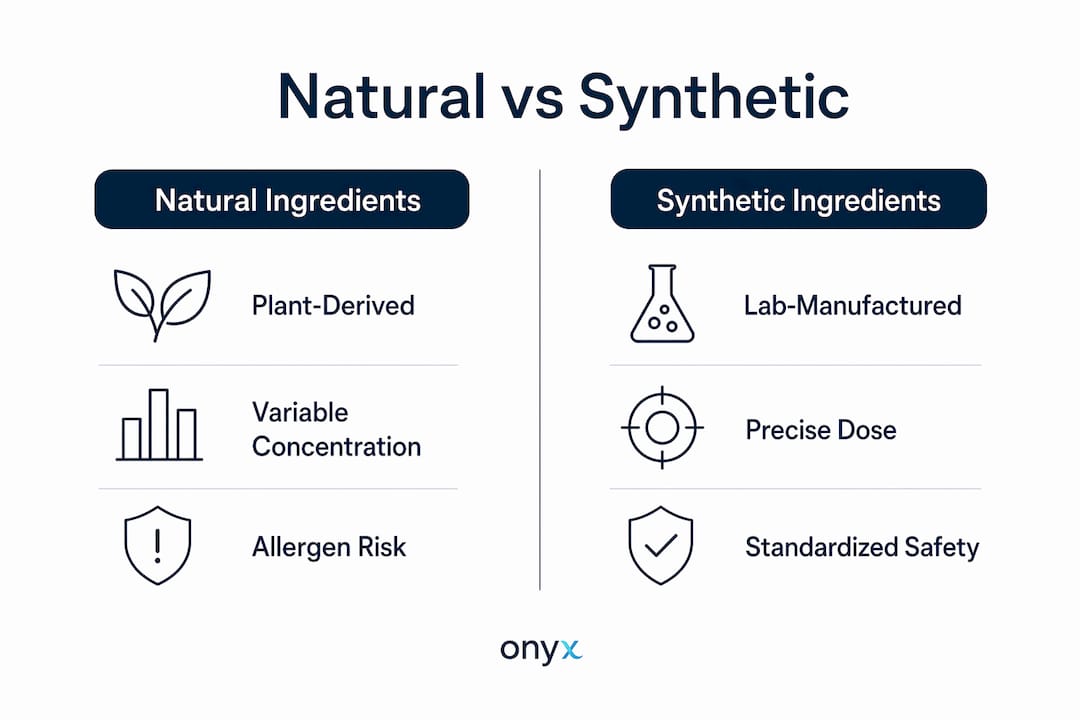
The comparison between natural and synthetic ingredients is not a contest with a clear winner. Each has strengths, and the best formulations often use both.
Synthetic actives like retinol, niacinamide, and ascorbic acid are manufactured to precise specifications. That precision means consistent potency, predictable stability, and reproducible results across batches. Botanical extracts, by contrast, vary in composition depending on growing conditions, harvest timing, and extraction method. A chamomile extract from one supplier may contain significantly different levels of bisabolol than one from another.
That said, bio-precision combining natural and synthetic actives delivers better wellness outcomes than either approach alone. The misconception that synthetic equals harmful and natural equals safe is one of the most persistent errors in consumer wellness thinking.
The safety picture is more complicated than most labels suggest. Natural products can cause allergic reactions in people sensitive to tree nuts, sesame, or shellfish-derived compounds. Annatto, a natural colorant used in foods and cosmetics, triggers reactions in a subset of the population. Poison ivy is entirely natural. The origin of an ingredient does not determine its safety profile.
Here is where natural ingredients genuinely excel over many synthetics:
- Environmental compatibility. Biodegradable plant and mineral ingredients break down without leaving persistent chemical residues in water systems.
- Synergistic complexity. Whole plant extracts contain multiple active compounds that work together in ways that isolated synthetics cannot replicate.
- Skin microbiome support. Certain plant-derived prebiotics and fermented ingredients support the skin’s bacterial balance rather than disrupting it.
- Consumer trust. For people with sensitivities to petrochemical derivatives, well-formulated natural alternatives provide a genuinely useful option.
The honest answer is that scientific evaluation of safety and efficacy should guide your choices regardless of ingredient origin. A label that says “100% natural” is a marketing claim. A published clinical study is evidence.
What should you know about the limits of natural ingredients?
Natural ingredients have real limitations, and knowing them protects you from wasted money and potential harm. The wellness market is not always your friend here.
1. “Natural” has no legal definition in most markets.
The FDA does not have a formal regulatory definition for the word “natural” on food or cosmetic labels in the United States. No universally accepted regulation governs its use, which means any brand can print it on a package without meeting a defined standard. That gap creates room for misleading claims.
2. Dose determines effectiveness.
A product containing 0.01% of a plant extract is not delivering the same benefit as one containing 2%. Concentration matters as much as ingredient identity. Many products list impressive-sounding botanicals at trace levels that have no measurable effect.
3. Allergenicity is real and individual.
Allergenicity in natural ingredients is dose and individual dependent. Essential oils, seed-derived compounds, and fragrant plant extracts are among the most common triggers for contact dermatitis. Standardization and full ingredient disclosure are the only reliable safeguards.
4. Preservation is a genuine challenge.
Natural formulations require preservatives to avoid spoilage and contamination risks. Without them, water-based natural products become breeding grounds for bacteria and mold within days. Some brands avoid synthetic preservatives for marketing reasons and end up with products that are either unstable or preserved with natural alternatives that carry their own sensitization risks.
5. Greenwashing is widespread.
Ingredient transparency and compliance with certifications are the most reliable consumer safeguards against greenwashing. Look for third-party certifications from organizations like COSMOS, USDA Organic, or NSF rather than relying on front-of-label claims alone.
Pro Tip: Check the full ingredient list, not the front label. Ingredients are listed in descending order by concentration. If your “rosehip oil serum” lists rosehip oil fifth after water, glycerin, and two synthetic emollients, you are mostly buying a conventional moisturizer.
How is technology improving the impact of natural ingredients?
The biggest limitation of many natural ingredients is not their chemistry. It is delivery. A powerful plant compound that cannot penetrate the skin barrier or survive shelf storage does nothing useful. Modern formulation science is solving that problem.
Nanocarrier systems, including solid lipid nanoparticles and nanoemulsions, have changed what is possible. Nanocarrier systems greatly improve delivery, stability, and therapeutic performance of plant-derived compounds in dermatological applications. A curcumin molecule encapsulated in a lipid nanoparticle penetrates skin far more effectively than raw turmeric powder ever could.
Structured delivery systems also improve the performance of natural adsorbents. Structured topical delivery systems containing natural adsorbents improve pollutant sequestration and skin barrier protection beyond what raw ingredient use achieves. The structure matters as much as the substance.
Other technologies advancing natural ingredient use include:
- Fermentation. Fermenting plant extracts with beneficial bacteria increases bioavailability and creates new bioactive compounds not present in the raw plant.
- Supercritical CO₂ extraction. This method pulls phytochemicals from plants without heat or chemical solvents, preserving fragile compounds that standard extraction destroys.
- Nanoencapsulation. Wrapping active compounds in protective shells extends shelf life and controls release timing, solving two of the biggest challenges in natural formulation.
- Phytochemical standardization. Identifying and measuring specific active compounds in botanical extracts allows manufacturers to guarantee consistent potency across batches.
These advances mean the herbal supplement guide you follow today is working with far more sophisticated tools than the tinctures and powders of a decade ago. The gap between “natural” and “clinically effective” is closing because of technology, not despite it.
Key Takeaways
Natural ingredients deliver proven health and wellness benefits when used at validated concentrations, supported by modern formulation technology, and evaluated by scientific evidence rather than label claims alone.
| Point | Details |
|---|---|
| Evidence over labels | Look for specific compound names, concentrations, and clinical study references, not just “natural” on the front label. |
| Concentration determines results | Zeolites and clays reduce skin pollutant accumulation by 35–50% at 2–5% concentration. Lower doses may not deliver the same effect. |
| Natural is not automatically safe | Allergens like essential oils and annatto are natural. Evaluate ingredients individually, not by their origin. |
| Technology closes the gap | Nanocarriers and fermentation dramatically improve the bioavailability and stability of plant-derived actives. |
| Greenwashing is a real risk | No legal definition of “natural” exists in U.S. markets. Third-party certifications are the most reliable standard. |
My honest read on the natural ingredients conversation
I have spent years reading the research behind wellness products, and the thing that frustrates me most is how the “natural vs. synthetic” debate gets framed as a values question rather than a science question. People feel morally aligned with natural ingredients, and brands exploit that feeling relentlessly.
Here is what I actually believe: nature is an extraordinary source of bioactive compounds. Thousands of years of traditional medicine, including Ayurvedic practice, identified plant and mineral ingredients that modern science is now validating with clinical trials. That is remarkable. It deserves respect.
But the naturalness bias leads people to pay more for products with functional equivalency to cheaper, better-studied alternatives. It also leads people to avoid synthetic ingredients that are genuinely safer and more effective than their natural counterparts in specific applications. Both outcomes are bad for your health and your wallet.
My advice is simple. Read the full ingredient list. Look for ingredient transparency as a non-negotiable brand standard. Ask whether the specific ingredient, at the specific concentration in the product, has been studied. If a brand cannot answer that question, the “natural” label on the front means nothing.
The best wellness routines I have seen combine well-studied natural actives with precision-formulated synthetics, chosen based on individual needs and real evidence. That is not a compromise. That is just good science.
— Chris
Onyxwellness and the science behind natural formulations
Onyxwellness was built on the principle that natural ingredients should be backed by evidence, not just tradition. Every product in the Onyxwellness line reflects that standard, from the sourcing of botanical actives to the delivery technology that gets them where they need to go.

The Digestive + Gut Health Strips and Hair, Skin and Nails Strips are two examples of how Onyxwellness applies this approach in practice. Both use plant-derived and clinically studied ingredients in dissolvable strip form for fast absorption without water. Full ingredient lists are published without fine print. If you want wellness products where “natural” means something specific and verifiable, the Onyxwellness collection is worth your time.
FAQ
What does “natural ingredient” actually mean?
A natural ingredient is any substance derived from a plant, mineral, or animal source without significant chemical modification. The term has no binding legal definition in U.S. food or cosmetic markets, so always look beyond the label.
Are natural ingredients safer than synthetic ones?
Not automatically. Natural compounds like essential oils and annatto cause allergic reactions in sensitive individuals, and some natural substances are toxic at certain doses. Safety depends on the specific ingredient, concentration, and individual response.
How do natural ingredients work in skincare?
Natural ingredients in skincare work through several mechanisms: antioxidants like plant polyphenols neutralize free radicals, mineral adsorbents like zeolites bind and remove pollutants, and hydrating compounds like hyaluronan attract and retain moisture in skin tissue.
What is greenwashing in natural wellness products?
Greenwashing is when a brand uses “natural” or “green” language to imply safety or environmental benefit without substantive evidence. Since no regulatory standard governs the term “natural” in the U.S., third-party certifications from bodies like COSMOS or NSF are the most reliable check.
Do natural ingredients need preservatives?
Yes. Water-based natural formulations require preservatives to prevent bacterial and mold growth. Without them, products spoil quickly and pose contamination risks. A product marketed as “preservative-free” is either anhydrous (no water) or potentially unstable.