


The quickest effective step-by-step relaxation routine starts with a 60-second breathing and grounding micropractice you can do anywhere, right now. Try this:
- Breathe in through your nose for 4 counts, hold for 4, exhale slowly for 6. (20 seconds)
- Ground yourself by pressing both feet flat on the floor and naming 3 things you can physically feel. (20 seconds)
- Soften your jaw and shoulders consciously, then take one more slow breath out. (20 seconds)
You’ll notice your heart rate ease almost immediately. That’s your parasympathetic nervous system responding. The rest of this guide gives you the full toolkit, from breathing sequences to a complete evening wind-down, so you can build on that first win.
Pro Tip: Ayurvedic evening routine research consistently recommends beginning your sensory wind-down 60–90 minutes before bed, not 10 minutes before. Dimming lights and stepping away from screens that early gives your nervous system time to genuinely shift gears, rather than just going through the motions.

Table of Contents
- Which breathing technique should you use, and when?
- How to do progressive muscle relaxation, step by step
- How to use guided imagery and body scans for deeper calm
- Pranayama and Ayurvedic-inspired breathing you can add tonight
- Two-minute micro-routines for when you have almost no time
- How to build a 60–90 minute evening wind-down that actually works
- Do botanical supplements actually help, and how should you take them?
- When should you stop, modify, or see a professional?
- Key Takeaways
- The part most relaxation guides skip entirely
- Onyxwellness strips as a wind-down adjunct
- Useful sources and further reading
- FAQ
Which breathing technique should you use, and when?
Three techniques cover most situations: diaphragmatic breathing for a daily reset, box breathing for focus under pressure, and 4-7-8 breathing for fast wind-down before sleep.
Diaphragmatic (belly) breathing is your everyday baseline. Sit upright, place one hand on your chest and one on your belly. Inhale through your nose for 4 counts, letting your belly rise while your chest stays relatively still. Exhale for 6 counts. Repeat 5–8 times. Use it every morning or whenever you feel a low-grade tension creeping in.
Box breathing works when you need to stay sharp but calm, like before a difficult conversation or a stressful meeting. Inhale for 4 counts, hold for 4, exhale for 4, hold for 4. That’s one box. Do 4–6 rounds. The symmetry of the counts is what makes it grounding rather than sedating.
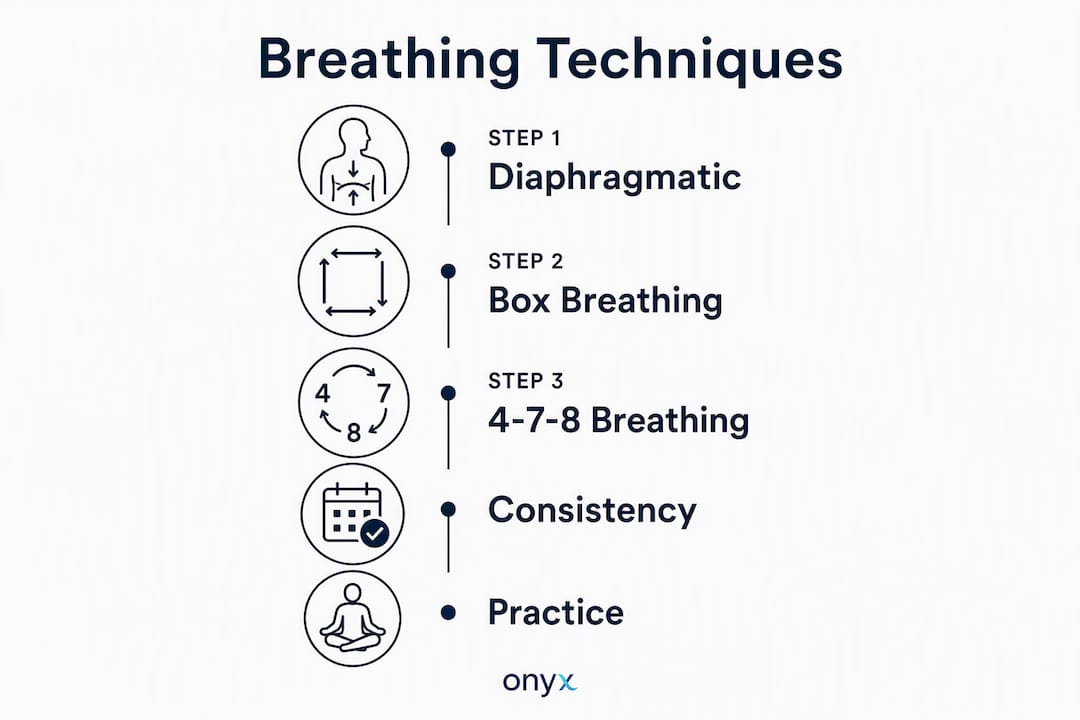
4-7-8 breathing is the fastest route to sleep-ready calm. Inhale for 4 counts, hold for 7, exhale slowly for 8. Two to four rounds is enough. Safety note: if breath-holding causes dizziness or discomfort, shorten the hold to 4 counts and skip this technique entirely if you have respiratory or cardiac conditions.
Mayo Clinic and Harvard experts both emphasize that consistency, not technique perfection, is what produces lasting results. Even five minutes daily outperforms a 30-minute session done once a week.
How to do progressive muscle relaxation, step by step
PMR reliably reduces physical tension when done stepwise and consistently, making it one of the most practical tools in any relaxation routine. Harvard Health recommends it specifically for people whose tension is physical rather than purely mental.
- Lie on your back or sit in a supported chair. Take 3 slow breaths to settle.
- Feet: Curl your toes and arch your feet. Hold 5 seconds, release for 10. Focus on the sensation of letting go.
- Calves: Flex your lower legs. Hold 5 seconds, release for 10.
- Thighs and hips: Squeeze. Hold 5 seconds, release for 10.
- Abdomen and chest: Tighten your core. Hold 5 seconds, release for 10.
- Shoulders: Shrug them toward your ears. Hold 5 seconds, release for 10.
- Hands: Make a fist. Hold 5 seconds, release for 10.
- Face: Squeeze your eyes shut and clench your jaw gently. Hold 5 seconds, release for 10.
The full sequence takes about a quarter of an hour. For a shortened version, do only feet, shoulders, and face — that covers the three spots where most people hold stress. If you’re at a desk, a seated PMR hitting just hands, shoulders, and face takes under 4 minutes. Recording a slow audio prompt on your phone removes the mental effort of remembering the sequence, which makes it far easier to actually do.
How to use guided imagery and body scans for deeper calm
Guided imagery works by shifting your attention into a calming sensory scene, while a body scan anchors awareness in the present physical moment. Both techniques use the same starting position: seated or lying down, eyes closed, minimal distractions.
For a 3-minute version, close your eyes and picture a place where you feel completely safe. What do you see? What sounds are there? What does the air smell like? Stay with one sense at a time for about 30 seconds each, breathing slowly throughout.
A 10-minute session adds movement through the scene. Walk slowly through your imagined space, noticing textures underfoot, temperature changes, and distant sounds. Anchor words like “soft,” “warm,” and “still” help sustain the image when your mind wanders.
For a 20-minute body scan, pair the imagery with a slow sweep from feet to head. After 5 minutes in your scene, bring attention to your feet and notice any sensation without judgment. Move upward through each body region, spending about 60 seconds per area.
Pro Tip: Pairing guided imagery with soft instrumental music (around 60 beats per minute) deepens the effect. The rhythm naturally slows your breathing without any effort on your part.
Dim lighting and a supported posture, either lying flat or reclined at roughly 45 degrees, make both techniques noticeably more effective than trying them upright at a bright desk.
Pranayama and Ayurvedic-inspired breathing you can add tonight
Alternate-nostril breathing (Nadi Shodhana) and humming breath (Bhramari) gently regulate nervous system tone and pair well with an evening wind-down, according to Ayurvedic evening routine guidance. These are the practices most often recommended in a step-by-step guide to Ayurvedic relaxation for good reason: they’re simple, require no equipment, and produce a noticeable shift within minutes.
Nadi Shodhana (alternate-nostril breathing):
- Sit comfortably with your spine upright.
- Rest your right hand’s index and middle fingers between your eyebrows.
- Close your right nostril with your thumb. Inhale through the left for 4 counts.
- Close both nostrils briefly, then release the right. Exhale through the right for 4 counts.
- Inhale through the right for 4 counts. Close both, then exhale through the left.
- That’s one cycle. Do 5–8 cycles, about 3–5 minutes total.
Bhramari (humming breath):
- Sit quietly, close your eyes, and plug your ears gently with your thumbs.
- Inhale deeply through the nose.
- Exhale slowly while making a steady humming sound, like a bee.
- Feel the vibration in your skull and chest. Repeat 5–7 times.
Safety note: avoid forceful breath retention if you have asthma, high blood pressure, or any active respiratory condition. Gentle, unforced breathing is always the right pace. For more on integrating these practices, the Ayurvedic home routine guide at Onyxwellness walks through a full daily structure.
Two-minute micro-routines for when you have almost no time
A 2-minute micro-routine can reliably downshift stress when done with precision and repeated often. The key is pairing a specific cue with a specific action so the routine runs on autopilot.
- Breath + posture reset: Sit tall, drop your shoulders, take 5 slow belly breaths. Set a phone alarm labeled “reset” for 10 AM, 2 PM, and 5 PM.
- Mini-PMR: Squeeze your hands into fists for 5 seconds, release. Shrug your shoulders for 5 seconds, release. Done.
- 5-4-3-2-1 grounding: Name 5 things you see, 4 you can touch, 3 you hear, 2 you smell, 1 you taste. Pulls your nervous system out of a stress spiral fast.
The cues that work best are arrival-based: walking in your front door, sitting down at your desk, or the moment you put your phone down for the night. Daily stress-reduction practices that attach to existing behaviors stick far longer than ones that require carving out new time slots. Short daily practice consistently beats occasional long sessions, a point Mayo Clinic makes explicitly in its relaxation guidance.
How to build a 60–90 minute evening wind-down that actually works
A progressive 60–90 minute ritual produces cumulative benefits that a 10-minute pre-bed scramble simply cannot replicate. The goal is to move your nervous system from sympathetic (alert, reactive) to parasympathetic (calm, restorative) before you ever lie down.
| Time before bed | Action |
|---|---|
| 90 minutes | Finish your last meal; dim overhead lights; silence non-urgent notifications |
| 60–90 minutes | Gentle 10-minute walk or slow stretching |
| 60 minutes | Warm shower or foot soak; apply warmed oil to feet and scalp (padabhyanga) |
| 45 minutes | 5–8 minutes of Nadi Shodhana or 4-7-8 breathing |
| 30 minutes | Guided imagery or body scan (10–20 minutes) |
| 15 minutes | Light reading, journaling, or quiet music only |
| Bedtime | Lights out, phone face-down |
Evening foot and scalp oiling can be done in 8–10 minutes and often improves sleep onset and maintenance in 3–7 days with consistent practice. Warm the oil in a cup of hot water for 3–5 minutes and test it on your inner wrist before applying.
For building the habit, pick just one anchor from this timeline to start. Most people find the oil application or the breathing practice easiest to add first, then build backward from there.
- Keep your wind-down kit (oil, journal, eye mask) in one visible spot so there’s no friction.
- A consistent start time matters more than a perfect sequence.
- Supplements that support sleep can slot in at the 45-minute mark, alongside your breathing practice.
Do botanical supplements actually help, and how should you take them?
Botanicals like ashwagandha, rhodiola, chamomile, and lavender can support relaxation when used consistently and as part of a routine, not as a standalone fix. Clinical trials on adaptogens report benefits for ashwagandha and rhodiola in stress reduction within studied dose ranges. Herbs show their best results when integrated into consistent routines and lifestyle changes rather than used in isolation.
For delivery format, the differences are practical:
| Format | Onset speed | Portability | Dosing precision | Best use case |
|---|---|---|---|---|
| Capsules/tablets | Slow (30–60 min) | High | High | Daily morning routine |
| Herbal teas | Moderate (15–30 min) | Low | Low | Evening ritual, sensory wind-down |
| Essential oils (topical/aromatic) | Fast (minutes) | Moderate | Low | Acute stress, environment setting |
| Dissolvable oral strips | Fast (under 15 min) | Very high | Moderate | On-the-go, pre-sleep, busy schedules |
Dissolvable strips offer faster onset than capsules or teas and integrate easily into a busy routine without water. For a deeper look at the evidence behind specific botanicals, the supplements for relaxation guide at Onyxwellness covers dosing and format comparisons in detail.
Safety: follow label dosing; most adaptogen studies use short-term protocols of 8–12 weeks. Consult your doctor before combining herbal supplements with prescription medications.
When should you stop, modify, or see a professional?
Stop any breath practice immediately if you feel faint, dizzy, or notice worsening shortness of breath. That’s the single most important safety rule across all techniques in this guide.
- Breath work contraindications: active asthma or COPD flare, uncontrolled high blood pressure, recent cardiac event, pregnancy (avoid breath retention).
- Herbal supplement cautions: pregnancy and breastfeeding, blood-thinning medications, thyroid conditions (ashwagandha specifically), and any autoimmune condition on immunosuppressants.
- Seek professional support if you experience persistent insomnia lasting more than 3 weeks, panic attacks, or anxiety that interferes with daily functioning. A primary care provider or licensed mental health professional is the right next step, not a deeper relaxation routine.
Relaxation techniques are powerful self-care tools, but they work alongside professional care, not instead of it. For natural self-care ideas that complement these practices, this partner resource offers practical everyday examples.
This article is general wellness information, not medical advice. Confirm any new practice or supplement with your healthcare provider, especially if you have an existing condition.
Key Takeaways
A consistent, short daily relaxation practice built around breathing, body awareness, and an Ayurvedic-inspired evening routine produces the most reliable long-term results.
| Point | Details |
|---|---|
| Start with the 60-second micropractice | Box breathing plus grounding takes under a minute and produces an immediate nervous system shift. |
| Consistency beats intensity | Short daily sessions outperform occasional long ones, per Mayo Clinic guidance. |
| Evening wind-down starts 90 minutes early | Dimming lights and reducing screens 60–90 minutes before bed shifts the nervous system toward sleep readiness. |
| Botanicals work best in routines | Ashwagandha and rhodiola show clinical benefits within studied dose ranges when used consistently, not sporadically. |
| Onyxwellness strips fit the routine | Fast-absorbing, sugar-free dissolvable strips slot into the 45-minute wind-down mark as a convenient herbal adjunct. |
The part most relaxation guides skip entirely
Most guides hand you a list of techniques and leave you to figure out the rest. What they rarely say is that the technique itself is almost never the problem. The real obstacle is the gap between knowing what to do and actually doing it at 9:30 PM when you’re tired, your phone is in your hand, and the path of least resistance is scrolling.
The Ayurvedic approach gets this right in a way that modern wellness content often misses. It doesn’t ask you to carve out a perfect hour of silence. It asks you to shift your environment gradually, starting with something as small as dimming one light or putting your phone in another room. That small environmental shift is what makes the breathing practice feel natural instead of forced.
My honest recommendation: don’t start with the 90-minute wind-down. Start with the 60-second micropractice from the top of this article, do it for 7 days at the same time each day, and notice what happens. Once that’s automatic, add one more step. That’s how a real routine gets built, not by willpower, but by making the next step the obvious one.
Onyxwellness strips as a wind-down adjunct
Supplements are adjuncts to the practices above, not replacements for them. That said, the right format makes a real difference when you’re building a new evening habit.
Onyxwellness offers three dissolvable strip formats that fit naturally into the 45-minute wind-down window. The Sleep Strips are the primary option for sleep onset support, dissolving fast without water and designed for exactly the moment you’re winding down. The Digestive + Gut Health Strips support gut comfort after your last meal of the evening, which matters more for sleep quality than most people realize. And the Probiotic + Metabolism Strips round out a gut-focused evening routine for those who want consistent microbiome support alongside their relaxation practice. All three are sugar-free, fast-absorbing, and built for the kind of busy lifestyle where a capsule and a glass of water just doesn’t happen every night. Browse the full range at Onyxwellness and find the format that fits your routine.
Useful sources and further reading
- Relaxation techniques: Try these steps to reduce stress — Mayo Clinic’s evidence-based overview of technique selection and consistency principles.
- Six relaxation techniques to reduce stress — Harvard Health’s summary of the six core methods, including breath focus and guided imagery.
- Common herbs for stress: The science and strategy of a botanical medicine approach to self-care — peer-reviewed review of adaptogen evidence, dosing, and delivery formats.
- Relaxation Techniques — StatPearls, NCBI Bookshelf — clinical reference covering PMR, box breathing, and guided imagery protocols.
- Ayurvedic relaxation support: a practical guide — Onyxwellness overview of Ayurvedic principles and supplement integration.
- Your herbal supplement routine guide for real results — practical Onyxwellness guide to building a consistent herbal routine.
- Relaxation tips for health-conscious consumers — Onyxwellness habit tips and pragmatic relaxation practices for busy adults.
FAQ
What is the fastest step-by-step relaxation technique?
Box breathing (4 counts in, hold 4, out 4, hold 4) is one of the fastest techniques to execute and can be done anywhere without any preparation, per StatPearls clinical guidance.
How long does progressive muscle relaxation take?
A full PMR sequence from feet to face takes about a quarter of an hour; a shortened version targeting feet, shoulders, and face covers the three spots where most people hold stress and can be done in under 4 minutes.
Can Ayurvedic herbs actually support relaxation?
Clinical trials report benefits for ashwagandha and rhodiola in stress reduction within studied dose ranges, and herbs show the strongest results when used consistently as part of a broader routine rather than alone.
When should you start your evening wind-down?
Ayurvedic guidance recommends beginning 60–90 minutes before bed, dimming lights and reducing screen exposure progressively to shift the nervous system toward parasympathetic readiness.
Are dissolvable strips a good format for herbal relaxation support?
Dissolvable oral strips offer faster onset than capsules or teas and require no water, making them a practical adjunct for busy people building a consistent evening routine. Onyxwellness Sleep Strips are designed specifically for this use case.