


TL;DR:
- Combining spirulina and chlorella provides a broader range of nutrients, especially B12, iron, and antioxidants. Spirulina supports blood pressure and immune health, while chlorella excels in B12 bioavailability and detoxification. Always consult a healthcare provider before adding algae supplements, especially if taking medication or managing health conditions.
Most people who want to combine spirulina and chlorella are making the right call. Together, these two algae cover more nutritional ground than either does alone, and the DoD’s Healthy Eating Initiative recommends exactly that for plant-based diets. If you have to pick just one, choose spirulina for blood pressure support and antioxidant benefits, or chlorella if you need a reliable plant-based B12 source.
Quick verdict at a glance:
- Spirulina: Best for antioxidant support, protein density, and blood pressure management
- Chlorella: Best for bioavailable B12, iron, omega-3s, and detox support
- Both together: Best for plant-based eaters, athletes, and anyone building a complete daily nutrient base
One caution before you start: Both algae can interfere with blood clotting, may worsen autoimmune conditions, and spirulina contains phenylalanine, which is dangerous for people with PKU. Tell your healthcare provider before adding either to your routine.
Table of Contents
- How do spirulina and chlorella compare side by side?
- What does the science actually say about their benefits?
- Which nutrients actually differ, and why does it matter?
- Who should be careful, and what contaminants should you watch for?
- Does the form you take actually change how well it works?
- What should you look for on the label before you buy?
- Sample routines for common wellness goals
- Key Takeaways
- Why fast-absorbing formats change the equation
- Onyxwellness strips for daily clarity and recovery support
- Useful sources
- FAQ
How do spirulina and chlorella compare side by side?
| Feature | Spirulina | Chlorella |
|---|---|---|
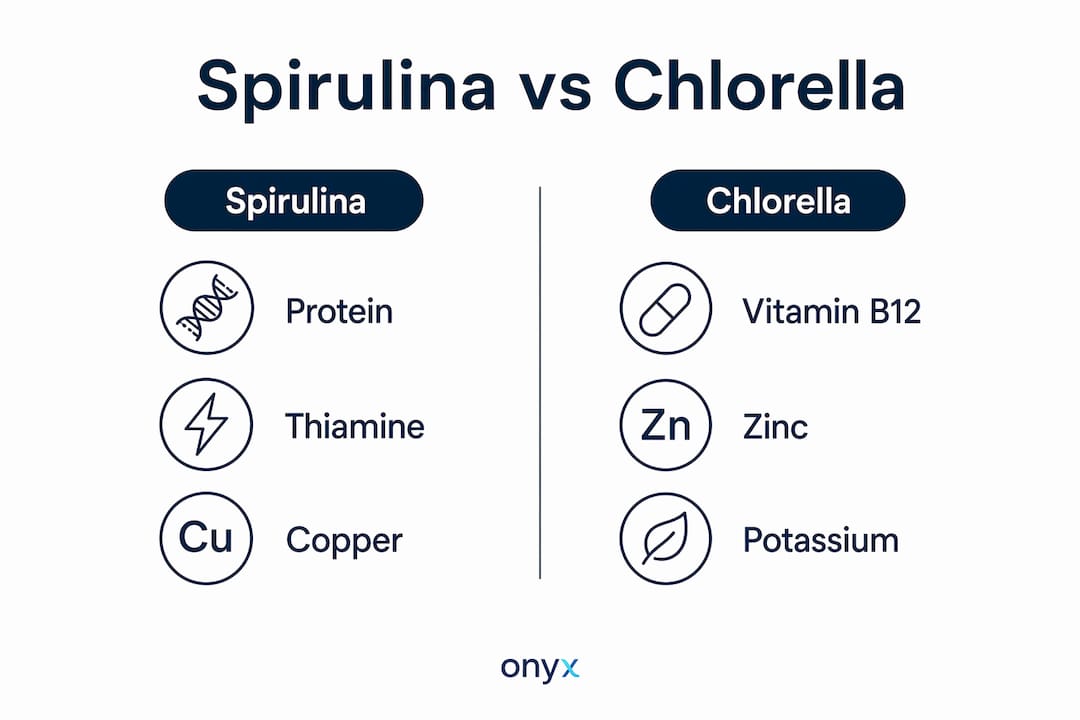
| Primary nutrients | Protein, thiamine, copper, potassium | B12 (active), iron, omega-3s, riboflavin, zinc, vitamin A |
| Evidence-backed benefits | Blood pressure reduction, antioxidant activity, protein source | B12 supplementation, iron support, detoxification |
| Typical study dosages | 1–8 g/day | 2–10 g/day |
| Common forms | Powder, tablets, capsules | Tablets, powder (cracked cell wall required) |
| Safety notes | Avoid with PKU, autoimmune conditions, blood thinners | Generally well tolerated; check for heavy metals |
| Best for | Athletes, cognitive support, antioxidant goals | Vegans needing B12, iron support, detox protocols |
Typical dosage ranges used in clinical settings:
| Goal | Spirulina | Chlorella |
|---|---|---|
| Daily maintenance | 1–3 g/day | 2–3 g/day |
| Clinical study range | 1–8 g/day | 2–10 g/day |
| Short-term higher dose | Up to 8 g/day (with provider guidance) | Up to 10 g/day (with provider guidance) |
Pro Tip: Start with a combined dose of 1–2 g each per day and ramp up over two weeks. This gives your digestive system time to adjust and lets you notice which benefits show up first.
What does the science actually say about their benefits?
The evidence for spirulina is stronger and more consistent across human trials. A review of five studies found that daily spirulina at 1–8 grams significantly reduced both systolic and diastolic blood pressure, particularly in people with existing hypertension. That’s a meaningful clinical outcome, not just a trend.
- Blood pressure reduction (spirulina): Multiple human RCTs show measurable reductions in hypertensive adults, notably in studies using daily spirulina within typical dosage ranges.
- Antioxidant and anti-inflammatory activity: Spirulina showed stronger antioxidant assay results in comparative biochemical analysis, suggesting it may help reduce oxidative stress.
- Plant-based protein: Both algae provide complete amino acid profiles, making them genuinely useful for vegans and vegetarians.
- B12 supplementation (chlorella): Chlorella’s B12 is biologically active in humans, a rare quality in plant foods.
- Iron and mineral support (chlorella): Chlorella contains more iron per serving than spirulina, relevant for anyone managing low ferritin on a plant-based diet.
“Combining spirulina and chlorella can cover a broader nutrient spectrum and may be recommended for plant-based diets.” — DoD Healthy Eating Initiative
The evidence for chlorella’s detox claims is more preliminary. Human studies exist but are smaller and less consistent than spirulina’s blood pressure data. Treat detox benefits as promising rather than proven.
Which nutrients actually differ, and why does it matter?
The B12 distinction is the most important one for vegans. Chlorella contains biologically active B12 that works in the human body. Spirulina contains what researchers call pseudovitamin B12, a form that is inactive in humans and can actually block absorption of real B12. If you’re relying on spirulina as your B12 source, you’re not getting what you think you are.
On the mineral side, chlorella tends to be richer in omega-3 fatty acids, vitamin A, riboflavin, and zinc, while spirulina leads in thiamine and copper. For athletes focused on recovery and cognitive clarity, spirulina’s copper content supports energy metabolism, while chlorella’s zinc contributes to immune function and testosterone regulation.
“Chlorella contains significant amounts of B12 per serving, whereas spirulina only contains trace amounts of a form of B12 that is ineffective in humans.” — DoD Healthy Eating Initiative
Protein content varies by sample and processing method. One comparative biochemical analysis found chlorella at 64.63% total protein versus spirulina at 58.24% in the same sample set, though spirulina typically scores higher in antioxidant assays. Species variability and growing conditions shift these numbers, which is exactly why third-party testing matters.
Pro Tip: If you’re pairing these algae with an Ayurvedic herbal blend, chlorella’s zinc and B12 fill gaps that most adaptogenic herbs don’t address.
Who should be careful, and what contaminants should you watch for?
Harvard Health guidance flags several groups who should proceed cautiously or avoid these supplements entirely:
- Blood clotting disorders: Both algae may interfere with anticoagulant medications like warfarin.
- Autoimmune conditions: Spirulina can stimulate immune activity, potentially worsening lupus, rheumatoid arthritis, or multiple sclerosis.
- PKU (phenylketonuria): Spirulina contains phenylalanine and must be avoided by anyone with this condition.
- Pregnancy: Consult your OB before using either supplement; contamination risk is a particular concern.
- Medication interactions: Both can interact with immunosuppressants and blood thinners.
Contamination is a real risk. U.S. dietary supplements are not preapproved by the FDA, meaning products can vary widely in contaminant levels and dose accuracy. Heavy metals and microcystins (toxins from blue-green algae) have been found in poorly sourced products.
Pro Tip: Search for “COA” or “third-party tested” on a brand’s website before buying. If it’s not there, ask for it. Reputable brands share this documentation without hesitation.
Does the form you take actually change how well it works?
Yes, and the difference between chlorella and spirulina here is structural. Chlorella’s cellulose cell wall is indigestible to humans and must be mechanically broken during processing. Without that step, most of its nutrients pass through you unabsorbed. Spirulina lacks this wall entirely, making it more immediately bioavailable when properly dried.
“Standardized processing and encapsulation improve sensory acceptance and bioavailability, and microalgae show real promise as sustainable functional ingredients.” — Frontiers in Nutrition, 2026
Processing also affects flavor. Raw spirulina and chlorella powders have a strong, grassy, oceanic taste that many people find difficult to stick with long-term. A 2026 Frontiers review highlights taste-masking, encapsulation, and microencapsulation as practical solutions for improving consumer acceptance. Dissolvable strips take this further by bypassing the mixing and measuring entirely, delivering ingredients directly through the oral mucosa for faster uptake.
For anyone who has abandoned a greens powder because of the taste, modern delivery formats are worth considering. You can read more about how wellness strips work and why the format matters for compliance.
What should you look for on the label before you buy?
Buying checklist:
- Species clearly named (e.g., Arthrospira platensis for spirulina; Chlorella vulgaris or C. pyrenoidosa for chlorella)
- “Cracked cell wall” or “broken cell” processing stated for chlorella products
- Third-party COA available, covering heavy metals and microcystins
- Country of origin listed (prefer U.S., Japan, or Taiwan for traceability)
- No cure-all language or unverifiable health claims on the label
- Allergen statement present
Starter protocol:
- Begin with 1 g of each per day for the first week.
- Increase to 2–3 g of each in week two if digestion is comfortable.
- Take with food to reduce nausea, especially at higher doses.
- Track energy, digestion, and mental clarity over 30 days.
- If you notice unusual fatigue, GI distress, or skin changes, stop and consult your provider.
- For therapeutic doses above 5 g/day, work with a clinician.
Pro Tip: Morning is generally the best time to take these, paired with a meal. Taking them on an empty stomach increases the chance of nausea, particularly with chlorella.
Sample routines for common wellness goals
| Goal | Spirulina | Chlorella | Timing |
|---|---|---|---|
| Daily nutrient support | 1–2 g/day | 1–2 g/day | Morning with breakfast |
| Mental clarity and focus | 3 g/day | 2 g/day | Morning, with daily greens |
| Athletic recovery | 3–5 g/day | 2–3 g/day | Post-workout with a meal |
| Blood pressure support | 1–8 g/day (study range) | Optional | Morning; consult provider above 5 g |
For blood pressure goals, the clinical evidence centers on spirulina at 1–8 grams daily. Doses above 5 g should be discussed with a healthcare provider, especially if you’re already on antihypertensive medication.
Key Takeaways
Taking both spirulina and chlorella together gives you the most complete nutrient coverage, with chlorella supplying bioavailable B12 and iron, and spirulina delivering antioxidant support and clinically studied blood pressure benefits at 1–8 g/day.
| Point | Details |
|---|---|
| Take both for full coverage | Combining them covers B12, iron, omega-3s, protein, and antioxidants that neither provides alone. |
| Chlorella for B12 | Only chlorella contains biologically active B12; spirulina’s pseudovitamin B12 is ineffective in humans. |
| Spirulina for blood pressure | Clinical studies used 1–8 g/day and found significant reductions in hypertensive adults. |
| Always check for a COA | U.S. supplements are not FDA preapproved; third-party testing is the only reliable safety check. |
| Onyxwellness for fast delivery | Onyxwellness dissolvable strips offer a taste-free, fast-absorbing alternative to raw algae powders. |
Why fast-absorbing formats change the equation
Here’s what most algae supplement guides skip: the format you choose is almost as important as the ingredient itself. Raw powders are effective in theory, but compliance is the real variable. If the taste makes you dread your morning routine, you’ll stop taking them within a month. That’s not a willpower problem; it’s a formulation problem.
What the 2026 Frontiers research makes clear is that encapsulation and standardized delivery are the direction the field is moving, precisely because bioavailability and palatability are inseparable from real-world outcomes. A dissolvable strip that you actually use every day outperforms a powder tub sitting in your cabinet. Onyxwellness builds around this principle, fusing Ayurvedic ingredient philosophy with delivery technology designed for modern life. Transparency matters too, and that means COA documentation, clear sourcing, and no proprietary-blend opacity.
Onyxwellness strips for daily clarity and recovery support
If the research on spirulina and chlorella has you thinking about how to actually build these benefits into your day, Onyxwellness offers a lineup of fast-absorbing dissolvable strips that take the friction out of supplementation entirely. No powder, no mixing, no taste barrier.
The Sleep Strips are formulated for nighttime recovery, supporting the rest that makes every other wellness habit more effective. The Hangover Strips target next-day recovery and rehydration support, and the Libido Support Strips address energy and vitality with the same fast-absorbing format. Each product is sugar-free, designed for quick oral absorption, and built on the same quality-first approach the article describes. Browse the full collection at Onyxwellness and find the format that fits your routine.
This section is promotional. Products are dietary supplements and are not intended to diagnose, treat, cure, or prevent any disease. Consult your healthcare provider before starting any new supplement.
Useful sources
- DoD Healthy Eating Initiative: The Benefits of Spirulina and Chlorella — Government nutrition guidance with practical combination-use recommendations; useful for plant-based diet context.
- Healthline: Chlorella vs. Spirulina — Accessible clinical summary covering nutrient differences and safety; good starting reference.
- Healthline: 10 Proven Benefits of Spirulina — Covers the five-study review on blood pressure reductions with dosage data.
- Examine: Chlorella vs. Spirulina — Evidence-based breakdown of B12 bioavailability and cell wall processing differences.
- Harvard Health: Is Spirulina Good for You? — Medical guidance on safety cautions, drug interactions, and PKU risk.
- Frontiers in Nutrition, 2026 — Peer-reviewed review on processing, encapsulation, and bioavailability for spirulina as a functional ingredient.
- De Gruyter: Comparative Biochemical Analysis — Primary research comparing protein content, minerals, and antioxidant activity across both algae.
FAQ
Is spirulina better than chlorella for vegans?
Not on its own. Chlorella provides biologically active B12 that the body can actually use, while spirulina’s pseudovitamin B12 is ineffective in humans. Vegans should prioritize chlorella for B12 or use both together.
Can you take spirulina and chlorella at the same time?
Yes, and most practitioners recommend it. The DoD Healthy Eating Initiative notes that combining them covers a broader nutrient spectrum, including complete protein, B vitamins, omega-3s, and minerals.
What dose of spirulina is supported by clinical evidence?
Studies on blood pressure reduction used 1–8 grams of spirulina daily. For general daily support, 1–3 g is a practical starting range; doses above 5 g should be discussed with a healthcare provider.
How do I know if a chlorella product is properly processed?
Look for “cracked cell wall” or “broken cell” on the label. Without mechanical disruption of chlorella’s cellulose wall, its nutrients are largely unavailable to your body.
Are there people who should avoid these supplements entirely?
Yes. Anyone with PKU, autoimmune conditions, blood clotting disorders, or who takes immunosuppressants or anticoagulants should consult a healthcare provider before using spirulina or chlorella. Pregnant individuals should also check with their OB first.
This article is for general informational purposes only and does not constitute medical advice. Confirm current supplement guidelines with a qualified healthcare professional for your specific situation.
Recommended
- Daily greens: 8% more energy and real clarity benefits – Onyx Wellness
- Creatine + Electrolytes: Why 2-in-1 Saves Money & Works – Onyx Wellness
- Mushroom Focus Strips vs Mushroom Extract Complex vs Reishi Relax Gumm – Onyx Wellness
- Probiotics + Enzymes: Buyer’s Guide to Gut Health Strips – Onyx Wellness