


TL;DR:
- Mushroom gummies contain non-hallucinogenic fungi, primarily offering beta-glucans and species-specific actives. Their benefits are modest and vary across individuals, requiring consistent, long-term use for noticeable effects. Safety depends on careful product selection, transparency, and considering possible medication interactions.
Mushroom gummies are everywhere right now, and if you’ve been scrolling wellness feeds, you’ve probably seen bold claims about laser focus, immune armor, and overnight recovery. But here’s the uncomfortable truth: not all mushroom gummies deliver what the label promises, and the gap between marketing and actual science is wider than most brands want you to know. This article cuts through the noise to give you a clear, honest picture of what these supplements can and cannot do, what safety risks you should take seriously, and how to pick a product that genuinely supports your wellness goals.
Table of Contents
- What are mushroom gummies and how do they work?
- Potential benefits and what the science says
- Safety, quality, and side effects: what every user must know
- Demanding more: how to choose the right mushroom gummy for holistic wellness
- What most guides miss about finding real value with mushroom gummies
- Explore quality supplements for your wellness journey
- Frequently asked questions
Key Takeaways
| Point | Details |
|---|---|
| Know active ingredients | Check the label for specific mushroom species and standardized compounds like beta-glucans. |
| Expect modest effects | Clinical studies typically show limited or task-specific benefits, not dramatic improvements. |
| Prioritize safety | Be alert for side effects, drug interactions, and avoid unverified mushroom species. |
| Focus on quality | Choose products with transparent labeling, third-party testing, and clear potency markers. |
| Consult professionals | Always talk to your healthcare provider if you take medications or have health risks. |
What are mushroom gummies and how do they work?
First, let’s clear up the most common misconception. Functional mushroom gummies contain absolutely no psilocybin. They are not hallucinogenic. These products are built around a completely different category of fungi, ones that have been used in traditional medicine for centuries and are now being studied for their potential health effects in modern clinical settings.
The active compounds that matter most are beta-glucans, which are polysaccharides found in the cell walls of fungi. Beta-glucans are believed to interact with receptors in your immune system, potentially supporting immune modulation. Beyond beta-glucans, different mushroom species carry their own unique actives. Lion’s mane, for example, contains hericenones and erinacines that may support nerve growth factor. Reishi carries triterpenes linked to relaxation and stress response. Cordyceps is associated with adenosine compounds that may influence energy metabolism.
Here’s a quick comparison of the most common species and what they’re typically used for:
| Mushroom species | Primary active compounds | Common wellness claim |
|---|---|---|
| Lion’s mane | Hericenones, erinacines | Cognitive support |
| Reishi | Triterpenes, beta-glucans | Relaxation, immune support |
| Cordyceps | Adenosine, cordycepin | Energy, endurance |
| Chaga | Betulinic acid, melanin | Antioxidant, immune support |
| Turkey tail | PSK, PSP polysaccharides | Immune modulation |
The honest reality is that clinical efficacy varies widely across species and study designs. Benefit magnitude is often modest in human trials, and many of the most exciting findings come from animal studies or in-vitro (lab dish) research that doesn’t automatically translate to what happens inside your body.
“Functional mushroom gummies are primarily positioned as delivery vehicles for compounds such as beta-glucans and other species-specific actives; however, benefit magnitude is variable and often modest in human studies.”
What this means for you: a well-formulated mushroom extract complex can be a genuinely useful addition to a wellness routine, but it works best when you approach it with realistic expectations rather than waiting for a dramatic overnight transformation. Think of it as a supportive layer in your routine, not a standalone solution.
Different species genuinely do target different outcomes. Reaching for a reishi product when you want better sleep is a smarter move than grabbing a cordyceps blend. If you’re curious about how Reishi gummies for relaxation stack up for cognitive support specifically, the species-specific research is worth reading before you buy.
Potential benefits and what the science says
Having defined the landscape, let’s look at what the science truly says about those much-touted benefits. The functional mushroom category covers a wide range of health domains, and the evidence quality is not equal across all of them.
Here’s a numbered breakdown of the four main benefit domains and what research actually supports:
- Immune modulation. Beta-glucans from turkey tail and reishi have the most consistent research behind them, particularly in the context of supporting immune function in people undergoing medical treatment. For healthy adults, the effect is real but modest.
- Cognitive support. Lion’s mane is the star here. A 2025 double-blind study of 18 to 35-year-olds using 3 g of a 10:1 lion’s mane extract found no significant improvement in composite cognitive performance or mood overall, though individual task performance (pegboard dexterity) improved at the 90-minute mark. That’s a nuanced finding, not a headline win.
- Energy and endurance. Cordyceps has some support for improving oxygen utilization and reducing fatigue, particularly in older adults and trained athletes. Results in young, healthy exercisers are less consistent.
- Recovery and antioxidant support. Chaga and reishi carry antioxidant properties, which may support recovery from physical stress. The evidence here is promising but still building.
| Benefit domain | Evidence strength | Best species |
|---|---|---|
| Immune modulation | Moderate | Turkey tail, reishi |
| Cognitive support | Limited, task-specific | Lion’s mane |
| Energy/endurance | Moderate in some groups | Cordyceps |
| Antioxidant/recovery | Preliminary | Chaga, reishi |
Why don’t most people notice dramatic effects? Two reasons. First, effect sizes in human studies tend to be small. Second, if you’re already healthy, eating reasonably well, and sleeping enough, you’re starting from a higher baseline. There’s simply less room for a supplement to move the needle visibly. This doesn’t mean the compounds aren’t doing anything, it means the benefit is more like a quiet, steady support system than a lightning bolt.
Acute effects (single-dose) are generally weaker than chronic effects (consistent use over weeks). If you’ve tried a mushroom gummy once and felt nothing, that’s expected. Consistent use over two to four weeks is typically where any meaningful response becomes noticeable.
Products like Reishi Relax Gummies are formulated with this chronic-use model in mind, supporting a gradual, sustainable shift rather than a short-term spike. If you’re also curious about how foundational nutrition interacts with these supplements, understanding energy and clarity from daily greens can help you build a more complete picture.
Safety, quality, and side effects: what every user must know
With benefits and limits in hand, turn your focus to the most common safety issues. This is where many wellness guides go quiet, and that silence can cost you.
Possible side effects include gastrointestinal upset (nausea, bloating, loose stools), allergic reactions ranging from mild to severe, and meaningful interactions with certain medications. These aren’t rare edge cases. They’re documented outcomes that deserve your attention.
Groups who need to be especially careful include:
- People on immunosuppressant medications (mushroom compounds may amplify or interfere with immune pathways)
- Anyone taking blood thinners like warfarin (reishi in particular has anticoagulant properties)
- People managing diabetes with medication (some species may affect blood sugar levels)
- Individuals with known mushroom allergies (obvious, but worth stating clearly)
- People who are pregnant or breastfeeding (insufficient safety data exists)
The regulatory reality matters here too. In the U.S., dietary supplements are not pre-approved by the FDA for safety or efficacy before they hit shelves. That means a product can legally be sold without proving it works or that it’s free of contaminants. This isn’t a reason to avoid supplements entirely, but it is a reason to be selective and informed.
“In the U.S., dietary supplements including mushroom gummies are not pre-approved by the FDA for safety or efficacy, so consumers should check labeling carefully and be wary of product quality and contaminants.”
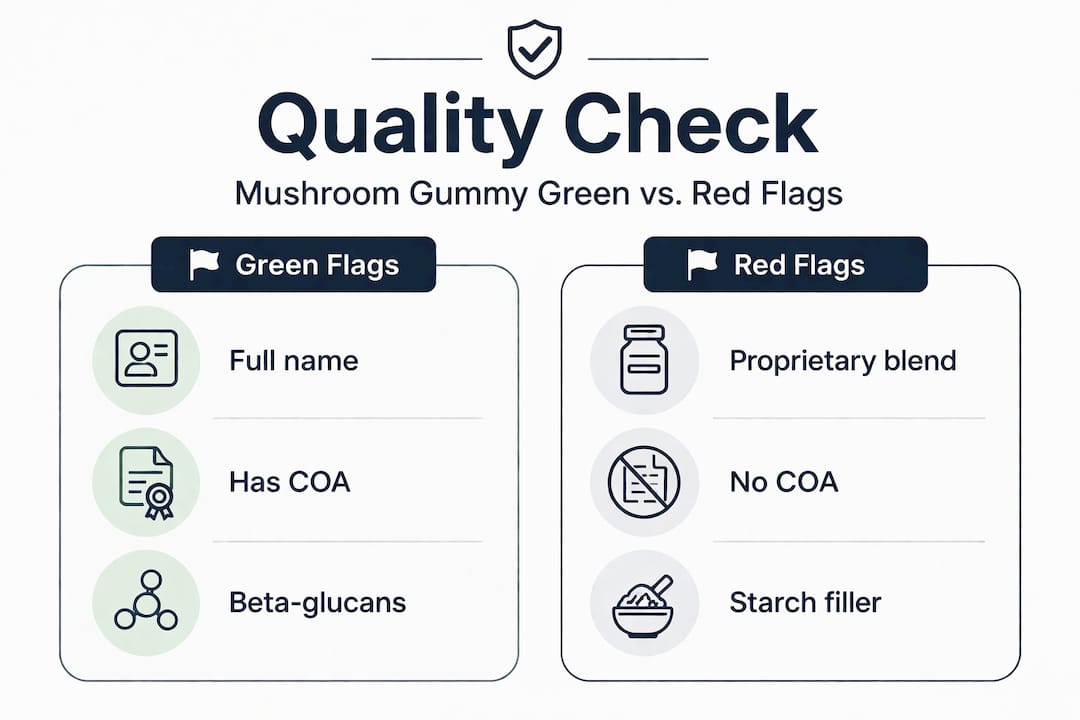
When you pick up a bottle, look at the Supplement Facts panel with real scrutiny. You want to see the specific mushroom species listed by its scientific name (not just “mushroom blend”), the part of the mushroom used (fruiting body versus mycelium matters), and the amount per serving in milligrams. Vague labeling is a red flag, not a minor inconvenience.

Pro Tip: Search for a product’s Certificate of Analysis (COA) before buying. A COA from an independent third-party lab confirms that what’s on the label is actually in the product, and that it’s free from heavy metals, pesticides, and microbial contaminants. If a brand won’t share one, that tells you something important.
If you’re building a broader recovery-focused routine and want to understand how mushroom supplements fit alongside other natural options, the guide on natural recovery supplements offers a practical framework worth bookmarking.
Demanding more: how to choose the right mushroom gummy for holistic wellness
After understanding risks, the next issue is how to objectively choose a safe, functional product. This is where most buyers get lost, because the marketing language on packaging is designed to impress, not inform.
Here’s a practical, step-by-step framework for evaluating any mushroom gummy before you buy:
- Confirm the species. The label must name the specific mushroom species, not just say “functional mushroom blend.” Lion’s mane, reishi, cordyceps, and chaga are the most studied. Vague blends make it impossible to know what you’re actually getting.
- Check the plant part. Fruiting bodies generally contain higher concentrations of active compounds than mycelium grown on grain. Some products use mostly mycelium, which can mean you’re paying for filler substrate rather than potent mushroom material.
- Look for standardized actives. Quality products disclose their beta-glucan content or other potency markers. A practical benchmark for informed buyers is to choose products that specify species, disclose standardized actives, and provide third-party testing or COAs.
- Verify third-party testing. NSF, USP, Informed Sport, or independent lab COAs are your best assurance of quality and safety.
- Watch for dangerous species. Not every “mushroom” on the market is safe. Some species associated with serious adverse reactions, including Amanita muscaria, have appeared in dietary supplements. Emergency symptoms like confusion, vomiting, or rapid heart rate after taking a mushroom product warrant urgent medical care.
- Trial for two to four weeks. Give any new supplement a fair, consistent trial period while monitoring how your body responds. Keep notes. Your individual response is more useful data than any average from a study.
| Quality indicator | Green flag | Red flag |
|---|---|---|
| Species naming | Full scientific name listed | “Mushroom blend” only |
| Plant part | Fruiting body specified | Mycelium on grain |
| Potency marker | Beta-glucan % disclosed | No actives listed |
| Third-party testing | COA available | No testing mentioned |
| Ingredient clarity | Full label transparency | Proprietary blend hiding doses |
For busy professionals and fitness enthusiasts who want cognitive and recovery support without complexity, the mushroom focus product from Onyx Wellness offers a convenient, transparent format worth exploring. If you’re drawn to the traditional roots of these practices, the connection between Ayurveda and mental wellness adds meaningful context to why these botanicals have endured for centuries.
Pro Tip: Start with a single-species product rather than a complex blend. If you notice a benefit, you’ll know exactly what’s responsible. If you have a side effect, you’ll know what to eliminate. Blends make it nearly impossible to troubleshoot either outcome.
What most guides miss about finding real value with mushroom gummies
Here’s the perspective most wellness content avoids because it’s not exciting enough to go viral: the average effect size for functional mushroom supplements in healthy adults is genuinely small. Not zero, but small. Most guides either ignore this or bury it in fine print while leading with the most optimistic study findings available.
The smarter approach isn’t to take more or stack more species together hoping for a stronger effect. It’s to focus relentlessly on quality over quantity and to use your own body as the most honest data source you have. A high-quality single-species product taken consistently for four weeks will tell you more about your personal response than any meta-analysis.
We’ve seen this pattern repeatedly: someone buys a multi-mushroom blend with eight species, takes it for a week, notices nothing, and concludes “mushroom supplements don’t work.” The real issue was never the category. It was the product quality, the timeline, and the lack of a baseline to measure against.
Real value with these supplements comes from treating them the way you’d treat any evidence-based tool: with clear intention, appropriate expectations, and honest self-monitoring. If you’re using reishi for relaxation and you’re sleeping better after three weeks, that’s a meaningful signal worth paying attention to. If nothing changes after a full month of consistent use, that’s equally useful information. The insights on cognitive use available from Onyx Wellness dig deeper into how to set realistic benchmarks for this kind of self-assessment.
The uncomfortable truth is that no supplement, mushroom or otherwise, can compensate for poor sleep, chronic stress, or a diet that’s working against you. Mushroom gummies work best as one well-chosen layer in a broader wellness strategy, not as the whole foundation.
Explore quality supplements for your wellness journey
You’ve now got a sharper lens for evaluating mushroom gummies than most people ever develop. The next step is putting that knowledge to work with products that actually meet the bar.
At Onyx Wellness, every product in the lineup is built around the principles you’ve read about here: transparent labeling, specific species and actives, and formats designed for real-life convenience. The Mushroom Focus Strips are a standout example, delivering fast-absorbing, sugar-free support without the need for water or capsules. Whether you’re looking for cognitive clarity before a demanding workday or recovery support after training, the vitamins and supplements selection offers curated options that align with both Ayurvedic tradition and modern quality standards.
Frequently asked questions
Do mushroom gummies really work?
Some people experience task-specific benefits, but most studies show only modest or domain-limited effects for healthy adults. Consistent use over several weeks gives you the most accurate picture of your personal response.
Are mushroom gummies safe to use every day?
They are generally safe for most healthy adults, but side effects and medication interactions are possible. Always check the label carefully and consult your doctor before committing to long-term daily use.
Which mushroom species should I avoid in gummies?
Avoid any product containing Amanita muscaria or products with unclear, unspecified ingredients. Some species have been linked to severe adverse reactions and emergency hospitalizations.
Can mushroom gummies interact with my medications?
Yes, particularly with immunosuppressants, blood thinners, and diabetes medications. People on these medications should discuss mushroom supplement use with a healthcare provider before starting.
How can I tell if a mushroom gummy is high quality?
Look for specific species names, disclosed beta-glucan or active compound percentages, clear ingredient labels, and third-party testing certificates. A practical benchmark is species specificity plus standardized actives plus a verifiable COA.