


L-carnitine is a naturally occurring compound your body makes from the amino acids lysine and methionine, and its primary job is shuttling long-chain fatty acids into the mitochondria so cells can burn them for energy. For most healthy adults, including strict vegetarians, the NIH Office of Dietary Supplements confirms that the body produces enough carnitine on its own to prevent deficiency. Routine supplementation is not clinically indicated unless you have a documented deficiency, a specific metabolic condition, or your clinician recommends it for a secondary indication.
That said, the evidence picture is more nuanced than a simple yes or no. Certain populations do benefit meaningfully from supplementation, and the form, dose, and duration all matter.
- Safety threshold: Up to 2 g/day is generally considered safe for healthy adults; doses of 3 g/day or more raise the risk of GI side effects and a fishy body odor.
- Likely benefits: Clinically established for primary carnitine deficiency; possibly helpful as an adjunct in some cardiac, cognitive, and metabolic conditions.
- Primary risks: GI discomfort at higher doses, potential elevation of plasma TMAO with prolonged use, and specific contraindications in kidney disease and seizure disorders.
Pro Tip: Before starting any carnitine supplement, bring your full medication list and any relevant lab results to your clinician. This is especially true if you have kidney disease, a seizure history, or take warfarin.
Table of Contents
- What is L-carnitine and what forms does it come in?
- How your body absorbs, distributes, and eliminates carnitine
- What does the clinical evidence actually say?
- What dose should you take, and how long before you see results?
- Side effects and safety: what you need to know
- Drug and supplement interactions to discuss with your clinician
- Who actually has a carnitine deficiency?
- How to choose a supplement format and what quality signals to look for
- Key Takeaways
- The case for treating L-carnitine as a precision tool, not a general supplement
- Onyxwellness strips for fast-absorption wellness support
- FAQ
- Authoritative sources
What is L-carnitine and what forms does it come in?
L-carnitine is a quaternary ammonium compound synthesized primarily in the liver, kidneys, and brain, and it functions as the essential transporter that carries long-chain fatty acids across the inner mitochondrial membrane for beta-oxidation. Without adequate carnitine, cells cannot efficiently use fat as fuel. That single biological role explains why it shows up in research on everything from heart disease to athletic endurance.
The supplement market offers several distinct forms, and they are not interchangeable:
- L-carnitine (free form): The most common supplement form, used for general metabolic support and studied across multiple indications.
- Acetyl-L-carnitine (ALCAR): Crosses the blood-brain barrier more readily than free-form carnitine; most clinical research on cognition and neuroprotection uses this form.
- Propionyl-L-carnitine: Studied primarily for peripheral vascular conditions and heart failure; the propionyl group may offer additional vasodilatory effects.
- Levocarnitine: The pharmaceutical-grade, prescription form used to treat primary and secondary carnitine deficiency; available orally and intravenously.
Dietary sources matter here too. Animal foods, particularly red meat and dairy, supply the most carnitine. Plant foods contain very little. Still, the Linus Pauling Institute notes that even strict vegans typically maintain adequate plasma carnitine through endogenous synthesis, though their total body stores may run slightly lower than omnivores.
- Red meat (beef, lamb): Highest dietary carnitine content
- Poultry and fish: Moderate amounts
- Dairy products: Lower but meaningful contribution
- Plant foods (grains, fruits, vegetables): Minimal carnitine
Pro Tip: When buying a supplement, always confirm the label says “L-carnitine” specifically. The D-isomer (D-carnitine) is biologically inactive and can actually interfere with L-carnitine function by competing for the same transport proteins. A product labeled simply “carnitine” without specifying the isomer is a red flag.
How your body absorbs, distributes, and eliminates carnitine
Here is the practical bottom line: oral carnitine supplements have surprisingly low bioavailability, and raising muscle carnitine levels takes far longer than most product labels suggest.

About 95% of total body carnitine is stored in skeletal and cardiac muscle, yet these tissues cannot synthesize carnitine themselves. They depend entirely on transport from the bloodstream. The gap between what you swallow and what actually reaches muscle is significant.
| Parameter | Value | Notes |
|---|---|---|
| Oral bioavailability (supplement) | ~5–20% | Lower at pharmacologic doses |
| Dietary carnitine absorption | Up to ~75% | From food sources in some studies |
| Renal reabsorption | High | Kidneys conserve carnitine efficiently |
| Carnitine stored in muscle | ~95% of total body stores | Skeletal and cardiac muscle combined |
Key figure: Oral supplement bioavailability runs roughly 5–20%, compared with up to ~75% from dietary sources. That gap is why food-based carnitine and supplemental carnitine behave very differently in the body.
Muscle uptake is the other bottleneck. Insulin stimulates the carnitine transporter OCTN2 in muscle cells, which is why co-ingesting carnitine with carbohydrates improves muscle uptake. Short-term supplementation, meaning less than about 12 weeks, typically fails to raise skeletal muscle carnitine at all because homeostatic mechanisms tightly regulate distribution.
There is also a gut microbiome angle worth knowing. Gut bacteria convert a portion of ingested carnitine to trimethylamine (TMA), which the liver oxidizes to trimethylamine-N-oxide (TMAO). Prolonged supplementation can raise fasting plasma TMAO in some people, and TMAO has been discussed as a potential pro-atherogenic marker. The clinical significance for long-term cardiovascular risk remains uncertain, but it is a reason to avoid unnecessarily high doses or indefinite supplementation without medical oversight.
What does the clinical evidence actually say?
The honest answer is: it depends entirely on the condition. The evidence ranges from well-established to genuinely weak, and conflating them is how supplement marketing gets ahead of the science.
Primary carnitine deficiency
Verdict: Effective. This is the one indication where the evidence is unambiguous. Levocarnitine replacement therapy is the standard of care for primary systemic carnitine deficiency, restoring plasma carnitine levels and preventing metabolic crises including hypoketotic hypoglycemia and cardiomyopathy. Clinical doses are individualized but typically range from 50–100 mg/kg/day in children and 990 mg two to three times daily in adults for oral replacement.
Heart disease
Verdict: Possibly effective as an adjunct. Systematic reviews show improvements in some cardiac parameters, including exercise tolerance and certain biomarkers, in patients with heart failure and peripheral arterial disease. The Linus Pauling Institute notes these benefits tend to be adjunctive to standard care and do not reliably change mortality in the available studies. Propionyl-L-carnitine has the most cardiac-specific trial data.
Weight loss and body composition
Verdict: Insufficient/conflicting. For a broader look at effective interventions beyond supplementation, readers can explore compare long-term weight loss options to understand how L-carnitine fits within the context of weight management strategies. L-carnitine is not a stimulant and is not supported as a primary weight-loss agent. Some controlled trials report modest reductions in BMI or waist circumference in specific populations, particularly older adults or people with metabolic syndrome, but many studies show no meaningful fat-loss effect. If weight management is your goal, the evidence for L-carnitine is far weaker than lifestyle interventions or clinically indicated therapies. For a broader look at what actually moves the needle, the weight management strategies guide puts L-carnitine’s role in honest perspective.

Athletic performance and recovery
Verdict: Possibly effective with prolonged use. Short-term supplementation consistently fails to improve performance because muscle carnitine does not increase. Studies show that 12–24 weeks of supplementation combined with carbohydrate co-ingestion can raise skeletal muscle carnitine content and, in some trials, improve endurance metrics. The key word is “prolonged.” Anyone expecting a performance boost within a few weeks is likely to be disappointed.
Cognition and neuroprotection
Verdict: Possibly effective (acetyl-L-carnitine specifically). Meta-analyses suggest acetyl-L-carnitine may modestly improve cognitive function in older adults and people with mild cognitive impairment. The evidence is more consistent for ALCAR than for free-form L-carnitine in this context.
Type 2 diabetes and insulin sensitivity
Verdict: Limited/emerging. Some trials report improvements in insulin sensitivity and fasting glucose with L-carnitine supplementation, but the evidence base is not yet strong enough to support routine use outside of clinical research settings.
Quick-reference evidence summary:
- Primary deficiency: Effective (established standard of care)
- Heart disease (adjunct): Possibly effective
- Weight loss: Insufficient/conflicting
- Athletic performance (prolonged use): Possibly effective
- Cognition (ALCAR): Possibly effective
- Type 2 diabetes: Limited/emerging
Statistic to keep in mind: Prolonged supplementation can raise fasting plasma TMAO in some studies, adding a cardiovascular uncertainty that makes high-dose, long-term use a conversation to have with your clinician rather than a solo decision.
What dose should you take, and how long before you see results?
For healthy adults considering supplementation, the typical range studied in trials is 0.5–2 g/day for free-form L-carnitine and acetyl-L-carnitine. Replacement therapy for documented deficiency uses higher, individualized doses prescribed by a clinician.
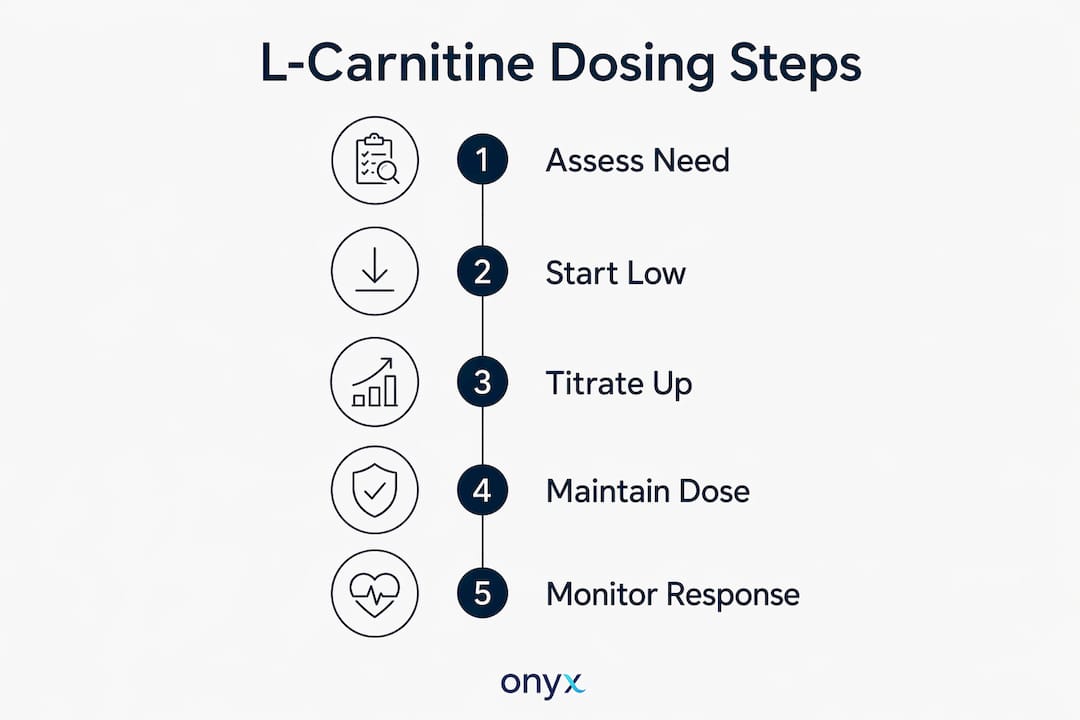
The NIH Office of Dietary Supplements sets 2 g/day as the generally safe threshold for healthy adults. Doses of 3 g/day or more are associated with a meaningful increase in GI side effects and the fishy body odor caused by gut microbial conversion of excess carnitine to trimethylamine.
Study dose examples by indication:
- Primary deficiency (adults): 990 mg orally two to three times daily; individualized by plasma levels
- Cardiac trials: Typically 1–3 g/day, often as propionyl-L-carnitine
- Athletic performance trials: 2–4 g/day with 80–94 g carbohydrate co-ingestion, over 12–24 weeks
- Cognitive trials (ALCAR): 1.5–3 g/day over 3–6 months
- Weight/metabolic trials: 1–2 g/day over 8–24 weeks
Timeline reality check: Raising skeletal muscle carnitine content requires at least 12 weeks of consistent dosing, and many studies use 24-week protocols. Biochemical changes in plasma carnitine appear faster, but plasma levels do not reflect muscle stores. If you are supplementing for exercise performance, plan for a 3–6 month commitment before drawing conclusions.
Key figure: Muscle carnitine increases typically require several months of sustained supplementation with carbohydrate co-ingestion. Short-term use is unlikely to produce measurable changes in muscle carnitine content.
Pro Tip: Start at the lower end of the dose range (0.5–1 g/day) and titrate up slowly. Watch for GI symptoms and the fishy odor signal at higher doses. If you have any history of kidney disease or seizures, discuss dosing and monitoring with your clinician before starting.
Side effects and safety: what you need to know
The most common side effects of L-carnitine supplementation are gastrointestinal: nausea, vomiting, stomach cramps, and diarrhea. These are dose-related and most likely to appear at 3 g/day or above. A distinct fishy body odor is another dose-related effect caused by gut bacteria converting excess carnitine to trimethylamine.
For most healthy adults staying at or below 2 g/day, the side effect profile is mild. The picture changes for specific populations.
Special precautions:
- Chronic kidney disease: The kidneys are the primary route for carnitine excretion and reabsorption. Impaired renal function disrupts carnitine homeostasis and can lead to accumulation of metabolites. Medical supervision is required.
- Seizure disorders: L-carnitine supplementation has been associated with increased seizure frequency in some people with pre-existing seizure disorders. This is not a theoretical risk; it warrants a direct conversation with a neurologist before use.
- Pregnancy and lactation: Safety data is insufficient to support routine supplementation. Levocarnitine is used in specific clinical situations during pregnancy under medical supervision, but OTC supplementation is not recommended without guidance.
- Premature infants: Carnitine status in preterm infants requires clinical monitoring; parenteral levocarnitine is used in specific neonatal indications.
- Dialysis patients: Patients on hemodialysis lose carnitine during each session. Intravenous levocarnitine is a prescription option for this population, managed by nephrology.
TMAO signal: Prolonged supplementation raises fasting plasma TMAO in some studies. The cardiovascular implications remain under active investigation, but it is a reason to avoid high-dose, indefinite supplementation without clinical justification.
The NIH ODS safety guidance is clear: L-carnitine is not recommended for people with these conditions without medical supervision, and even in healthy adults, more is not better.
Drug and supplement interactions to discuss with your clinician
L-carnitine has several clinically relevant interactions that are easy to overlook when buying an OTC supplement.
Key interactions:
- Anticoagulants (warfarin): L-carnitine may enhance the anticoagulant effect of warfarin, potentially increasing bleeding risk. Anyone on warfarin should have INR monitored if starting or stopping carnitine.
- Thyroid medications (levothyroxine): L-carnitine has been shown to inhibit thyroid hormone action in some tissues. This can be a concern for people with hypothyroidism taking thyroid replacement therapy, as carnitine may reduce the effectiveness of their medication.
- Seizure-threshold-lowering drugs: Given carnitine’s association with increased seizure activity in susceptible individuals, combining it with medications that already lower the seizure threshold warrants careful review.
- Renally-excreted drugs: Because carnitine competes for renal transport mechanisms, it can theoretically affect the clearance of other renally-excreted compounds. Your pharmacist can flag specific combinations.
- Multi-ingredient sport and weight-loss supplements: Many products combine L-carnitine with stimulants (caffeine, synephrine), diuretics, or other compounds that have their own interaction profiles. The carnitine dose may be listed, but the full formula may not be.
Pro Tip: Before combining L-carnitine with any prescription medication, run the combination through an evidence-based drug interaction checker like Drugs.com Interaction Checker or Lexicomp, and bring the product label to your next appointment. Your pharmacist is often the fastest resource for this.
Who actually has a carnitine deficiency?
Primary systemic carnitine deficiency is rare. It results from mutations in the OCTN2 transporter gene, which impairs carnitine uptake into cells and leads to excessive urinary carnitine loss. This is a genetic condition, not something that develops from a low-meat diet or heavy exercise.
Causes of carnitine deficiency:
- Primary (genetic): OCTN2 transporter mutations; autosomal recessive inheritance
- Inborn errors of metabolism: Certain organic acidemias and fatty acid oxidation disorders cause secondary carnitine depletion
- Renal loss: Fanconi syndrome and other renal tubular disorders impair carnitine reabsorption
- Prematurity: Preterm infants have limited endogenous synthesis capacity
- Long-term parenteral nutrition: Without dietary carnitine intake, stores can deplete
- Certain medications: Valproic acid and some antibiotics (pivampicillin) can deplete carnitine over time
Clinical presentation varies by age. In infants, the classic picture is hypoketotic hypoglycemia, often triggered by fasting. In older children and adults, cardiomyopathy, skeletal muscle weakness, and fatigue are more common presentations.
Diagnostic thresholds and evaluation:
| Measure | Threshold for Deficiency | Clinical Context |
|---|---|---|
| Plasma free carnitine | ≤20 µmol/L | Primary diagnostic marker |
| Plasma total carnitine | — | Includes acylcarnitines |
| Urine carnitine excretion | Elevated in primary deficiency | Reflects renal transport failure |
| Acylcarnitine profile | Abnormal pattern | Guides differential diagnosis |
Diagnosis requires plasma carnitine measurement in the appropriate clinical context, not a trial of supplementation. If deficiency is suspected, referral to a metabolic genetics specialist, nephrologist, or cardiologist is appropriate depending on the presentation. Levocarnitine replacement is the established treatment and is highly effective when started promptly.
How to choose a supplement format and what quality signals to look for
Dissolvable oral strips and liquids generally offer faster absorption than tablets or capsules because they bypass the need for tablet disintegration and can begin absorbing through the oral mucosa or upper GI tract more quickly. This matters less for carnitine than for some nutrients, since the bioavailability ceiling is set by intestinal transporters regardless of format, but convenience and dose consistency are real practical advantages.
Format comparison:
| Format | Absorption Speed | Dose Accuracy | Convenience | Notes |
|---|---|---|---|---|
| Dissolvable oral strips | Fast | High (pre-dosed) | High | No water needed; good for travel |
| Liquid (l carnitine liquid) | Fast | Variable (measured) | Moderate | Easy to titrate dose |
| Capsules/tablets | Moderate | High (pre-dosed) | High | Most common OTC form |
| Prescription oral levocarnitine | Moderate | Pharmaceutical-grade | Moderate | For clinical deficiency |
| Parenteral (IV) levocarnitine | Immediate | Exact | Low (clinical setting only) | Dialysis and severe deficiency |
Product quality signals to look for:
- Label specifies L-carnitine (not just “carnitine”)
- Dose per serving is clearly stated in milligrams
- Third-party testing certification (NSF, USP, Informed Sport)
- Certificate of analysis available on request
- No proprietary blends that obscure the actual carnitine dose
- No D-carnitine listed as an ingredient
For readers who prefer fast-absorption strip formats for other supported nutrients, Onyxwellness offers several dissolvable strip options worth knowing about. The Sleep Strips and Digestive + Gut Health Strips are good examples of the format’s convenience advantages: pre-dosed, sugar-free, and no water required. The Hangover Strips demonstrate the same fast-delivery format for recovery support. These are format examples for supported nutrients; they are not clinical carnitine replacement products.
When prescription levocarnitine is appropriate, such as for documented primary deficiency, dialysis-related depletion, or certain secondary deficiencies, OTC supplements are not a substitute. That distinction matters.
Pro Tip: Take your L-carnitine supplement with a carbohydrate-containing meal or drink. Insulin stimulates the OCTN2 transporter in muscle, improving carnitine uptake. This is one of the few evidence-backed ways to improve the notoriously low muscle uptake from oral supplementation. For more on quick-absorption formats, the Onyxwellness guide covers the trade-offs clearly.
Key Takeaways
L-carnitine is a targeted therapeutic for documented deficiency and a possible adjunct in select clinical conditions, not a general-purpose fat-loss or performance supplement for healthy adults.
| Point | Details |
|---|---|
| Safe dosing threshold | Up to 2 g/day is generally safe for healthy adults; 3 g/day or more increases GI side effects and fishy odor risk. |
| Muscle uptake takes time | Raising skeletal muscle carnitine requires at least 12 weeks of consistent dosing with carbohydrate co-ingestion. |
| Evidence is condition-specific | Effective for primary deficiency; possibly effective for cardiac and cognitive uses; insufficient for weight loss in most healthy adults. |
| TMAO risk with prolonged use | Prolonged supplementation can raise fasting plasma TMAO; clinical cardiovascular significance remains uncertain. |
| Onyxwellness strip formats | Onyxwellness dissolvable strips offer fast-absorption delivery for supported nutrients; consult a clinician for clinical carnitine replacement needs. |
The case for treating L-carnitine as a precision tool, not a general supplement
The supplement industry has done L-carnitine a disservice by marketing it as a fat-burning staple for anyone trying to lose weight or improve gym performance. The actual evidence tells a more specific story, and that specificity is worth respecting.
What gets underestimated is how tightly the body regulates carnitine. The homeostatic mechanisms are so effective that most healthy people, even vegans with lower dietary intake, maintain adequate plasma levels through synthesis alone. Supplementing on top of that is not inherently harmful at reasonable doses, but it is also not doing much for most people. The body simply excretes the excess.
Where L-carnitine genuinely earns its place is in documented deficiency, certain cardiac conditions as an adjunct to standard care, and possibly in cognitive support using the acetyl form. For athletic performance, the evidence is real but conditional: you need prolonged use, carbohydrate co-ingestion, and realistic expectations about the timeline. Pairing carnitine with a broader natural recovery supplement strategy makes more sense than relying on it alone.
The TMAO question is the one I think deserves more attention in consumer conversations. Most supplement guides either ignore it or bury it in a footnote. The reality is that prolonged, high-dose carnitine supplementation raises a cardiovascular marker whose long-term significance we do not fully understand yet. That is not a reason to panic, but it is a reason to avoid treating carnitine like a harmless daily vitamin you can take indefinitely without clinical justification.
The practical takeaway: prioritize whole-food carnitine sources, reserve supplementation for documented need or specific clinical goals, choose products with clear L-isomer labeling and third-party testing, and plan for a 3–6 month commitment if you are supplementing for muscle-level effects. Fast-absorption formats like dissolvable strips can improve convenience and consistency, which matters when you are committing to a prolonged protocol.
Onyxwellness strips for fast-absorption wellness support
If you have read this far, you already know that delivery format and consistency matter more than most supplement labels admit. Onyxwellness was built around exactly that insight: fast-absorbing, sugar-free dissolvable strips that fit a real daily routine without the pill fatigue.

The Onyxwellness strip lineup covers sleep support, gut health, hangover recovery, and more, all in the same pre-dosed, no-water format that removes the friction from staying consistent. For readers who want to support their wellness routine with convenient, Ayurvedic-inspired formulas, the Digestive + Gut Health Strips are a natural fit alongside any gut-conscious supplement protocol. The Sleep Strips bring the same fast-delivery format to recovery and rest support.
For clinical carnitine replacement, work with your clinician. For the rest of your wellness stack, browse the full Onyxwellness collection and find the formats that actually fit your life.
FAQ
What happens if you take L-carnitine every day?
Daily supplementation at 2 g/day or less is generally well tolerated in healthy adults, with mild GI effects possible. Prolonged daily use can raise fasting plasma TMAO in some people, so long-term high-dose use warrants medical oversight.
Will L-carnitine reduce belly fat?
The evidence does not support L-carnitine as a meaningful fat-loss agent for healthy adults. Some trials show modest body composition changes in specific populations, but it is not a primary weight-loss therapy and should not replace lifestyle interventions.
Who should not take L-carnitine?
People with chronic kidney disease, seizure disorders, or those taking warfarin or thyroid medications should not take L-carnitine without medical supervision. Pregnant and breastfeeding individuals should also consult a clinician before use.
Can L-carnitine help with weight loss?
L-carnitine plays a role in fat metabolism, but the clinical evidence for meaningful weight loss in healthy adults is mixed and generally weak. It works best as part of a broader, evidence-based approach; for context on what actually supports weight management, the weight loss supplement guide at Onyxwellness covers the realistic options.
Authoritative sources
The claims in this article draw from the following primary and peer-reviewed sources. Consulting them directly, alongside your clinician, is the best way to verify details for your specific situation.
- NIH Office of Dietary Supplements — Carnitine Health Professional Fact Sheet: The most comprehensive U.S. government summary of carnitine physiology, clinical indications, dosing, safety, and drug interactions.
- Linus Pauling Institute — L-Carnitine: Detailed coverage of metabolism, bioavailability, tissue distribution, and evidence by indication; regularly updated.
- PMC — The bright and dark sides of L-carnitine supplementation (systematic review): Systematic review covering athletic performance, prolonged supplementation effects, and TMAO concerns.
- PubChem CID 10917 — L-Carnitine: Chemical and pharmacological data including bioavailability figures and isomer toxicity.
- PMC — L-carnitine: Nutrition, pathology, and health benefits: Broad review of carnitine’s nutritional role, pathological states, and therapeutic applications.
For product options in fast-absorption strip formats, visit Onyxwellness.