


Oral hyaluronic acid supplements can modestly improve skin hydration and texture within 2 to 12 weeks, backed by moderate-quality randomized trials. Evidence for joint pain relief is far weaker and shouldn’t replace medical treatment for real osteoarthritis. They’re generally well tolerated, but the FDA hasn’t reviewed them for safety or effectiveness the way it does drugs, so talk to your doctor before adding one to your routine.
TL;DR:
- Oral hyaluronic acid supplements at doses of 100 to 200 mg daily can improve skin hydration within 2 to 8 weeks, especially in those with drier or older skin.
- Evidence for joint pain relief is weak, with no large-scale studies supporting oral HA as an effective treatment for osteoarthritis compared to intra-articular injections.
- Molecular weight plays a crucial role in absorption, but many products do not disclose this detail, limiting your ability to evaluate their potential effectiveness.
- Oral HA is well tolerated, but long-term safety data is limited, so pauses after 8 to 12 weeks of use are advisable if no benefits are observed.
- Choose products with transparent labeling, third-party testing, and dosages matching clinical trials, and always consult a healthcare professional before starting or continuing supplementation.
Table of Contents
- What Are Hyaluronic Acid Supplements, Really?
- How Oral Hyaluronic Acid Is Supposed to Work in Your Body
- What Clinical Trials Actually Found for Skin and Joints
- What to Realistically Expect for Your Skin
- Can Hyaluronic Acid Help Your Joints, or Not?
- Side Effects, Interactions, and What “Not FDA-Approved” Actually Means
- How to Choose a Product and Set Realistic Doses
- Where Onyx Wellness Fits Into This Picture
- What Happens if You Take Hyaluronic Acid Long Term?
- The Real Takeaway on Oral Hyaluronic Acid
- Try Onyx Wellness Strips for Skin and Joint Support
- Sources
- FAQ
What Are Hyaluronic Acid Supplements, Really?
Hyaluronic acid is a glycosaminoglycan your body already makes. It sits in your skin, joints, and connective tissue, where it holds onto water and keeps tissue cushioned and pliable. On supplement labels, you’ll see it listed under a few different names: hyaluronan, sodium hyaluronate, or hydrolyzed hyaluronic acid. They’re variations on the same molecule, processed differently for absorption.
Supplement companies package hyaluronic acid several ways:
- Capsules or softgels — the most common oral format, often dosed in amounts tested in clinical trials.
- Powders — mixed into water or smoothies, sometimes marketed for higher bioavailability.
- Unit-dose drinks or nutricosmetic blends — frequently combined with collagen, vitamin C, or biotin for a “beauty from within” pitch.
Here’s where a lot of shoppers get confused: oral, topical, and injectable hyaluronic acid are not interchangeable. Topical HA sits on the skin’s surface and pulls in moisture there, which is why it shows up in nearly every moisturizer. Injectable HA (dermal fillers or joint injections) delivers a concentrated dose directly where it’s needed, producing an immediate, localized effect. Oral HA works through your digestive system and bloodstream, a slower, systemic route that produces smaller, gradual changes rather than instant results. If you’re expecting filler-level plumping from a pill, you’re going to be disappointed.
How Oral Hyaluronic Acid Is Supposed to Work in Your Body
The proposed mechanism hinges almost entirely on molecular weight. Hyaluronic acid molecules come in different sizes, and size determines how they behave once they hit your gut. A comprehensive review of HA formulations found that molecular weight affects both absorption and downstream function, which is part of why study results are so inconsistent across brands.
- Low molecular weight (LMW) HA breaks into smaller fragments that appear to cross the intestinal lining more readily.
- High molecular weight (HMW) HA is thought to interact with gut receptors and possibly influence tissue hydration indirectly, though the pathway is less understood.
- Once absorbed, HA fragments are theorized to circulate and support hydration in skin tissue, though the exact route from gut to dermis is still being mapped out by researchers.
That gut-to-skin theory is plausible but not fully proven. It’s also why oral HA can’t do what an injection does. A joint injection places concentrated HA exactly where cartilage has worn down. A capsule has to survive digestion, get absorbed, and travel through your bloodstream before it reaches the same tissue, in a far more diluted form.
Pro Tip: If a product doesn’t list its molecular weight anywhere on the label, you have no way of knowing which mechanism it’s even relying on. That’s worth factoring into which brand you trust.
What Clinical Trials Actually Found for Skin and Joints
The strongest data point comes from a randomized double-blind trial with 129 participants, which found that 100 to 200 mg of oral HA per day significantly increased skin hydration within weeks, with epidermal thickness increasing by 12 weeks. That’s a real, measurable outcome, not just a marketing claim. It’s also one of the better-designed studies in this space, which matters given how much of the supplement industry runs on thin evidence.
What the numbers show: In that trial, hydration improvements appeared as early as 2 weeks in some participants, with more pronounced skin changes by the 8 to 12 week mark, at daily doses of 100 to 200 mg.
A separate Japanese randomized, double-blind, controlled study using HA at molecular weights of 800 kDa and 300 kDa reported improved skin moisture and better dermatologist-assessed dryness scores compared to placebo, with no significant adverse effects. Two different trials, two different formulations, similar direction of effect. That’s a reasonably encouraging pattern for skin.
Joint evidence is a different story. Medical society resources, including patient guidance from the American College of Rheumatology, treat intra-articular HA injections as a distinct clinical tool for joint pain, not something oral supplementation replicates. There’s no equivalent large-scale RCT showing oral HA meaningfully reduces joint pain the way injections can for appropriate candidates.
When you’re sizing up any hyaluronic acid trial, a few things separate solid evidence from marketing fluff:
- Sample size — a 129-person trial carries more weight than a 20-person pilot study.
- Placebo response — skin hydration studies often show some improvement in the placebo group too, so the real effect is the gap between groups.
- Measurement tool — trials using objective instruments like a Corneometer (which measures skin moisture) are more reliable than ones relying purely on self-reported “skin felt better.”
- Funding source — many HA trials are sponsored by ingredient manufacturers, which doesn’t invalidate the data but is worth knowing.
What to Realistically Expect for Your Skin
If you’re taking hyaluronic acid supplements specifically for skin, the timeline and effect size matter more than the marketing copy. Trial data suggests measurable hydration changes can show up within 2 to 8 weeks, with some studies reporting continued improvement in skin tone and epidermal thickness through 12 weeks of consistent use.
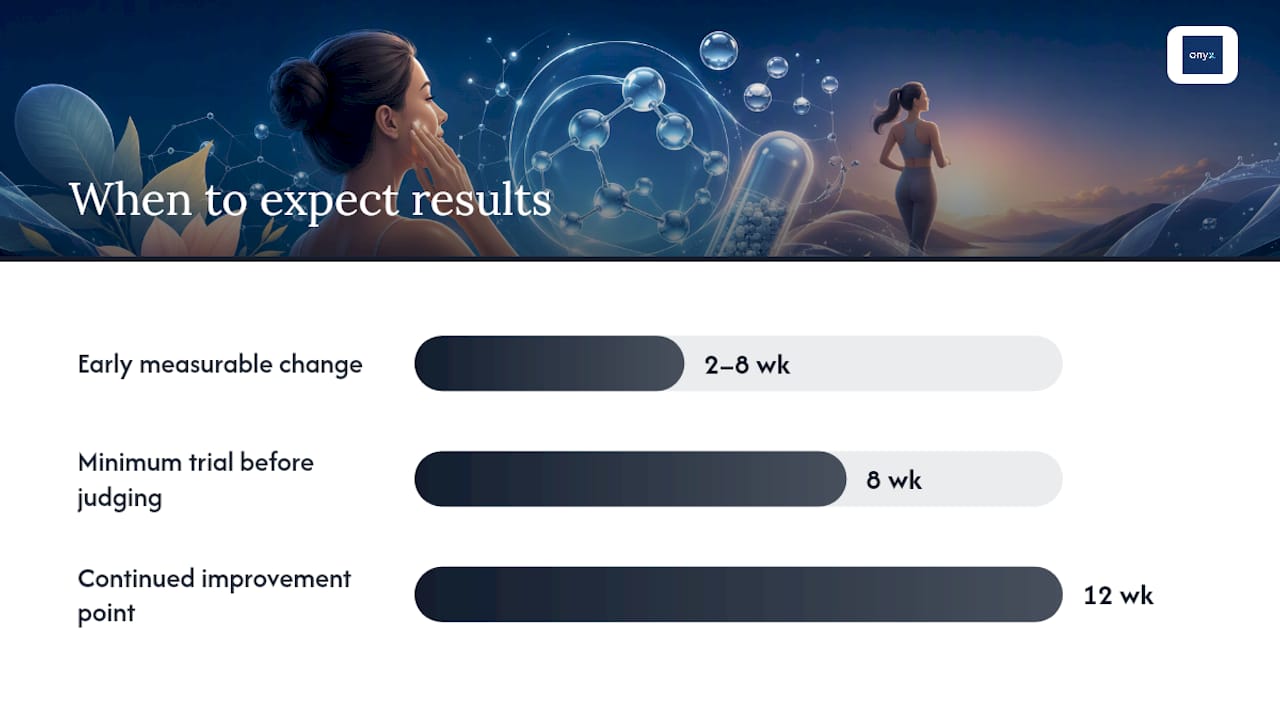
Not everyone responds equally. People who start with drier skin, and older adults in several trials, tended to show clearer, more noticeable hydration gains than participants with already well-hydrated skin. That tracks with basic physiology: there’s more room for measurable improvement when you’re starting from a drier baseline.
The most sensible approach pairs oral HA with a topical routine rather than treating it as a replacement. Since topical humectants work by holding moisture at the skin’s surface, combining that surface-level hydration with the slower, systemic effect of oral HA covers two different mechanisms at once. A broader look at nutricosmetics explains why this layered approach tends to outperform relying on any single product.
- Take oral HA consistently for at least 8 weeks before judging results.
- Keep using a topical moisturizer or serum alongside it.
- Track hydration with photos or a simple touch test rather than relying on memory.
Can Hyaluronic Acid Help Your Joints, or Not?
Here’s the honest answer: the evidence is thin and mixed. Some smaller trials report modest relief for mild to moderate knee discomfort with daily oral HA, but nothing at the scale or consistency of the skin hydration data. Oral HA has not been established as a primary treatment for diagnosed osteoarthritis, and no major medical society recommends it as a substitute for proven interventions.
Guidance from bodies like the American College of Rheumatology generally prioritizes a different set of tools for joint disease: weight management, targeted exercise, physical therapy, NSAIDs when appropriate, and intra-articular HA injections for select cases where a physician determines they’re warranted. Those interventions have a much deeper evidence base behind them than a daily capsule.
That doesn’t mean oral HA is worthless for joint comfort. It just means you should treat it as a low-risk adjunct, not a plan. If your knee pain is getting worse, waking you up at night, or limiting how you move day to day, that’s a signal to see a clinician rather than wait out a supplement trial. Progressive or debilitating symptoms deserve a real diagnosis, not another month of guessing.
Side Effects, Interactions, and What “Not FDA-Approved” Actually Means
Across clinical studies, oral hyaluronic acid has a good safety record. Cleveland Clinic’s overview of HA describes it as generally well tolerated, and serious adverse events in trials are rare. Mild issues like bloating or headache occasionally show up, and allergic reactions, while uncommon, are possible with any supplement ingredient.
Roughly speaking, the trials behind oral HA report a strong tolerability profile, with most reported issues being mild and non-serious rather than dose-limiting.
On interactions: there’s no well-documented list of drugs that clash with hyaluronic acid. That’s not the same as “guaranteed safe with everything.” It mostly means the research hasn’t specifically tested every combination, which is a gap, not a green light. Mention any supplement, HA included, to your healthcare provider, especially if you’re on prescription medication or managing a chronic condition.
The regulatory piece trips up a lot of people. In the United States, dietary supplements are regulated by the FDA differently than drugs. Manufacturers don’t need FDA approval proving safety or effectiveness before selling an HA supplement; they’re responsible for that themselves. That’s why label transparency matters so much:
- Look for third-party testing seals, like USP or NSF, on the bottle.
- Check that the label states an exact milligram dose per serving, not a vague “proprietary blend.”
- Avoid products stacking in unnecessary fillers or unlisted ingredients.
Pregnant or nursing readers, and anyone managing an autoimmune or chronic condition, should treat HA supplements the same as any other new supplement: a conversation with a doctor first, not an assumption of safety. If you want a deeper look at how supplement regulation works generally, this guide on evidence-based natural supplements walks through what “not FDA-approved” actually implies for consumers.
How to Choose a Product and Set Realistic Doses
Picking a decent hyaluronic acid supplement comes down to reading the label carefully, not trusting the packaging claims. Here’s a practical approach:
- Check the dose. Trial doses that showed real effects landed mostly in the 100 to 240 mg per day range. Anything wildly lower probably won’t match published results.
- Look for molecular weight disclosure. Few consumer brands list it, but products that do give you more confidence the formulation matches what was actually tested.
- Confirm third-party testing. A USP or NSF seal means an outside lab verified what’s on the label is what’s in the bottle.
- Scan for ingredient transparency. Skip anything hiding behind a “proprietary blend” with no specific amounts.
- Set a real timeline. Give it 4 to 12 weeks before deciding whether it’s working, and stop if you notice no benefit or any adverse reaction.
Comparing HA to something like collagen dosing is useful context here. Collagen dosage guidance follows a similar pattern: modest daily amounts, weeks of consistent use, and realistic expectations rather than overnight transformation.
Pro Tip: Take a baseline photo in consistent lighting before you start, and note how your skin feels first thing in the morning. Four weeks in, you’ll actually have something to compare against instead of relying on a fuzzy memory of “before.”
Where Onyx Wellness Fits Into This Picture
Onyxwellness builds its supplement line around Ayurvedic-inspired formulations, delivered through dissolvable strips designed for fast absorption without water or capsules to swallow. That format matters for anyone who has struggled to stay consistent with a daily pill routine, since consistency is exactly what the skin hydration trials depend on.
For readers whose goals touch both skin and joint support, a few categories align directly: Hair, Skin and Nails Strips target the same beauty-from-within space the nutricosmetic trials point toward, Bone Support Strips address the broader joint and skeletal side that oral HA alone doesn’t fully cover, and Probiotic + Metabolism Strips support the gut environment that absorption of any oral ingredient, HA included, depends on.
Systemic hydration and joint comfort rarely improve from one ingredient in isolation. A layered approach, addressing gut health, skin support, and skeletal support together, reflects how the body actually processes what you put into it.
[Author bio and credentials for Chris to be added]
What Happens if You Take Hyaluronic Acid Long Term?
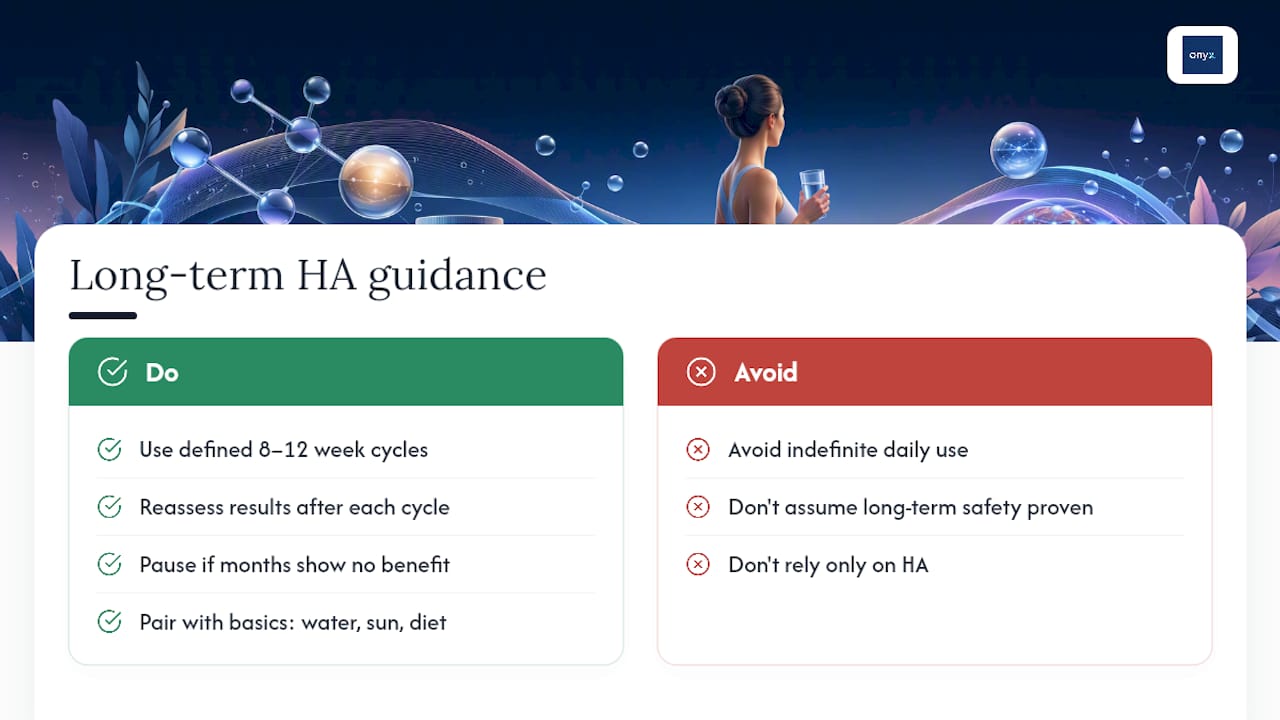
Most clinical trials on oral HA run somewhere between 8 and 12 weeks, which means long-term data, think years of continuous use, is genuinely thin. That’s worth sitting with before you commit to indefinite daily use.
What we do know: nothing in the current evidence suggests HA builds up harmfully in your system or causes cumulative toxicity. Your body already produces and breaks down hyaluronic acid constantly as part of normal tissue turnover, so there’s no obvious biological red flag with sustained intake. Tolerability data from shorter trials hasn’t flagged emerging risk patterns.
The honest gap is that nobody has run a five-year trial checking whether benefits plateau, whether your body adapts and reduces its own HA production in response, or whether any subtle effects only show up after extended use. That’s not a reason to panic, it’s a reason for moderation. If you’ve been taking an HA supplement for months with no noticeable benefit, it’s more efficient to pause than to keep dosing on faith.
A reasonable middle path: use HA in defined cycles, say 8 to 12 weeks, reassess visible or measurable results, and take a break rather than assuming more months automatically means more benefit. Pair it with basics that have decades of safety data behind them, adequate water intake, sun protection, a balanced diet, rather than treating any single supplement as the whole strategy. Long-term reliance on one ingredient rarely outperforms a routine built on fundamentals plus a smart supplement layered on top.
The Real Takeaway on Oral Hyaluronic Acid
The evidence here supports something more modest and more honest than most product pages let on. Oral HA has real, trial-backed support for skin hydration. The joint pain claims riding alongside it in marketing copy are borrowing credibility they haven’t earned yet.
Where conventional advice falls short is treating hyaluronic acid supplements as a single category with one universal benefit. Skin and joints respond to completely different mechanisms, at completely different evidence strengths, and lumping them together in a headline claim does readers a disservice. The dosage transparency issue matters more than most buying guides admit. A product that hides its molecular weight and exact milligram count is asking you to trust a mechanism it won’t even disclose.
If you’re prioritizing one thing first, prioritize the label over the promise. Confirm the dose matches what trials actually tested, give it a real 8 to 12 week window, and treat any joint-pain claim with real skepticism until you see your own results. Supplements can support a routine. They shouldn’t be mistaken for medical treatment when your joints are telling you something more serious is going on.
— Chris
Try Onyx Wellness Strips for Skin and Joint Support
Skipping capsules altogether has its appeal, especially if consistency has been your biggest obstacle with supplements. Onyxwellness solves that with dissolvable strips you take without water, built around Ayurvedic-inspired formulations rather than another generic capsule blend.
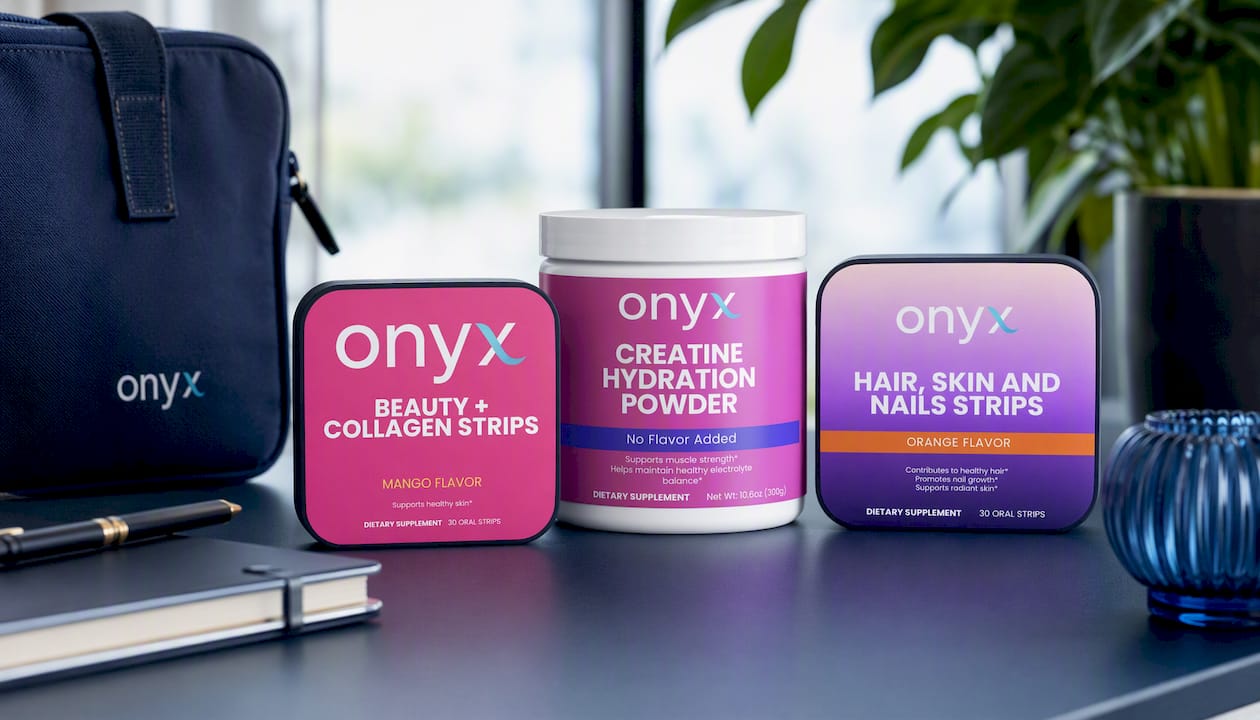
If skin hydration is your main goal, the Hair, Skin and Nails Strips target the same beauty-support space the clinical trials point toward. If joint and skeletal comfort matters more to you, the Bone Support Strips address that angle directly, while the Probiotic + Metabolism Strips support the gut absorption process that any oral supplement depends on. Many readers pair two or three strips into a simple daily stack rather than juggling separate bottles and capsules.
Browse the full Onyx Wellness collection to build a stack that matches your specific skin, joint, or recovery goals, and check the site for current first-order savings before you check out.
Sources
This article draws on a randomized double-blind clinical trial on oral HA and skin hydration, Cleveland Clinic’s hyaluronic acid overview, WebMD’s HA uses and side effects summary, American College of Rheumatology patient guidance, and FDA dietary supplement guidance.
This article is general information, not a substitute for advice from a qualified doctor. Consult a qualified healthcare professional about your own circumstances before acting on anything here.
- Hyaluronic Acid — Cleveland Clinic
- Hyaluronic acid — American College of Rheumatology (patient resources)
- Dietary supplements — U.S. Food and Drug Administration
FAQ
Is there any real benefit to taking hyaluronic acid supplements?
Yes, primarily for skin. Randomized trials show measurable improvements in skin hydration and, in some cases, epidermal thickness after 2 to 12 weeks of consistent use. Evidence for joint benefits is much weaker.
What are the side effects of taking hyaluronic acid orally?
Oral HA is generally well tolerated, with serious adverse events being rare in clinical trials. Mild issues like bloating or headache occasionally occur, and allergic reactions are possible, though uncommon.
Which foods are naturally high in hyaluronic acid?
Bone broth, organ meats, and soy-based foods are often cited as containing compounds that may support the body’s own HA production, though direct HA content in food is much lower and less concentrated than in supplement form.
Is it safe to take hyaluronic acid orally every day?
Clinical trials lasting 8 to 12 weeks have found daily oral HA generally safe and well tolerated, but long-term data beyond a few months is limited. Talk to your healthcare provider before committing to indefinite daily use, especially if you’re pregnant, nursing, or managing a chronic condition.