


TL;DR:
- Building holistic health habits involves integrating nutrition, movement, and mindfulness as a unified system for overall well-being. Starting with one small habit, anchoring it to existing routines, and respecting individual rhythms improves sustainability. Tracking patterns and allowing flexibility help sustain progress and prevent burnout.
Building holistic health habits is the process of developing consistent, natural practices that support your physical, mental, and emotional well-being by treating nutrition, movement, and mindfulness as one interconnected system rather than separate tasks. The National Institutes of Health recognizes this integrated approach as a foundation for lasting wellness. What separates people who succeed from those who quit after two weeks is not willpower. It is strategy. This guide gives you a practical, step-by-step framework for how to build holistic health habits that fit your real life, respect your body’s natural rhythms, and grow stronger over time.
What foundational elements do you need to start holistic health habits?
Nutrition, movement, and mindfulness form the core wellness triad. Each pillar reinforces the others, and neglecting one weakens the whole system. Think of them less like separate boxes to check and more like legs on a stool.

The NIH recommends at least 150 minutes of moderate-intensity physical activity per week. Breaking that into short daily segments makes the habit far easier to build than saving it all for the weekend. The same guidelines recommend 7–9 hours of sleep per night for adults. Sleep is not passive recovery. It is when your body consolidates habits, regulates hormones, and repairs tissue.
Mindful eating is the practice of slowing down, removing distractions, and paying attention to hunger and fullness cues. Research links this practice to improved gut-brain axis function and lower cortisol levels. That matters because chronic stress disrupts digestion, disrupts sleep, and makes every other wellness habit harder to sustain.
Nervous system regulation is the often-overlooked prerequisite. Calming practices like slow breathing or gentle movement restore your body’s capacity to recover. Without that foundation, adding more habits on top of a stressed system usually backfires.
| Pillar | Core Practice | Basic Recommendation |
|---|---|---|
| Movement | Moderate aerobic activity | 150 minutes per week, broken into daily segments |
| Sleep | Consistent sleep schedule | 7–9 hours nightly; screens off 30 minutes before bed |
| Nutrition | Mindful eating | Eat without distraction; prioritize whole foods |
| Mindfulness | Breathing or meditation | 5–10 minutes daily to regulate the nervous system |
| Recovery | Rest and stress management | Include at least one full rest day per week |
How do you develop and layer holistic health habits sustainably?
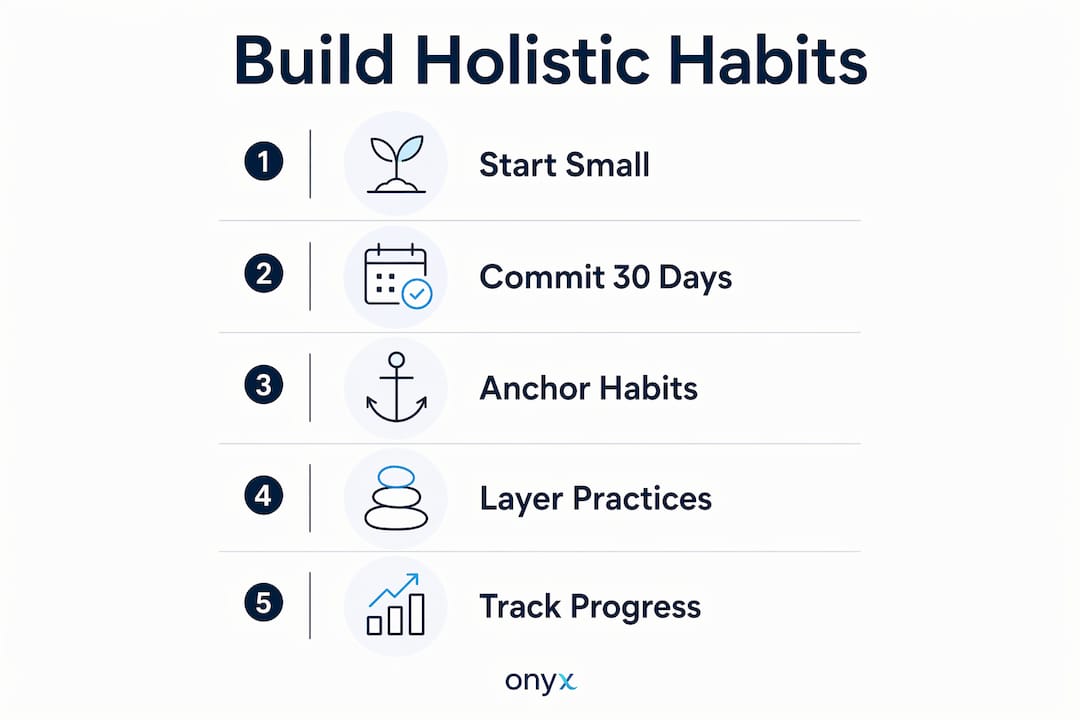
The most common mistake people make is trying to change everything at once. Developing wellness routines that last requires a different approach: start with one pillar, commit to one small daily practice, and give it 30 days before adding anything new.
Committing to one practice for 30 days before layering in more is the single most effective method for avoiding burnout. Your brain needs repetition to wire a new behavior into automatic territory. Adding too many habits at once floods your decision-making capacity and leads to abandoning everything.
Habit anchoring makes this process easier. Attaching a new habit to an existing daily behavior reduces the willpower required to start. Drinking a glass of water right after brushing your teeth is a classic example. The existing behavior becomes the trigger, and the new habit rides along for free.
Bioindividuality means your optimal routine looks different from anyone else’s. Forcing a 5 AM wake-up when your natural energy peaks at 9 AM creates friction that erodes consistency. Align your habits with when you actually feel alert and capable.
Here is a practical layering method you can follow:
- Pick one pillar. Choose nutrition, movement, or mindfulness based on where you feel the most friction in your current life.
- Choose one micro-habit. Make it small enough that skipping it would feel almost embarrassing. A 10-minute walk counts. Five minutes of journaling counts.
- Anchor it to an existing routine. Attach your new habit to something you already do every day without thinking.
- Track it for 30 days. Note how your energy, mood, and sleep respond. You are gathering data, not chasing perfection.
- Add one more habit after 30 days. Only after the first habit feels automatic should you layer in the next one.
Pro Tip: Track patterns over perfection. Noticing that your energy dips every Wednesday after skipping lunch is more useful than a perfect streak. That kind of self-observation is what lets you adjust your routine to fit your actual life.
For more ideas on building a sustainable approach, the evidence-based wellness routines guide from Onyxwellness is a solid next read.
What are common challenges when building holistic health habits?
Rigid, all-or-nothing goals are the leading cause of wellness plan failure. When a goal leaves no room for a bad day, one missed workout becomes a reason to quit entirely. That thinking pattern is the enemy of lasting change, not a sign that you lack discipline.
Stress states are another major barrier. When your nervous system is in a chronic fight-or-flight mode, your body prioritizes survival over growth. Trying to build complex new habits while running on empty is like trying to renovate a house during a flood. The timing is wrong, not the person.
Ignoring your natural rhythms creates the same problem. If you schedule a workout at a time when your body is naturally winding down, you will white-knuckle it for a few days and then stop. Habits that clash with your biology rarely survive contact with real life.
Here are practical solutions for the most common sticking points:
- Adapt your schedule, not your standards. If your evening workout keeps getting skipped, try a 15-minute morning walk instead. The goal is movement, not a specific time slot.
- Forgive setbacks without ceremony. Missing one day does not erase progress. Return to the habit the next day without a guilt spiral.
- Focus on curiosity, not judgment. Ask “What made this hard today?” instead of “Why did I fail again?” That shift in framing keeps you engaged rather than defeated.
- Respect your body’s signals. Fatigue, irritability, and poor sleep are data points. They tell you to scale back, not push harder.
Pro Tip: When stress spikes and your routine falls apart, reset with a two-minute breathing exercise before anything else. Calming the nervous system first creates the internal conditions where habits can actually take root.
If you want a practical framework for recovery days built into your routine, the Ayurvedic recovery strategies guide from Onyxwellness covers this well.
What tools and tracking methods support holistic habit building?
Tracking does not mean obsessing over data. It means creating a feedback loop between your habits and your results so you can make smart adjustments. The right tool is the one you will actually use consistently.
Journaling is the most flexible option. A simple notebook where you record what you did, how you felt, and what you noticed costs nothing and requires no setup. It builds self-awareness faster than any app because writing forces you to process, not just log. Wellness journals with structured prompts work well for people who find blank pages intimidating.
Habit tracking apps provide visual streaks and reminders, which help during the early weeks when a habit is not yet automatic. Simple paper checklists work just as well for people who prefer low-tech solutions. The format matters less than the consistency of use.
| Tracking Method | Best For | Ease of Use | Key Benefit |
|---|---|---|---|
| Paper journal | Reflection and pattern spotting | Very easy | Builds self-awareness |
| Habit tracking app | Visual motivation and reminders | Easy | Streak accountability |
| Wellness journal with prompts | Structured self-assessment | Easy | Guided daily check-ins |
| Simple checklist | Minimalists and busy schedules | Very easy | Fast daily review |
The goal of any tracking method is to notice how your energy, mood, and sleep respond to your habits. That insight tells you which habits are working, which need adjusting, and when you are ready to add the next layer. Observing personal responses over time is what separates people who build lasting routines from those who cycle through resets every few months.
Onyxwellness products fit naturally into a tracking practice. Noting how your sleep quality changes after using Sleep Strips or how your digestion responds to Digestive + Gut Health Strips gives you concrete data points to work with. For a broader look at integrating supplements into your routine, the herbal supplement routine guide from Onyxwellness is worth bookmarking.
You can also find additional guidance on building healthy habits naturally through Dietium’s resource on sustainable wellness practices.
How do nutrition, movement, and mindfulness work together?
These three pillars do not just coexist. They reinforce each other biologically through mechanisms like the gut-brain axis and cortisol regulation. Understanding that connection changes how you approach each habit.
A balanced meal stabilizes blood sugar, which directly affects mood and motivation. When your mood is stable, you are more likely to follow through on a planned workout. That workout then reduces cortisol, which improves sleep quality. Better sleep sharpens your food choices the next day. The cycle feeds itself in either direction. Build it well and it becomes self-sustaining. Let it break down and the collapse tends to be total.
Mindfulness practices accelerate recovery from exercise by reducing the physiological stress response. A five-minute breathing session after a workout lowers heart rate faster and signals to your nervous system that the threat is over. That recovery window is where adaptation happens. Skipping it means your body stays in a mild stress state longer than necessary.
The practical takeaway is that you do not need to perfect all three pillars simultaneously. Improving one creates conditions that make the other two easier. Start with sleep if everything else feels impossible. Better sleep improves food choices and makes movement feel less like a chore. That is the scenic path, and it works. For a deeper look at how Ayurvedic principles connect these pillars, the Ayurveda-inspired vitality tips from Onyxwellness offer a practical framework.
Key Takeaways
Building lasting wellness habits requires starting small, anchoring new practices to existing routines, and respecting your body’s individual rhythms before adding complexity.
| Point | Details |
|---|---|
| Start with one pillar | Commit to one small daily habit for 30 days before adding anything new. |
| Use habit anchoring | Attach new habits to existing behaviors to reduce willpower demands. |
| Respect bioindividuality | Align your routine with your natural energy peaks, not generic schedules. |
| Track patterns, not perfection | Observe how energy, mood, and sleep respond to guide smart adjustments. |
| Regulate first, build second | Calm your nervous system before layering in complex new habits. |
What I have learned from years of watching people build wellness routines
Most people who struggle with habits for holistic living are not lazy or undisciplined. They are trying to run before they can walk, and they are doing it while already exhausted. The advice to “just be consistent” misses the point entirely. Consistency is the result of a well-designed system, not a character trait you either have or do not.
The single most underrated piece of this puzzle is bioindividuality. I have seen people abandon perfectly sound wellness plans because the plan was built for someone else’s body clock, stress level, and lifestyle. When you stop forcing a template and start listening to your own signals, the whole thing gets easier. Not easy, but easier.
Embracing imperfection is not a soft consolation prize. It is a practical strategy. The person who misses Monday and returns Tuesday will always outperform the person who misses Monday and waits until next month to restart. Wellness is not a destination you reach. It is a practice you return to, again and again, with a little more skill each time.
— Chris
How Onyxwellness products fit into your wellness routine
Building a consistent wellness routine is easier when your tools work as hard as you do. Onyxwellness offers Ayurvedic-inspired products designed to support the habits you are already building.

The Sleep Strips are a natural fit for anyone working on sleep hygiene. They dissolve quickly without water, making them simple to use as part of a screen-free wind-down routine. For those focusing on nutrition habits, the Digestive + Gut Health Strips support nutrient absorption and gut comfort, two factors that directly affect energy and mood. Both products are sugar-free and built for modern schedules. Browse the full vitamins and supplements collection to find what fits your current routine.
FAQ
What does “holistic health habits” actually mean?
Holistic health habits are daily practices that address your physical, mental, and emotional well-being together rather than in isolation. Nutrition, movement, and mindfulness are the three core pillars of this approach.
How long does it take to build a new health habit?
Committing to one small practice for 30 days is the recommended starting point before adding more habits. The timeline varies by person, but consistency over perfection is the key driver of success.
What is habit anchoring and why does it work?
Habit anchoring means attaching a new behavior to an existing daily routine, like drinking water after brushing your teeth. It reduces the willpower needed to start and makes the new habit easier to remember.
Why do most wellness routines fail?
Overly rigid goals and all-or-nothing thinking are the most common causes. When one missed day feels like total failure, most people stop rather than restart.
How do I know which wellness habit to start with first?
Start with the pillar that causes you the most friction right now. If sleep is poor, prioritize sleep hygiene. If stress is high, begin with a five-minute breathing practice. Fixing the weakest link first creates momentum across all three pillars.