


A short set of evidence-backed habits, timed around your body’s own ultradian rhythm, can restore steady attention without a single cup of coffee. Six moves matter most: fix your sleep window, get morning light and water immediately, eat a protein-rich breakfast, schedule movement between 90-minute work blocks, use a breathing reset when focus dips, and try L-theanine for a quieter, non-jittery lift. Try these today:
- Wake at the same time every day, even weekends, to anchor your circadian clock.
- Get outside within 30 minutes of waking and drink a glass of water before anything else.
- Eat protein and fat first, not carbs alone, to avoid a mid-morning crash.
- Work in 90-minute blocks with a 10-minute movement break after each.
- Try a 30-second stimulating breath pattern when attention drifts.
- Take 100 to 200 mg of L-theanine before a demanding task if you want extra support.
Key Takeaways
Sustained focus without caffeine comes from stacking sleep timing, morning light, steady nutrition, movement breaks, and one well-tested nonstimulant supplement like L-theanine.
| Point | Details |
|---|---|
| Sleep and light come first | Fix your wake time and get outdoor light within 30 minutes of waking for the biggest alertness gains. |
| Protein stabilizes energy | Eating protein and fat at breakfast prevents the blood sugar dips behind most afternoon crashes. |
| Movement beats scrolling | Active microbreaks between 90-minute focus blocks restore attention faster than passive rest. |
| L-theanine has real RCT support | A 200 mg dose improved reaction time and attention in a 31-trial meta-analysis, with quieter effects than caffeine. |
| Onyx Wellness offers a convenient format | Mushroom Focus and Cognitive Focus strips dissolve without water, fitting easily into a two-week supplement trial. |
Table of Contents
- Why Caffeine Helps Focus (and What to Support Instead)
- What Should You Eat and Drink to Stay Sharp All Day?
- How Does Sleep Quality Affect Daytime Focus?
- What Movement and Break Habits Restore Focus Fastest?
- Can Your Workspace Make You More Alert Without Caffeine?
- What Are the Best Caffeine-Free Drinks for Energy?
- Which Supplements Actually Support Focus Without Stimulants?
- What Can People With ADHD Use Instead of Caffeine?
- What Does a Full Day Without Caffeine Look Like?
- Stress Management Beyond Mindfulness
- Does Cutting Screen Time Improve Sustained Attention?
- A Layered Approach Beats Quick Fixes
- A Convenient Way to Add Nonstimulant Support
- Sources
- FAQ
Why Caffeine Helps Focus (and What to Support Instead)
Caffeine works by blocking adenosine, the molecule that builds up in your brain and makes you feel drowsy. It doesn’t create energy. It masks fatigue signals your body is already sending, which is why the crash hits once the blockade wears off. Replacing that trick means supporting three systems directly: circadian light cues that regulate alertness hormones, stable blood sugar so your brain isn’t running on fumes, and your natural ultradian rhythm, the 90 to 120 minute cycles of high and low alertness your brain moves through all day.
Pro Tip: If your whole focus routine has been “make coffee, sit down, start working,” that ritual is doing real psychological work, not just chemical. Replace it with something equally repeatable, like filling a water bottle and doing two minutes of stretching before you open your laptop.
- Adenosine blockade explains caffeine’s alertness effect, not any added energy.
- Morning light exposure resets your circadian clock and delays evening melatonin release.
- Ultradian cycles mean forcing focus past 90 minutes usually backfires.
What Should You Eat and Drink to Stay Sharp All Day?
Start the day with protein and healthy fats, not a bagel or cereal bowl. A steady blood sugar curve is the difference between sharp focus at 10 a.m. and a foggy slump by 11. Eggs with avocado, Greek yogurt with nuts, or a protein smoothie all outperform sugary breakfasts for sustained attention.
Hydration timing matters as much as the meal. Drink most of your water in the morning and early afternoon, sip steadily during focus blocks, and add electrolytes if you’ve been sweating heavily. OSF Healthcare lists hydration and protein-forward meals among the most accessible ways to reduce dependence on caffeine for energy.
Good snack pairings for the 2 p.m. slump:
- Apple slices with almond butter
- Hummus with raw vegetables
- A handful of walnuts and a hard-boiled egg
- Cottage cheese with berries
Pro Tip: Suspect your afternoon crash is blood sugar, not tiredness? Swap your usual lunch for a protein-and-vegetable plate with no refined carbs for two weeks and track how you feel at 2:30 p.m. Most people notice the difference by day four.
How Does Sleep Quality Affect Daytime Focus?
Consistent sleep timing and morning bright light are the two most powerful non-stimulant levers you have for daytime alertness. Neither costs money, and both outperform most supplements for restoring natural focus.
A simple sleep hygiene checklist:
- Fix your wake time, even on weekends
- Dim screens or switch to night mode two hours before bed
- Keep your bedroom cool and fully dark
- Skip alcohol and heavy meals within three hours of bedtime
Expect small improvements in alertness within 1 to 2 weeks of consistent timing. Deeper gains, like faster morning task initiation and fewer afternoon crashes, tend to show up after 4 or more weeks of steady practice. If you’re still exhausted despite good sleep hygiene, especially with loud snoring or morning headaches, that’s worth a conversation with a doctor rather than another lifestyle tweak.
What Movement and Break Habits Restore Focus Fastest?
Schedule focused work in 25 to 90 minute blocks, then take an active microbreak instead of scrolling your phone. WebMD lists movement and short breaks among the most reliable ways to feel awake without caffeine, and the mechanism is straightforward: movement increases blood flow to the brain, which supports the same alertness that caffeine chemically forces.
Microbreaks worth trying:
- A brisk 5-minute walk outside
- 60 to 90 seconds of dynamic stretching (leg swings, arm circles)
- A short breathing reset at your desk
Pro Tip: For an immediate alertness boost, try 30 seconds of fast, sharp nasal breathing, in for two counts, out for two, repeated for 15 cycles. It works fastest right before a demanding meeting or task, and pairs well with breaks timed just after meals, when blood flow naturally shifts toward digestion.
Can Your Workspace Make You More Alert Without Caffeine?
Bright, cool-toned light and a decluttered, single-task setup measurably improve sustained focus. Workplace studies tied to biophilic design, meaning natural elements like plants and window views, consistently link nature exposure to better perceived concentration.
- Get outdoor light exposure within the first hour of waking
- Set screens to cooler, brighter tones during work hours and warmer tones after dark
- Keep your workspace at a comfortable temperature since rooms that are too warm increase drowsiness
- Add one plant or position your desk near a window if possible
Pro Tip: Replace your coffee cue with a new “work start” signal, like filling a dedicated water bottle or lighting a specific desk scent. The ritual matters more than the substance.
What Are the Best Caffeine-Free Drinks for Energy?
Chicory coffee, herbal infusions, turmeric lattes, kombucha, and sparkling water with fruit all deliver ritual and mild functional benefits without the crash. GoodRx catalogs these as common swaps, but the evidence and caffeine content vary widely between products, so check labels for hidden sugar. Decaf coffee still carries small amounts of caffeine, and some herbal blends are marketed with more hype than clinical backing, a caution Harvard Health raises directly.
- Chicory coffee: roast and brew like regular coffee for a similar flavor, zero caffeine
- Turmeric latte: warm milk, turmeric, black pepper, and a pinch of cinnamon
- Kombucha: mild natural fizz, some contains trace caffeine from tea
- Caffeine-free chai: check flavor-forward blends if you miss the spice of a chai latte
- Matcha or yerba mate still carry real caffeine, so treat them as low-caffeine, not caffeine-free
Which Supplements Actually Support Focus Without Stimulants?
L-theanine, creatine, and select adaptogens like Rhodiola rosea and Bacopa monnieri carry the strongest evidence for steady, non-stimulant attention support. Their effects are quieter than caffeine and tend to build over weeks rather than deliver an immediate kick.
A 2026 meta-analysis published in Nature found that a single 200 mg dose of L-theanine significantly improved choice reaction time and attention in healthy adults across 31 randomized controlled trials, though effects on anxiety and fatigue were smaller and varied more between studies. SupplementScore’s nonstimulant stack guidance recommends L-theanine at 100 to 200 mg before a focus-demanding task and creatine at 3 to 5 grams daily for cognitive buffering. Bacopa monnieri typically needs 12 or more weeks of consistent use before benefits appear, so patience matters more than dose size.
Always start one new supplement at a time, check for interactions with any medication, and talk to a clinician before adding anything new, especially if you’re pregnant, nursing, or managing a health condition.
Pro Tip: Test any new supplement the same way you’d test a lifestyle change: one variable, two weeks, and a simple daily log of focus and energy. If you want a convenient starting point, Onyx Wellness’s Mushroom Focus strips dissolve without water, which makes the habit easier to actually keep for two weeks straight.
What Can People With ADHD Use Instead of Caffeine?
Caffeine can genuinely help some people with ADHD manage attention, but it’s not a substitute for a clinical treatment plan, and swapping it for supplements without guidance carries real risk. Talk to a clinician before changing medication or adding a new supplement, particularly since stimulant medications can interact with other compounds.
Non-stimulant tactics that frequently help:
- Structured, repeatable morning and work-start routines
- Short focus rituals that replace the “coffee equals go time” trigger
- L-theanine or creatine as adjuncts, only with clinician sign-off
- Movement breaks scheduled at fixed intervals rather than “when needed”
If daytime focus problems are severe or medication isn’t managing symptoms well, that’s a conversation for your prescriber, not a supplement aisle.
What Does a Full Day Without Caffeine Look Like?
A realistic day balances light, food, movement, and protected work time:
- Wake and get outside for 10 minutes with a full glass of water.
- Eat a protein-rich breakfast within an hour of waking.
- Start a 90-minute focus block, taking L-theanine beforehand if desired.
- Take a movement break after lunch, ideally a 10-minute walk.
- Protect a second deep-work block in the early afternoon before energy naturally dips.
- Wind down with dim light two hours before a fixed bedtime.
Expect small, noticeable gains, steadier energy, fewer 3 p.m. crashes, within 1 to 2 weeks. The bigger payoff, longer deep-work stretches and more consistent mood, tends to show up between 4 and 8 weeks of sticking with the routine. The effort is mostly upfront: once the habits are set, they run on autopilot.
Stress Management Beyond Mindfulness
Breathing exercises and meditation get most of the attention in focus advice, but they’re not the only tools worth learning. Progressive muscle relaxation, tensing and releasing muscle groups one at a time from your feet upward, lowers physical tension that otherwise drains cognitive bandwidth without you noticing. It takes about 8 to 10 minutes and works well before a high-stakes task or at the end of a stressful day.
Visualization is another underused technique. Spending two or three minutes mentally rehearsing a task, picturing yourself starting it, working through the tricky part, and finishing, primes the same neural pathways you’ll use when you actually do it. Athletes have used this for decades; it works just as well for a dense spreadsheet or a difficult email.
Journaling before a demanding stretch of work also helps, not as therapy, but as a dumping ground for the background noise your brain keeps replaying. Writing down what’s worrying you for five minutes tends to quiet the mental chatter that competes with focus.
None of these replace medical treatment for chronic stress or anxiety, but as daily tools, they fill a real gap. Mindfulness meditation gets recommended constantly, and for good reason, but if it’s never clicked for you, progressive muscle relaxation or visualization might be the better fit. Different nervous systems respond to different inputs, and there’s no reason to force one technique when another might work faster for you specifically.
Does Cutting Screen Time Improve Sustained Attention?
Screens fragment attention in a way that’s easy to underestimate. Every notification, tab switch, or reflexive phone check resets your brain’s task-focus, and research on attention residue shows it takes real time to fully re-engage after each interruption. That cost compounds across a workday full of small distractions.
A structured digital detox doesn’t have to mean abandoning your phone for a week. The more sustainable version is smaller: turning off non-essential notifications during focus blocks, keeping your phone in another room during deep work, and setting specific times to check email instead of leaving it open all day. Even a 90-minute stretch of genuinely uninterrupted screen use, matching your natural ultradian rhythm, tends to produce more finished work than three hours of fragmented, notification-interrupted effort.
Evening screen habits matter separately from daytime focus. Bright, blue-heavy light from phones and laptops late at night delays melatonin release, which then undercuts the sleep quality your next day’s focus depends on. Cutting screens an hour or two before bed isn’t just a sleep tip, it’s a focus tip with a one-day delay.
If you notice your attention span shrinking over months, not just in the afternoon slump but as a general pattern, it’s worth auditing how much of your day involves rapid task switching between apps, tabs, and notifications. That pattern trains your brain toward shorter attention spans by repetition, the same way consistent focus blocks train it the other direction.
A Layered Approach Beats Quick Fixes
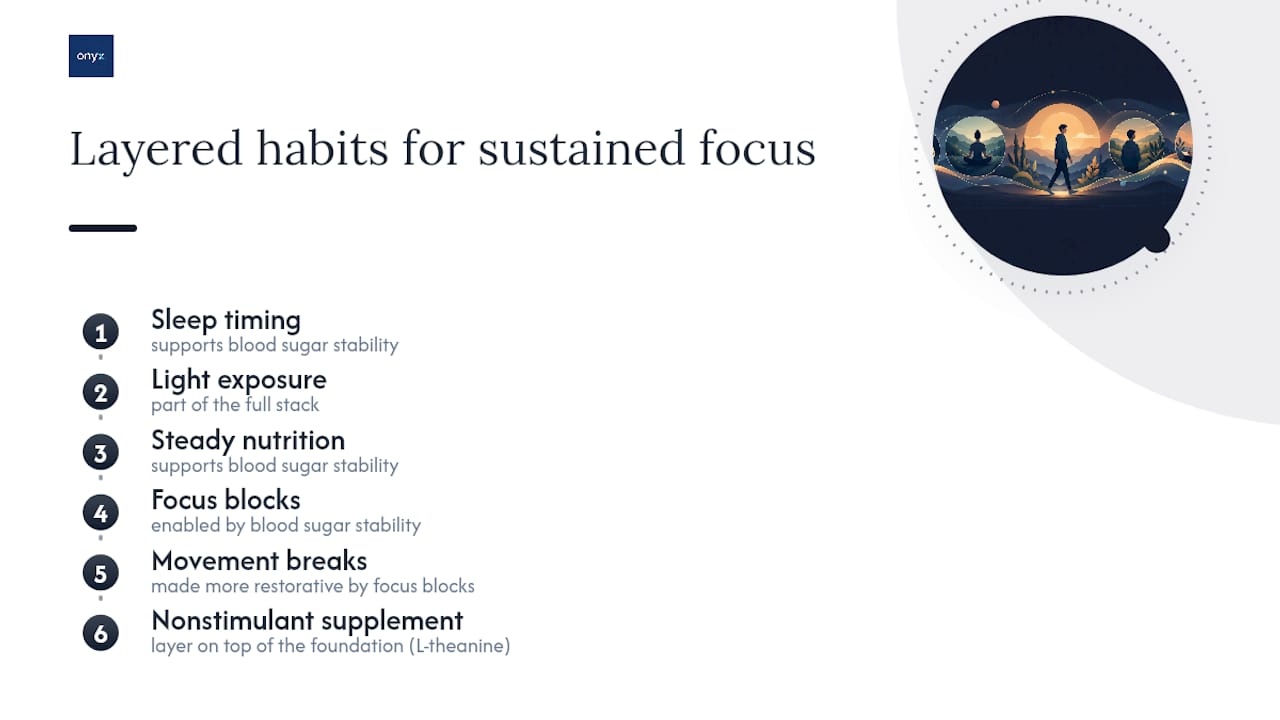
Nonstimulant strategies work because they compound, not because any single one is dramatic. Sleep timing supports blood sugar stability. Blood sugar stability supports focus blocks. Focus blocks make movement breaks more restorative. Supplements like L-theanine are a layer on top of that foundation, not a replacement for it. Anyone expecting a supplement alone to match caffeine’s kick is going to be disappointed. Anyone building the full stack, sleep, light, food, movement, and one well-chosen supplement, tends to end up more consistently focused than they were with coffee in the first place.
A Convenient Way to Add Nonstimulant Support
If you’ve read this far, you already know the foundation, sleep, light, food, and movement, does the heavy lifting. But building a new supplement habit on top of that foundation is easier when it doesn’t require water, measuring, or remembering a pill bottle. Onyx Wellness makes dissolvable strips specifically for that gap.
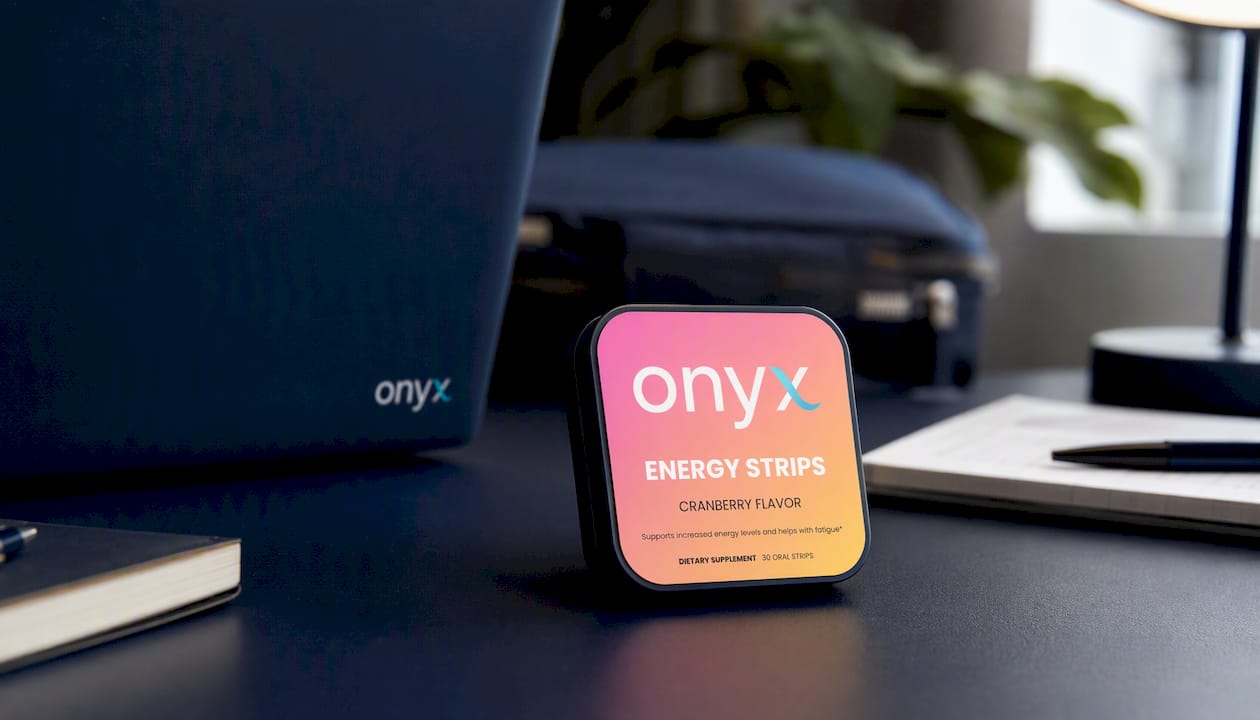
The Mushroom Focus strips dissolve on the tongue in seconds, no water needed, which makes them easy to fold into a morning routine or a pre-focus-block ritual. Onyx Wellness’s Cognitive Focus strips work the same way, using the fast-absorbing format the brand is built around. Both fit naturally into the two-week test plan described earlier: one consistent variable, tracked daily, without the friction of a bulky supplement routine.
Always check the ingredient list against any medications you take, and talk to a clinician before starting anything new if you’re pregnant, nursing, or managing a health condition. If gut comfort is part of your energy equation too, Onyx Wellness’s Digestive + Gut Health Strips are worth a look. Browse the full Onyx Wellness collection to find the format that fits your routine, and start with one strip on one focus block to see how it feels.
Sources
- Time for tea: meta-analytic evidence on L-theanine and attention — Nature (2026)
- Energy-boosting coffee alternatives: What to know - Harvard Health
- Focus without stimulants stack — SupplementScore
- 10 ways to feel awake without caffeine - WebMD
- Caffeine alternatives: Getting your energy boost without coffee - OSF Healthcare
FAQ
What can people with ADHD use instead of caffeine?
Structured routines, short focus rituals, and clinician-approved supplements like L-theanine or creatine can help, but any substitution should go through a doctor first, especially alongside medication.
Do people with ADHD focus better with caffeine?
Some people with ADHD report better focus with caffeine, but the effect varies widely and isn’t a substitute for an actual treatment plan.
What drink clears brain fog?
No single drink reliably clears brain fog, but staying hydrated, pairing water with electrolytes after exertion, and avoiding sugary beverages support clearer thinking more consistently than any specific drink.
Is it true that people can’t function without caffeine?
No. Caffeine masks fatigue rather than creating energy, and habits like consistent sleep, morning light, and protein-rich meals restore natural alertness without it.
How long does it take to feel normal after quitting caffeine?
Most people notice steadier energy within 1 to 2 weeks of consistent sleep and nutrition changes, with fuller focus gains often building over 4 to 8 weeks.