


TL;DR:
- Clean label supplements require full ingredient disclosure, minimal synthetic additives, and verified safety through third-party testing. Since the term is not legally defined, consumers should scrutinize the Supplement Facts panel, avoid proprietary blends, and verify third-party certifications like NSF or USP. Transparency and independent testing are essential for confirming quality and safety in supplement products.
Clean label supplements are dietary products defined by full ingredient disclosure, minimal synthetic additives, and verified safety through independent testing. If you’ve spent any time reading supplement labels, you know how confusing the fine print can get. Explaining clean label supplements clearly matters because the term itself has no legal definition in the United States, which means any brand can print “clean” on a bottle without meeting a single standard. The Clean Label Project, the FDA’s 21 CFR 101.36 labeling regulations, and third-party certifiers like NSF International and USP are the real gatekeepers here. Understanding what sits behind those claims is the difference between buying quality and buying marketing.
What are clean label supplements and how do you read them?
A genuine clean label supplement lists every ingredient by name and amount on the Supplement Facts panel. Under U.S. law, 21 CFR 101.36 requires the panel to include serving size, ingredient amounts, percent daily values where applicable, an “other ingredients” list, allergen disclosures, and FDA-mandated disclaimers for structure/function claims. Missing or misordered elements are among the most common compliance failures.
The Supplement Facts panel is your first checkpoint. Scan the active ingredients and confirm each one has a specific milligram or microgram amount listed next to it. If you see a line that reads something like “Proprietary Blend 500 mg” followed by a list of ingredients, that is a red flag. Proprietary blends hide doses, making it impossible to know whether any single ingredient is present at a meaningful level or just a trace amount added for label appeal.
The “other ingredients” section deserves just as much attention as the actives. This is where you find capsule materials, flow agents like magnesium stearate, colorants, and fillers. A clean label product keeps this list short and uses recognizable, food-grade materials. Excipients and allergen notes in this section also reveal whether the product was made in a facility that handles common allergens like tree nuts, soy, or dairy.
- Supplement Facts panel: Confirm every active ingredient has a named amount, not a blend total.
- Proprietary blends: Treat any blend listing as a transparency failure until proven otherwise.
- Other ingredients: Look for short, recognizable lists. Long lists with chemical-sounding names signal synthetic additives.
- Allergen disclosures: Check for “manufactured in a facility that also processes…” statements if you have sensitivities.
- Structure/function claims: Any claim like “supports immune health” must be followed by the FDA disclaimer: “This statement has not been evaluated by the Food and Drug Administration.”
Pro Tip: Flip the bottle over before you read the front. The back label tells you what is actually in the product. The front label tells you what the brand wants you to believe.
How do manufacturing standards and third-party testing verify clean label claims?
Manufacturing quality is the foundation that label transparency rests on. Current Good Manufacturing Practices (cGMP), codified in 21 CFR Part 111, require supplement manufacturers to test incoming raw materials for identity, purity, and strength, and to maintain detailed records throughout production. These regulations set the floor for quality assurance. The FDA does not issue cGMP certifications to individual companies, so a brand saying it is “cGMP compliant” is self-reported unless a third party has verified it.

That verification gap is exactly where independent certifiers step in. NSF International and USP both audit manufacturing facilities and test finished products against label claims. Their seals on a bottle indicate documented quality control, not just a marketing promise. Brands claiming quality testing should be able to produce documentation that aligns with cGMP standards on request.
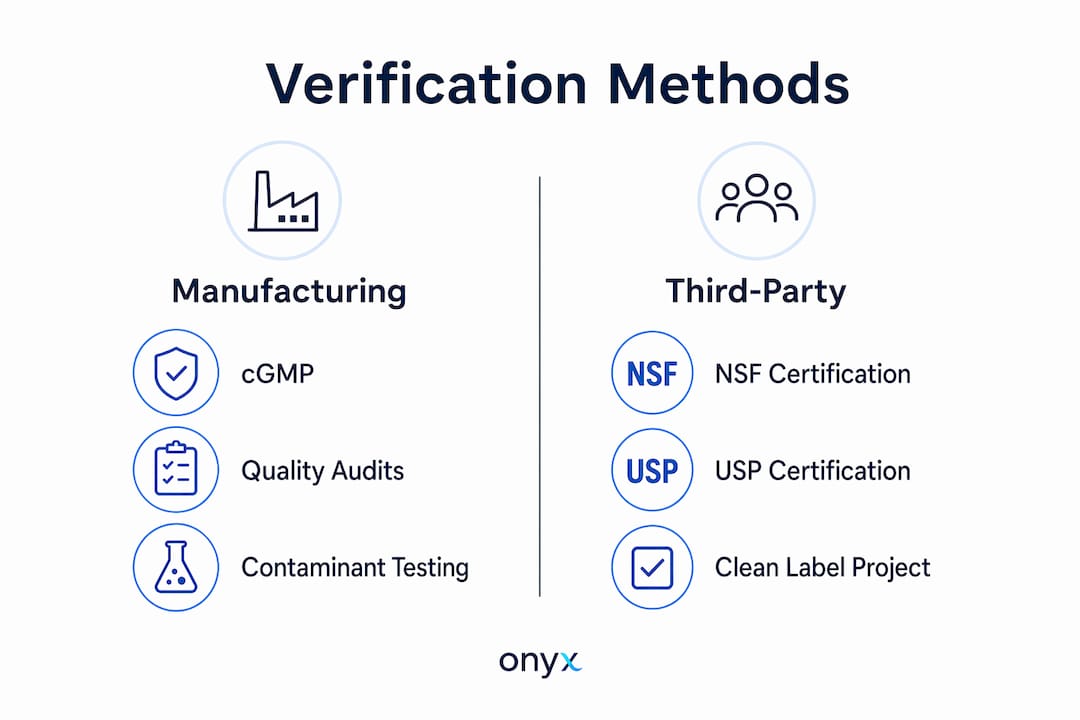
Contaminant testing goes a step further than label accuracy. The Clean Label Project uses ISO 17025-accredited labs to screen for more than 400 contaminants, including heavy metals, pesticides, and plasticizers. Their protein powder study found that 47% of tested products exceeded at least one safety threshold for heavy metals, and 21% exceeded twice California’s Prop 65 limits. That finding means a product can have a perfectly accurate label and still carry a meaningful contaminant burden.
| Verification type | What it means | What it does not mean |
|---|---|---|
| NSF Certified for Sport | Third-party tested for banned substances and label accuracy | Guarantees clinical efficacy |
| USP Verified | Meets USP standards for purity, potency, and manufacturing | FDA approval |
| cGMP compliant (self-reported) | Brand claims to follow 21 CFR Part 111 | Independent verification |
| Clean Label Project certified | Tested for 400+ contaminants in ISO-accredited labs | Confirms therapeutic benefit |
| “Natural” or “clean” on front label | Unregulated marketing claim | Any legal standard |
Pro Tip: Ask the brand directly for a Certificate of Analysis (COA) from a third-party lab. Legitimate companies keep these on file and share them without hesitation. If a brand can’t produce one, that tells you everything.
What are the biggest misconceptions about clean label supplements?
The biggest misconception is that “clean label” is a regulated term with a fixed definition. It is not. Clean label is a marketing umbrella that any company can apply to any product without meeting a specific legal standard. This creates real confusion for consumers who assume the phrase carries the same weight as, say, USDA Organic or NSF Certified.
Proprietary blends are the most common way this confusion gets exploited. A product can call itself clean while listing a blend of 12 ingredients with a single combined weight. You have no way of knowing if the headline ingredient is present at a clinically relevant dose or at a fraction of a milligram. Full dose and ingredient disclosure is the core principle that separates a genuinely transparent product from one that just looks clean on the shelf.
Cross-contamination is another challenge that clean label marketing rarely addresses. Even if a formula contains only natural ingredients, shared manufacturing facilities can introduce allergens or contaminants from other products on the same production line. This matters especially for people with celiac disease, nut allergies, or sensitivities to soy or dairy. A clean ingredient list does not automatically mean a clean manufacturing environment.
- A “natural” claim on the front of a package has no regulatory definition in the supplement space.
- A short ingredient list does not guarantee ingredient quality or sourcing standards.
- “No fillers” claims are often inaccurate. Most capsule-based supplements require some form of flow agent or filler to manufacture consistently.
- Third-party certification logos can be expired or misrepresented. Always verify the certification status directly on the certifier’s website.
Pro Tip: Pair label reading with a quick search on the Clean Label Project or NSF’s public databases. Both maintain searchable product registries that take about 30 seconds to check.
Why do clean label product benefits matter for your wellness routine?
Choosing verified clean label supplements gives you three concrete advantages. First, you reduce your exposure to synthetic additives and undisclosed contaminants. Second, you get accurate dosing information, which means you can actually evaluate whether a supplement is working. Third, you gain confidence that the product was manufactured under documented quality controls. Ingredient transparency directly supports better decisions about what you put in your body.
Clean label status does not guarantee that a supplement will produce a clinical benefit. A product can be completely transparent, third-party tested, and free of contaminants while still containing an ingredient that lacks strong clinical evidence for your specific goal. Transparency tells you what is in the bottle. It does not tell you whether the formula will work for you. That distinction matters when you are spending money on wellness products.
Practical shopping comes down to a short checklist. Prioritize products with named ingredient amounts, a short “other ingredients” list, and a visible third-party certification from NSF, USP, or the Clean Label Project. Check allergen disclosures if you have sensitivities. And use resources like nutrigenomics-informed guidance to understand how your individual biology interacts with specific ingredients.
| Clean label benefit | Common supplement pitfall |
|---|---|
| Named ingredient amounts | Proprietary blends hide individual doses |
| Short, recognizable excipient list | Synthetic fillers and colorants with no function |
| Third-party contaminant testing | Self-reported quality claims without documentation |
| Allergen disclosures | No mention of shared facility risks |
| Verified manufacturing standards | “cGMP compliant” without independent audit |
Key Takeaways
Clean label supplements are only as trustworthy as the independent verification behind them. Marketing language on the front of a package means nothing without a transparent Supplement Facts panel, documented manufacturing standards, and third-party contaminant testing to back it up.
| Point | Details |
|---|---|
| Read the Supplement Facts panel first | Confirm every active ingredient has a named amount, not a proprietary blend total. |
| Third-party seals matter | NSF, USP, and Clean Label Project certifications indicate documented quality beyond self-reported claims. |
| “Clean” is unregulated | No legal definition exists, so label reading and independent testing are your real verification tools. |
| Contaminants can hide in clean products | Clean Label Project found 47% of tested protein powders exceeded at least one heavy metal safety threshold. |
| Excipients and allergens count | Review the “other ingredients” section and shared facility disclosures, not just the active ingredients. |
My honest take on finding truly clean supplements
I’ve spent a lot of time evaluating supplement labels, and the honest truth is that the market makes it harder than it should be. The phrase “clean label” shows up on products that would not survive a serious third-party audit. That gap between marketing and reality is frustrating, but it is also fixable once you know what to look for.
The single most useful shift I made was stopping at the Supplement Facts panel before reading anything on the front of the bottle. Front-of-pack language is written by a marketing team. The back panel is written by a regulatory team. Those are very different documents with very different incentives. When I started treating the back label as the real product story, my purchasing decisions got sharper immediately.
I am cautiously optimistic about where the industry is heading. Organizations like the Clean Label Project are publishing contaminant data that puts real pressure on brands to clean up their supply chains. Consumers who understand supplement transparency are driving that pressure. The more people ask for Certificates of Analysis and check certification databases, the harder it becomes for brands to coast on vague marketing claims. That is a genuinely good trend, and you are part of it every time you flip the bottle over.
— Chris
Onyxwellness and the clean ingredient standard
Onyxwellness was built around the idea that what goes into a supplement matters as much as what it is supposed to do. Every product in the Onyxwellness lineup reflects an Ayurvedic-inspired philosophy that favors recognizable, natural ingredients over synthetic shortcuts.
If you are looking for a practical starting point, the Digestive + Gut Health Strips offer a transparent ingredient profile in a dissolvable strip format that skips the fillers common in capsule-based products. For nighttime recovery, the Sleep Strips use a short, clean ingredient list designed for fast absorption without water. Both products reflect the same commitment to ingredient clarity that this article has been about. You can review the full Onyxwellness collection and read every ingredient label at onyxwellness.co.
FAQ
What does “clean label” mean for supplements?
Clean label supplements are products that disclose every ingredient by name and amount, avoid synthetic additives, and ideally carry third-party verification for safety and purity. The term has no legal definition in the U.S., so independent testing is the most reliable way to verify a claim.
How do I spot a proprietary blend on a supplement label?
A proprietary blend appears as a single line item with a combined weight followed by a list of individual ingredients without separate amounts. This format makes it impossible to confirm whether any ingredient is present at a meaningful dose.
Are NSF and USP certifications the same thing?
NSF and USP are separate organizations with different testing protocols. NSF Certified for Sport focuses on banned substance testing and label accuracy, while USP Verified confirms purity, potency, and manufacturing quality. Both are credible, and either is stronger than a self-reported cGMP claim.
Does clean label mean a supplement is effective?
No. A clean label confirms what is in the product and how it was made. It does not confirm that the formula will produce a clinical benefit for your specific health goal. Efficacy depends on the ingredient, the dose, and your individual biology.
How can I verify a supplement’s third-party certification?
Search the certifier’s public database directly. NSF maintains a searchable product registry at nsf.org, USP has a verified products database, and the Clean Label Project lists certified products on its website. Certification logos on packaging can be outdated, so checking the source takes about one minute and removes all doubt.