


DHM shows real, mechanistically sound promise for hangover symptoms, backed by consistent animal data on liver enzymes and GABA-A receptors, but robust human clinical trials confirming that promise are still missing. That gap doesn’t mean DHM is useless. It means you should treat it as a reasonable adjunct to real recovery basics, not a proven cure, and you should pick products that actually disclose their dose.
TL;DR:
- Most DHM products lack clear dosage information, making it difficult to assess if consumers receive research-supported amounts.
- Animal studies show DHM reduces alcohol intoxication and supports liver enzyme activity, but peer-reviewed human evidence remains absent.
- DHM appears safe in animal models at high doses, yet there is no established human dose or regulatory approval for safety and efficacy.
- Taking DHM before or during drinking may align better with its mechanisms, but it does not speed alcohol clearance or prevent heavy hangovers alone.
- The best recovery strategy combines hydration, sleep, and food, with DHM supplements serving as a convenient, but not proven, adjunct.
Table of Contents
- What Is DHM for a Hangover, and Where Does It Come From?
- How DHM Works: The Biology Behind the Buzz
- Animal Studies vs. Human Trials: Where the Evidence Actually Stands
- Is DHM Safe? Dosing and Label Red Flags
- Timing DHM Around Drinking: What Actually Helps
- Where DHM Fits Into a Real Recovery Plan
- Author Take: What Onyx Wellness Believes About DHM
- Is DHM Legal? Regulatory Status Around the World
- How to Avoid Counterfeit or Underdosed DHM Products
- The Real Limitations in DHM Hangover Research
- Chris’s Take: What the Research Actually Supports
- Try Onyx Wellness Hangover Strips for Your Next Recovery
- Sources
- FAQ
What Is DHM for a Hangover, and Where Does It Come From?
DHM stands for dihydromyricetin, also called ampelopsin, a flavonoid pulled from the Japanese raisin tree, Hovenia dulcis, along with related plants like Ampelopsis and vine tea. People have used Hovenia dulcis in East Asian herbal traditions for centuries, well before anyone isolated the compound now sold in Western supplement shops. If you’re searching for dihydromyricetin hangover research, know that DHM and ampelopsin are the same molecule under two names, so don’t be thrown off if a label uses one or the other.
Product format matters more than most shoppers realize. You’ll find DHM in:
- Capsules and tablets — the most common format, but absorption speed varies by manufacturer and fillers.
- Loose powder — mixed into drinks, harder to dose precisely without a scale.
- Dissolvable oral strips — designed to absorb quickly without water, useful when you want something fast and portable.
Delivery method affects how quickly the compound reaches your bloodstream, which matters if you’re timing a dose around drinking.
How DHM Works: The Biology Behind the Buzz
DHM’s reputation rests on two separate mechanisms, and it helps to understand both before you decide how much faith to put in it. The first involves your brain. Alcohol intoxicates you largely by binding to GABA-A receptors, the same receptors targeted by sedatives like benzodiazepines. A well-cited 2012 preclinical study found that DHM counteracts acute alcohol intoxication in rats by acting directly on those GABA-A receptor sites, blunting some of the behavioral signs of both intoxication and withdrawal.
The second mechanism involves your liver. Alcohol metabolism runs through two enzymes: alcohol dehydrogenase (ADH), which converts ethanol into acetaldehyde, and aldehyde dehydrogenase (ALDH), which clears that acetaldehyde, a toxic byproduct largely responsible for hangover misery. DHM appears to support the activity of both enzymes, potentially helping clear the aldehyde buildup faster.
By the numbers: researchers evaluating 82 commercial hangover products found that 59% of those containing DHM didn’t list a dose on the label, which makes it nearly impossible to know if you’re getting an amount anywhere close to what’s been studied.
Beyond these two headline pathways, comprehensive pharmacology reviews also credit DHM with:
- Antioxidant activity that may counter oxidative stress from alcohol breakdown.
- Anti-inflammatory effects that could ease some of the achy, foggy hangover feeling.
- A favorable safety profile in animal models, though that doesn’t automatically translate to humans.
Animal Studies vs. Human Trials: Where the Evidence Actually Stands
Here’s the honest picture: DHM’s animal data is genuinely strong, and its human data is genuinely thin. Those two facts coexist, and a good hangover supplement claim has to hold both at once.
On the animal side, the evidence is consistent and mechanistically coherent. Rodent studies show DHM reduces loss-of-righting reflex (the wobbly, falling-over stage of intoxication) and shortens recovery time after alcohol exposure. Separately, USC researchers reported that DHM increased ADH and ALDH enzyme activity in liver tissue, reduced fat accumulation in the liver, and lowered inflammatory markers, an added angle beyond simple symptom relief.
The systematic review of 82 commercial hangover products concluded there is no peer-reviewed human data confirming the safety or efficacy of these DHM-containing formulations, and that most products offer consumers no way to verify what they’re actually taking.
That’s the core problem. Nobody has run the kind of controlled, peer-reviewed human trial that would let you say “DHM reduces hangover severity by X percent” with confidence. What exists instead is:
- Strong mechanistic rationale from cell and animal studies.
- Zero large-scale, peer-reviewed human clinical trials specifically testing hangover outcomes.
- A commercial market where most products don’t disclose dosage, making it hard to know if store-bought DHM even approaches research-level amounts.
If you see a brand claiming clinical proof of hangover prevention, that claim is running ahead of the science.
Is DHM Safe? Dosing and Label Red Flags
Preclinical toxicity data on DHM looks reassuring. Animal studies have used comparatively high doses without major adverse signals, and reviews of DHM’s broader pharmacology describe a favorable biosafety profile in these models. What’s missing is a consolidated human dosing standard. No health authority has published an established safe or effective dose for people, so any number on a supplement bottle reflects the manufacturer’s own choice, not a regulatory benchmark.
That label gap is the real safety issue you can actually control. Before buying, take a few concrete steps:
- Confirm the DHM amount is printed on the label in milligrams per serving, not buried in a proprietary blend.
- Check for third-party testing claims, which suggest the manufacturer verifies its own dosing accuracy.
- Read the full ingredient list for other actives, some hangover blends add ingredients like NAC, which carries its own complicated regulatory status in the U.S.
- Avoid stacking DHM with sedatives or sleep aids, since both act on GABA-A pathways and combining them acutely with alcohol is not well studied.
Pro Tip: Skip any hangover product where “proprietary blend” appears above the ingredient list without a milligram figure next to DHM. If the company won’t tell you the dose, assume it’s underdosed relative to what’s been studied in animals.
Timing DHM Around Drinking: What Actually Helps
Preclinical studies testing DHM’s anti-intoxication effects generally dosed animals before or during alcohol exposure, which lines up with how the GABA-A mechanism would need to work: it has to be present in your system while alcohol is acting on those same receptors. That suggests taking DHM before or during drinking has more theoretical grounding than taking it the next morning, though no human trial has directly compared timing strategies for hangover outcomes.
Keep your expectations realistic. DHM, at best, may blunt some symptoms and support liver enzyme activity, it does not speed up how fast your body clears alcohol from your bloodstream, and it does not cancel out heavy drinking. Time and liver metabolism remain the real drivers of hangover recovery. For practical use:
- Check the label for actual milligrams of DHM per serving before deciding when to take it.
- Pair it with water and electrolytes throughout the night, not just in the morning.
- Prioritize sleep, since alcohol disrupts sleep architecture regardless of what supplement you take.
- Never combine DHM (or any hangover product) with sedatives, sleep medication, or additional alcohol as a “fix.”
Where DHM Fits Into a Real Recovery Plan
Hydration, electrolytes, food, and sleep still do the heaviest lifting in hangover recovery. Public health guidance from the CDC is blunt about this: no supplement replaces moderating intake, and recovery ultimately depends on time and basic physiological repair. Our complete hangover recovery guide walks through those fundamentals in more depth.
Where a supplement like DHM earns its place is as a convenient adjunct, something you take alongside those basics, not instead of them. A fast-absorbing strip format appeals to people who don’t want to swallow pills or mix powders at 1 a.m. Other ingredients researchers have looked at for similar purposes include:
- Prickly pear extract, studied for anti-inflammatory effects.
- Clove extract, explored for antioxidant support.
- L-cysteine, investigated for acetaldehyde clearance.
None of these, DHM included, outperforms simply drinking less and hydrating more.
Author Take: What Onyx Wellness Believes About DHM
Chris covers evidence-based wellness topics for Onyx Wellness, weighing mechanistic research against what’s actually verifiable in a bottle you can buy.
Some companies build their products around Ayurvedic-inspired ingredients paired with fast-absorption delivery, dissolvable strips that skip water and pills. Transparency about format and ingredients matters more than bold claims.
- Onyx Wellness discloses ingredients on its product pages rather than hiding behind blend labeling.
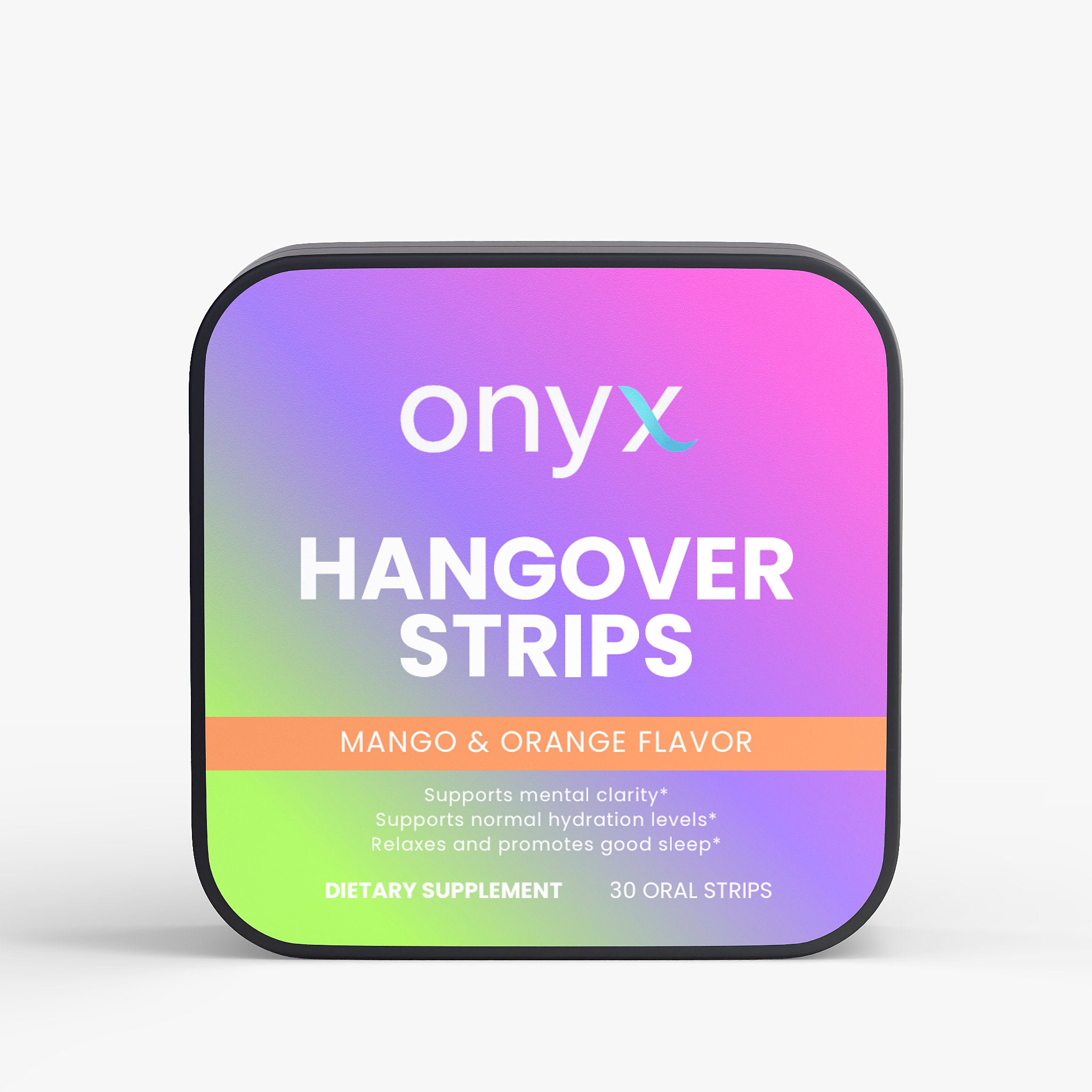
- The Hangover Strips format targets the convenience gap, fast dissolving, no water needed, no swallowing capsules mid-evening.
- The brand does not claim its strips cure or prevent hangovers, only that they offer a convenient way to take DHM alongside real recovery basics.
| What matters | Why it matters |
|---|---|
| Disclosed DHM dose | Lets you compare against research amounts |
| Fast-absorption format | Convenient during or after drinking |
| No overstated claims | Keeps expectations realistic |
Is DHM Legal? Regulatory Status Around the World
In the United States, DHM is sold as a dietary supplement under the Dietary Supplement Health and Education Act framework, meaning the FDA does not pre-approve it for safety or efficacy before it hits shelves. Manufacturers are responsible for their own safety claims, and the agency only intervenes after problems surface. That’s a meaningfully different bar than drug approval, and it’s why hangover product labels can vary so widely in what they claim.
Elsewhere, DHM’s status shifts by jurisdiction. In the European Union, novel food regulations govern ingredients without a documented history of consumption before 1997, and Hovenia dulcis extract’s status can require case-by-case evaluation depending on the specific extract and concentration. Some Asian markets, particularly China and South Korea, have longer traditional use of Hovenia dulcis, which affects how it’s classified there compared to a novel Western import.
None of this means DHM is banned anywhere significant for general consumer use. It means the regulatory bar is low almost everywhere, low enough that a product can legally reach the market without any human trial behind its specific formulation. If you’re ordering from outside the U.S. or buying an imported brand, check whether the product complies with your country’s supplement or novel-food rules before assuming U.S. labeling standards apply. When in doubt, favor brands that publish their sourcing and testing practices rather than ones that stay vague about origin.
How to Avoid Counterfeit or Underdosed DHM Products
The DHM supplement market has a counterfeit and underdosing problem that’s easy to miss if you’re not looking for it. Because no regulatory body verifies potency before sale, a bottle labeled “DHM 500mg” could contain far less active compound, diluted with fillers, or extracted from a lower-quality source than what was used in the research you’re trying to replicate.
A few concrete habits protect you here. Buy from brands that name their actual DHM source, ideally Hovenia dulcis extract with a stated purity percentage, rather than a vague “proprietary hangover blend.” Favor companies that publish third-party lab testing results, or at least state clearly that they conduct them, since that’s currently the only real check on whether a product contains what it claims. Be suspicious of prices that seem too low relative to competitors selling standardized extract, since quality raw DHM costs money to source and test.
Cross-reference online reviews with actual ingredient complaints, not just general satisfaction, since counterfeit or diluted products often generate complaints about “no effect at all” rather than complaints about taste or packaging. And if a company won’t answer a direct email asking about their DHM sourcing or testing protocol, treat that silence as information. Our guide to hangover cure alternatives breaks down how DHM compares to other ingredients on the market if you want a broader shopping framework before you buy.
The Real Limitations in DHM Hangover Research
The biggest limitation in DHM research isn’t the science itself, it’s the gap between what’s been studied and what’s being sold. Every strong finding on DHM’s anti-intoxication or liver-protective effects comes from animal models or cell studies, not from controlled human trials measuring actual hangover severity the morning after drinking. That’s not a small caveat. Animal metabolism, dosing, and alcohol exposure protocols don’t map cleanly onto how a person drinks socially, and researchers haven’t published the human equivalent of those rodent studies yet.
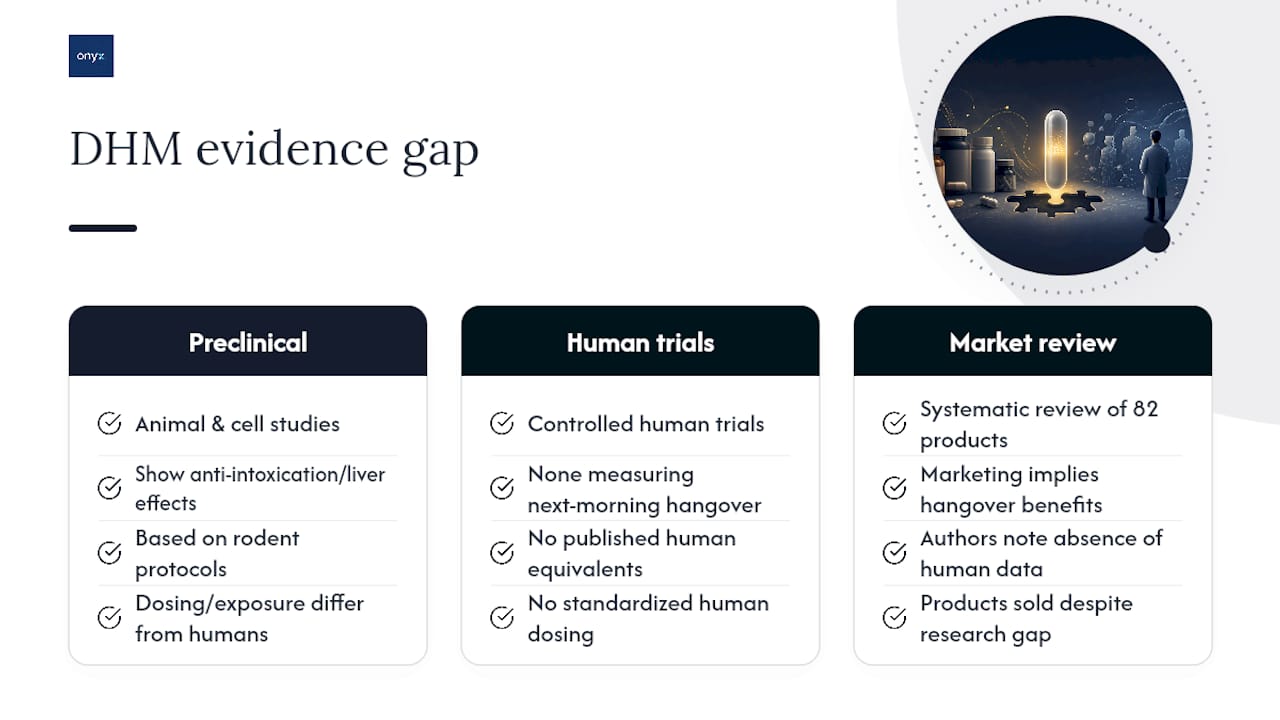
There’s also a controversy simmering under the surface: the systematic review of 82 commercial products found that manufacturers routinely market DHM-based products using language that implies proven hangover benefits, despite the review authors explicitly noting the absence of peer-reviewed human safety or efficacy data. That disconnect between marketing confidence and research reality is arguably the single biggest issue in this space.
A second limitation is dosing standardization. Without agreed-upon human dosing guidelines, researchers can’t easily compare results across the handful of studies that do exist, and consumers can’t compare products against a meaningful benchmark. Until larger, peer-reviewed human trials measure real hangover outcomes, standardize dosing, and require full label disclosure, DHM will remain a scientifically interesting compound with more promise on paper than proof in practice.
Chris’s Take: What the Research Actually Supports
The conventional hangover-supplement pitch oversells certainty. Marketing copy on plenty of DHM products reads like the science is settled, and it isn’t. What the research actually supports is narrower and, frankly, more interesting: a flavonoid with a plausible dual mechanism, backed by consistent animal data, sitting in a supplement category that still lacks basic dosing transparency.
Where I think most guidance falls short is treating DHM like a binary, either a miracle cure or snake oil. It’s neither. It’s a legitimate research candidate operating in a market that hasn’t caught up to the science with proper labeling standards.
If you take one thing from this article, prioritize label transparency over marketing claims. A product that clearly states its DHM dose in milligrams tells you more than any testimonial ever could. Pair that scrutiny with the basics, water, food, sleep, that have never gone out of style, and you’ll get more real benefit than chasing the next hangover breakthrough headline.
— Chris
Try Onyx Wellness Hangover Strips for Your Next Recovery
If you’ve read this far, you already know the biggest problem with DHM products isn’t the ingredient, it’s not knowing what’s actually in the bottle. Some hangover strips are built around exactly that gap: a fast-dissolving, water-free strip format with ingredients listed plainly, no proprietary blend hiding the dose you’re paying for.
That format matters more than it sounds. A strip dissolves under your tongue in seconds, no capsule to swallow with a shaky stomach, no powder to mix when you’re already three drinks in. It fits the same Ayurvedic-inspired, fast-absorption approach behind some products, from relaxation strips to cognitive support, built for people who want convenient wellness without guesswork on ingredients. Browse the full collection to see how the strip format applies across sleep, focus, and recovery categories. If tonight’s the night you want to plan ahead, check out the Hangover Strips product page and see the ingredient list for yourself before your next drink.
This article is general information, not a substitute for advice from a qualified doctor. Consult a qualified healthcare professional about your own circumstances before acting on anything here.
Sources
- Dihydromyricetin: an emerging compound with comprehensive effects on multiple systems
- Unknown safety and efficacy of alcohol hangover treatments puts consumers at risk
- Noted hangover remedy has added benefit of protecting the liver (USC News)
FAQ
Should I take DHM before or after drinking?
Animal studies testing DHM’s anti-intoxication effects dosed it before or during alcohol exposure, which fits its proposed GABA-A mechanism better than next-morning dosing, though no human trial has directly compared timing strategies.
Does DHM protect the liver from alcohol?
USC researchers found DHM increased liver enzyme (ADH/ALDH) activity, reduced liver fat accumulation, and lowered inflammatory markers in preclinical models, suggesting a liver-protective effect that hasn’t yet been confirmed in human trials.
What is the best supplement for a hangover?
No single supplement has proven, peer-reviewed hangover benefits in humans; DHM has the strongest mechanistic and animal-based rationale, but it works best as a convenient adjunct to hydration, food, and sleep rather than a standalone fix.
Is it safe to take DHM?
Animal toxicity studies suggest a favorable safety profile at the doses tested, but there’s no consolidated human dosing standard, so choosing a product that discloses its exact DHM amount matters more than the ingredient’s general safety reputation.