


TL;DR:
- Sugar-free supplements contain less than 0.5 grams of sugar per serving with no added sugar ingredients, complying with FDA regulations. They use sweeteners like stevia, monk fruit, and allulose for sweetness, and bulk ingredients such as erythritol or fibers for texture, but may have drawbacks like digestive issues or higher costs. Choosing truly effective sugar-free supplements requires evaluating ingredient transparency, formulation quality, and potential trade-offs beyond just the label claim.
Sugar-free supplements are products formulated to contain less than 0.5 grams of sugar per serving with no added sugar-containing ingredients, as defined under FDA regulations 21 CFR 101.60. The industry term for this category is “low-sugar or sugar-free dietary supplements,” and it covers everything from gummies and powders to dissolvable strips. If you’ve been scanning supplement labels and wondering what these claims actually mean, you’re in the right place. This guide breaks down the legal definitions, the sweeteners behind the formula, the real benefits, and the honest trade-offs, so you can make a confident, informed choice.
What are sugar-free supplements, exactly?
Sugar-free supplements are not simply products with less sugar. Under FDA rules, a product can only carry the “sugar-free” label if it contains fewer than 0.5 grams of total sugars per serving and uses no ingredients that are themselves sugars or sugar-based sweeteners. That is a strict threshold. It means a supplement with 0.4 grams of naturally occurring fructose still qualifies, but one with 0.6 grams does not.

This definition matters because the supplement market is crowded with claims. “Reduced sugar,” “lightly sweetened,” and “no added sugar” all sound similar but carry different legal meanings. Knowing the exact FDA standard helps you cut through the noise and read labels with confidence.
Sugar-free dietary products span a wide range of formats. You’ll find sugar-free protein powders, multivitamin gummies, collagen supplements, and newer delivery formats like dissolvable strips from brands such as Onyxwellness. Each format uses a different approach to achieve sweetness without sugar, which leads directly to the question of what goes in instead.
What sweeteners and ingredients replace sugar?
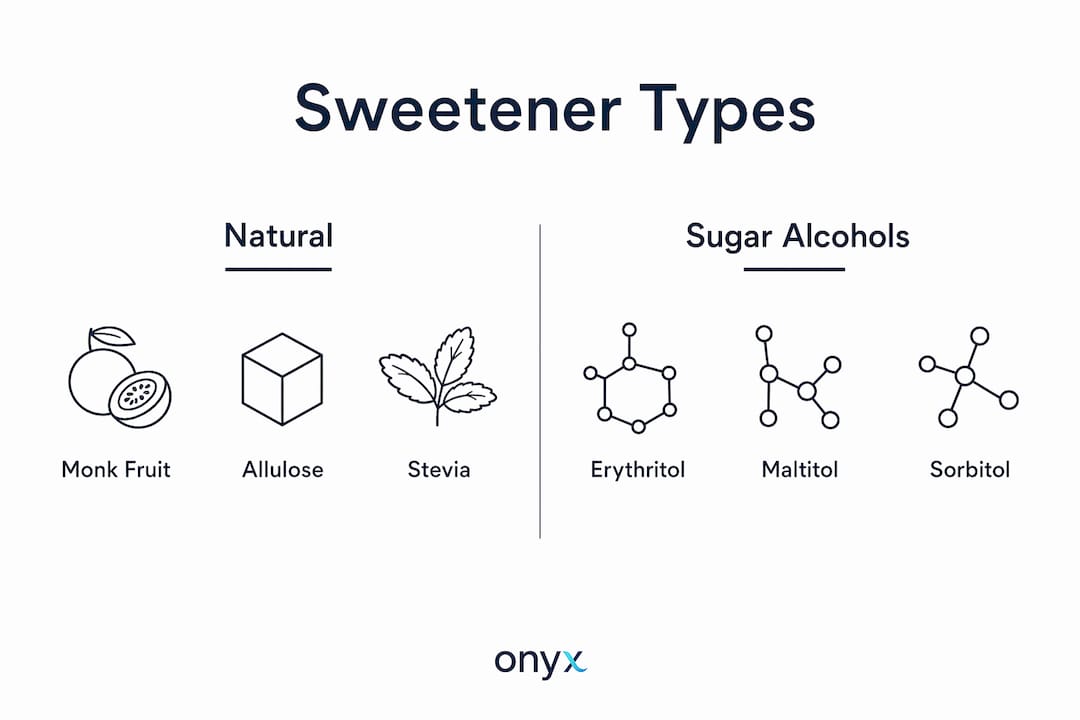
Manufacturers replace sugar with two broad categories: high-intensity sweeteners and bulk sweeteners. Each plays a different role in the final product.
High-intensity sweeteners provide sweetness at a fraction of the quantity sugar requires:
- Stevia is derived from the Stevia rebaudiana plant and is 200–300 times sweeter than sugar. It contributes zero calories and has a glycemic index of zero.
- Monk fruit extract carries GRAS (Generally Recognized as Safe) status and a long history of use. It delivers a clean, zero-calorie taste with no blood sugar impact, making it a top choice for premium supplement formulations.
- Allulose is a rare sugar that the FDA excludes from counting as added sugar on nutrition labels. It mimics sugar’s physical properties closely, which makes it especially useful in gummy manufacturing where texture matters.
Bulk sweeteners replace sugar’s physical volume and moisture retention:
- Erythritol is a sugar alcohol with roughly 70% of sugar’s sweetness and almost no calories. It is well tolerated by most people at moderate doses.
- Soluble corn fiber replaces sugar’s structural bulk in gummies without adding significant calories.
- Maltitol is another sugar alcohol used for bulk, though it has a higher glycemic impact than erythritol and can cause digestive discomfort in larger amounts.
Sugar-free gummy formulation requires a full system redesign, not just a sweetener swap. Sugar provides texture, moisture retention, and shelf stability. Replacing it means engineers must rebuild the entire formula using combinations of soluble fibers, sugar alcohols, and gelling agents. That complexity is why high-quality sugar-free gummies cost more than their conventional counterparts.
Pro Tip: When evaluating a sugar-free supplement, check whether the sweetener is monk fruit or allulose rather than maltitol. Maltitol has a glycemic index of around 35, which is low but not negligible, and it can cause bloating at higher doses.
Why choose sugar-free supplements? benefits and who benefits most
The reasons to prefer sugar-free nutrition supplements go beyond simple calorie counting. Here are the four strongest cases for making the switch:
-
Glycemic control. Sweeteners like erythritol, stevia, monk fruit, and allulose are recommended for diabetics and keto consumers because they do not trigger blood glucose or insulin spikes. For anyone managing Type 2 diabetes or following a ketogenic protocol, this is not a minor perk. It is a clinical necessity.
-
Avoiding supplement stacking sugar loads. If you take a daily multivitamin, a collagen gummy, a probiotic, and a protein shake, the sugar in each product adds up fast. Over 40% of adults prefer sugar-free options specifically to avoid excess daily sugar intake from stacking multiple supplements. That statistic reflects a real behavioral shift among health-conscious consumers.
-
Calorie management. Sugar-free vitamin options and protein powders reduce the caloric load of your supplement routine without sacrificing taste. This matters most for people in a caloric deficit or those who take supplements multiple times per day.
-
Alignment with clean-label values. Sugar-free supplements reflect a broader shift toward clean-label wellness, where consumers want to know exactly what is in their products and why. Choosing sugar-free is often as much about ingredient transparency as it is about sugar itself.
The market agrees. Sugar-free gummy supplements are growing at 8.6% CAGR, a rate that outpaces the broader gummy supplement market. That growth signals sustained consumer demand, not a passing trend.
If you are managing blood sugar, following a low-carb diet, or simply trying to reduce your overall sugar intake, sugar-free supplements give you a practical path to doing that without giving up the convenience of daily supplementation.
“Sugar-free” vs. “no added sugar” vs. “zero sugar”: what’s the difference?
These three claims look interchangeable on a label. They are not. Here is exactly what each one means:
| Label Claim | FDA Definition | Natural Sugars Present? | Added Sugars Present? |
|---|---|---|---|
| Sugar-Free | Less than 0.5g sugars per serving, no sugar-containing ingredients added | Possibly, in trace amounts | No |
| No Added Sugar | No sugars added during processing or manufacturing | Yes, possibly | No |
| Zero Sugar | Typically used interchangeably with sugar-free; implies 0g on the label | Possibly trace amounts | No |
“No added sugar” means no sugars were introduced during processing, but naturally occurring sugars from ingredients like fruit concentrates or dairy may still be present. A whey protein powder labeled “no added sugar” could still contain several grams of lactose per serving. That is not a loophole. It is a precise regulatory distinction that consumers often miss.
“Zero sugar” is not a formally defined FDA term the way “sugar-free” is. Most manufacturers use it to mean the same thing as sugar-free, but you should verify by checking the nutrition facts panel rather than trusting the front-of-pack claim alone.
The safest approach is to read the ingredient list, not just the label claim. Look for sugar, cane sugar, honey, agave, maltose, dextrose, or fruit juice concentrate in the ingredients. If any of those appear, the product is not truly sugar-free regardless of what the front label says.
Pro Tip: On the nutrition facts panel, check both “Total Sugars” and “Added Sugars” rows. A product can show 0g added sugars while still listing 2–3g of total sugars from natural sources. Both numbers matter.
What are the real drawbacks of sugar-free supplements?
Choosing sugar-free is not a free pass. There are genuine trade-offs worth knowing before you commit.
-
Digestive discomfort from sugar alcohols. Erythritol is generally well tolerated, but maltitol and sorbitol can cause bloating, gas, and loose stools at higher doses. If a sugar-free supplement uses maltitol as its primary bulk sweetener, you may notice digestive effects after consistent use.
-
Enamel erosion risk from added acids. Sugar-free gummies often use acids like citric acid or malic acid to compensate for flavor lost when sugar is removed. These acids lower the pH in your mouth and can erode tooth enamel over time, even though the product eliminates the cavity risk from sugar. Rinsing with water after taking acidic gummies reduces this risk.
-
Higher cost. Monk fruit and allulose increase manufacturing cost compared to standard sugar or corn syrup. Premium sugar-free supplements often carry a price premium of 20–40% over conventional versions. That cost reflects real ingredient quality, but it is worth factoring into your budget.
-
“Sugar-free” does not mean healthy. Dietitians consistently advise that sugar-free processed products still require scrutiny of the full ingredient list and nutrition facts. A sugar-free gummy can still contain artificial colors, fillers, or low-quality active ingredients. The sugar-free label tells you one thing about one ingredient. It says nothing about the rest of the formula.
-
Texture and taste differences. Older sugar-free formulas had a bitter or chemical aftertaste from early-generation stevia extracts. Modern formulations using allulose and monk fruit have nearly closed the taste gap, but texture in gummies can still differ from sugar-based versions. If taste is a priority, look for products that use allulose as the primary bulk sweetener.
The sugar-free label is just the first step. Texture, digestive tolerance, and dental health all need to be considered for a truly informed choice. Treat the sugar-free claim as a starting point for evaluation, not a finish line.
Key takeaways
Sugar-free supplements are defined by FDA regulation as containing less than 0.5 grams of sugar per serving with no added sugars, but choosing the right product requires looking well beyond that single label claim.
| Point | Details |
|---|---|
| FDA definition is precise | Sugar-free means less than 0.5g sugar per serving and no added sugar-containing ingredients. |
| Sweetener choice matters | Monk fruit and allulose offer the cleanest taste and lowest glycemic impact for premium formulas. |
| Label claims differ significantly | “No added sugar” allows natural sugars; “sugar-free” does not. Always check the nutrition facts panel. |
| Trade-offs are real | Sugar alcohols can cause digestive issues; added acids in gummies may affect enamel health. |
| Sugar-free is not automatically healthier | Scrutinize the full ingredient list, not just the front-of-pack sugar claim. |
My take on sugar-free supplements in 2026
Where the sugar-free conversation is actually heading
I’ve spent years watching the supplement industry evolve, and the sugar-free category has made more genuine progress in the last three years than in the previous decade combined. Allulose and monk fruit changed the game. The bitter aftertaste that made early sugar-free products feel like a compromise is largely gone. Today, a well-formulated sugar-free supplement can taste as good as its conventional counterpart.
But here’s what I think most articles get wrong: they treat “sugar-free” as the destination. It isn’t. It’s a filter. Once a product passes that filter, you still need to ask about ingredient transparency, the quality of the active ingredients, the delivery format, and whether the formula actually does what it claims.
The consumers I find most satisfied with sugar-free supplements are the ones who use it as one criterion among several, not the only one. They check the sweetener type, the full ingredient list, and the dosage of active compounds. They also pay attention to format. Dissolvable strips, for example, bypass the gummy formulation challenges entirely. No acids needed for texture. No sugar alcohols for bulk. Just active ingredients in a fast-absorbing format.
My honest advice: use the sugar-free label to narrow your options, then read the full label to make your final call. The sugar-free wellness movement is real and worth engaging with. Just go in with clear eyes.
— Chris
Sugar-free supplements worth trying from Onyxwellness
If you’ve done the research and you’re ready to act on it, Onyxwellness offers a range of clean-label, sugar-free supplement strips designed for fast absorption without the formulation trade-offs that come with gummies.
The Digestive + Gut Health Strips deliver targeted gut support in a dissolvable format with no sugar, no acids for texture, and no sugar alcohols. For sleep support, the Sleep Strips offer a clean, sugar-free option that absorbs quickly. If bone health is your focus, the Bone Support Strips provide a straightforward, sugar-free alternative to conventional calcium gummies. Explore the full collection at Onyxwellness to find the right fit for your wellness routine.
FAQ
What does “sugar-free” mean on a supplement label?
“Sugar-free” means the product contains less than 0.5 grams of total sugars per serving and no sugar-containing ingredients were added, as defined by FDA regulations 21 CFR 101.60.
Are sugar-free supplements safe for people with diabetes?
Yes, when they use low-glycemic sweeteners like stevia, monk fruit, erythritol, or allulose, which do not cause blood glucose or insulin spikes. Always verify the sweetener type on the ingredient list before purchasing.
Can sugar-free supplements still cause digestive issues?
They can, particularly if they contain sugar alcohols like maltitol or sorbitol. Erythritol is better tolerated, but high doses of any sugar alcohol may cause bloating or loose stools in sensitive individuals.
Is “zero sugar” the same as “sugar-free” on supplements?
“Zero sugar” is not a formally defined FDA term, but manufacturers typically use it to mean the same as sugar-free. Confirm by checking the nutrition facts panel for total sugars rather than relying on the front-of-pack claim.
Do sugar-free supplements taste different from regular supplements?
Modern formulations using allulose and monk fruit have significantly reduced taste differences. Older stevia-based products had a notable bitter aftertaste, but current premium sugar-free supplements closely match the taste profile of conventional versions.