


Green powders line every wellness shelf, and the promises on those labels can feel almost too good to believe. Maybe you’ve wondered whether a single scoop can truly replace a salad, or whether you’re just paying a premium for expensive hype. The honest answer sits somewhere in the middle, and that middle ground is worth understanding. Small clinical trials show measurable improvements in energy, blood pressure, and antioxidant status, yet researchers are quick to note the limits. This guide walks you through what daily greens actually contain, what the science genuinely supports, and how to use them as a smart, Ayurveda-inspired complement to real food.
Table of Contents
- What are daily greens and how do they work?
- Science-backed benefits and real limitations
- Daily greens vs whole foods: What experts want you to know
- How to choose and use daily greens safely and effectively
- Our perspective: The Ayurvedic insight most people miss
- Explore science-backed wellness solutions with Onyx
- Frequently asked questions
Key Takeaways
| Point | Details |
|---|---|
| Daily greens supplement gaps | Powdered greens blends can help fill nutrient shortfalls for busy people or low produce intake. |
| Science supports some benefits | Small studies report increased energy and better antioxidant status, but effects are modest and not a substitute for vegetables. |
| Whole foods still best | Experts consistently recommend whole vegetables over powders for fiber, fullness, and overall wellness. |
| Choose and use wisely | Opt for certified products, start with small servings, and listen to your body’s response for best results. |
What are daily greens and how do they work?
The term “daily greens” sounds simple, but the category covers a surprisingly wide range of products. Daily greens powders are dehydrated blends of vegetables, fruits, algae, grasses, probiotics, enzymes, adaptogens, and vitamins and minerals designed for convenient nutrient supplementation. Think spirulina, wheatgrass, kale, ashwagandha, digestive enzymes, and Lactobacillus strains all packed into one scoop. The goal is to deliver a broad spectrum of micronutrients in a format that fits a busy morning routine.
From an Ayurvedic perspective, this approach actually makes intuitive sense. Ayurveda has long emphasized plant synergy, the idea that herbs and greens work better together than in isolation, supporting both mind and body balance. Modern green powders attempt to replicate that synergy in a convenient format. The key word, though, is attempt. Processing and dehydration inevitably alter some nutrient profiles, particularly heat-sensitive vitamins and live enzymes.
So where do daily greens genuinely fit? Think of them as a nutritional safety net, not a foundation. They supplement your diet on the days when vegetables are hard to come by, not as a permanent substitute for a colorful plate.
Here is a quick look at the most common ingredient categories and what each one brings:
| Ingredient category | Primary function | Common examples |
|---|---|---|
| Leafy greens and grasses | Chlorophyll, vitamins K and C | Wheatgrass, spinach, kale |
| Algae | Protein, omega fatty acids, B12 | Spirulina, chlorella |
| Adaptogens | Stress regulation, energy balance | Ashwagandha, rhodiola |
| Probiotics and enzymes | Gut health, nutrient absorption | Lactobacillus, bromelain |
| Antioxidant fruits | Polyphenols, immune support | Acai, blueberry, beet |
Busy professionals tend to gravitate toward these powders for a few practical reasons:
- They take under 60 seconds to prepare
- They require no chopping, cooking, or refrigeration
- They travel easily in single-serve packets
- They consolidate multiple supplement categories into one product
If you are also monitoring your iron levels, pairing a daily greens powder with targeted iron supplementation options can help address gaps that even the best green blend may leave behind.
Science-backed benefits and real limitations
With a foundation in what daily greens are, let’s examine what clinical research actually proves and where the hype remains ahead of the science.
The most cited data comes from small randomized controlled trials (RCTs). Studies show potential for improved energy of around 8% in women, reduced systolic blood pressure by roughly 8 mmHg, and measurable improvements in antioxidant status. Those are real numbers, not marketing copy. Participants in several trials also reported high compliance, meaning people actually stuck with the regimen, and GI tolerability was generally good.

Here is a snapshot of what the research landscape currently looks like:
| Outcome measured | Reported result | Study quality |
|---|---|---|
| Energy levels (women) | ~8% improvement | Small RCT |
| Systolic blood pressure | ~8 mmHg reduction | Small RCT |
| Antioxidant markers | Measurable increase | Observational and RCT |
| GI tolerability | High compliance noted | RCT |
“The evidence is promising but not definitive. Most trials are short, involve small sample sizes, and do not follow participants long enough to assess lasting effects.” This is the honest framing that expert analysis from UCLA Health consistently applies to green powder research.
So who benefits most from daily greens? The picture is clearer than you might expect:
- People with low vegetable intake who struggle to hit even three servings a day
- Frequent travelers who lack consistent access to fresh produce
- Those in high-stress periods where cognitive load makes meal planning difficult
- Individuals with mild nutrient gaps confirmed by bloodwork, not just guesswork
The limitations are equally important to understand. Most studies run for only four to twelve weeks. Long-term effects on chronic disease risk, weight, or sustained cognitive performance remain largely unstudied. Proprietary blends often obscure exact ingredient doses, making it hard to know whether you are getting a therapeutic amount or a token sprinkle of spirulina.
If digestive comfort is a concern for you, pairing your greens with targeted digestive health supplements can help your gut adapt, especially during the first few weeks of a new supplement routine.
Daily greens vs whole foods: What experts want you to know
Understanding the clinical data leads naturally to the bigger question: how do these powders actually stack up against eating your greens?
The comparison is not flattering for powders, at least not across the board. A single serving of a typical green powder contains very little dietary fiber, often under one gram, while a cup of raw spinach delivers around two grams and a cup of broccoli provides over five. Fiber is not a minor detail. It feeds your gut microbiome, slows glucose absorption, and creates the satiety signal that tells your brain you are full. Powders simply cannot replicate that.
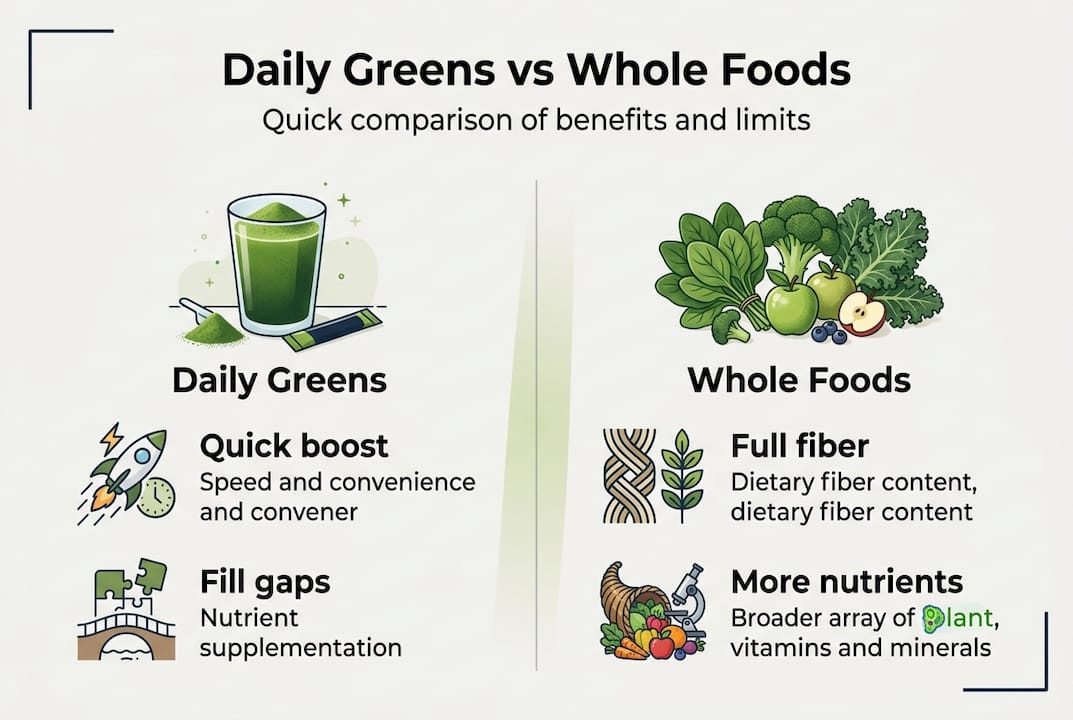
Supplements can fill gaps for busy professionals or those with low veggie intake, but they cannot replace whole foods’ fiber, synergy, or satiety. That expert consensus is worth taking seriously. Whole vegetables also contain thousands of phytonutrients (plant compounds) that interact in ways science has not fully mapped. When you process and concentrate those plants, some of that complexity is lost.
Here is a side-by-side look at a typical powder serving versus a comparable whole-food option:
| Metric | 1 scoop green powder | 1 cup raw spinach plus half cup broccoli |
|---|---|---|
| Dietary fiber | 0.5 to 1g | 4 to 5g |
| Vitamin K | Variable (often high) | Naturally occurring |
| Phytonutrient diversity | Partially preserved | Fully intact |
| Cost per serving | $2 to $4 | $0.50 to $1.50 |
| Satiety effect | Minimal | Moderate to high |
A few things worth keeping in mind when evaluating any green powder:
- Proprietary blends list ingredients without revealing individual doses, making quality comparisons difficult
- High-dose vitamin additions can push certain nutrients above safe upper limits if you already eat a varied diet
- Taste and mixability vary widely, which affects long-term consistency
Pro Tip: Blend your daily greens powder into a smoothie that also includes a handful of spinach or frozen peas. You get the convenience of the powder and the fiber and phytonutrient complexity of real produce. That combination is far more powerful than either option alone.
For readers focused on metabolism support options, combining whole-food fiber with probiotic-rich supplements creates a more complete environment for nutrient absorption than powders alone can provide. And for a broader expert commentary from UCLA on where powders genuinely help versus where they fall short, that resource is worth bookmarking.
How to choose and use daily greens safely and effectively
Recognizing the pros and cons, let’s get practical: how can you safely select and use daily greens for real-life results?
Start with the label. Not all green powders are created equal, and the difference between a quality product and a marketing-heavy dud often lives in the fine print. Prioritize certified products for purity, check labels for fiber and probiotic count, and start with small doses to minimize GI upset. That framework gives you a reliable starting point.
Here is a step-by-step approach for getting started safely:
- Check for third-party certification. Look for NSF Certified for Sport or USP verification. These seals confirm that what is on the label is actually in the product.
- Review the fiber and probiotic content. A quality powder should list at least one billion CFU (colony-forming units) of probiotics and ideally more than one gram of fiber per serving.
- Scan for adaptogens and their doses. Ashwagandha and rhodiola are beneficial, but only at clinically studied amounts, typically 300 to 600 mg per day.
- Start with half a serving. Give your digestive system one to two weeks to adjust before moving to a full dose. This is especially important if you are not used to concentrated plant compounds.
- Monitor for warning signs. Persistent bloating, loose stools, or unusual fatigue may signal that a specific ingredient does not agree with you or that doses need adjusting.
Medication interactions deserve a mention here. Ingredients like vitamin K (found in many greens) can interfere with blood thinners. High-dose B vitamins may affect certain antidepressants. If you take prescription medications, a quick conversation with your doctor before starting any new supplement is genuinely worth the five minutes.
Pro Tip: Keep a simple two-week journal when you start a new green powder. Note your energy, digestion, and sleep quality. Patterns emerge faster than you expect, and you will have real data to guide your next decision rather than relying on how you feel on any given morning.
For additional gut-friendly supplement tips, supporting your digestive system during the adjustment period can make the whole experience smoother and more sustainable.
Our perspective: The Ayurvedic insight most people miss
Having covered the science and practicalities, let’s step back for a deeper look at how daily greens fit holistically into a modern Ayurvedic-inspired life.
Here is what we have noticed: people who get the most from daily greens are rarely the ones obsessing over the perfect formula. They are the ones who pair their powder with a consistent morning ritual, reduced screen time before meals, and genuine attention to how their body responds day to day. Ayurveda calls this sattva, a quality of clarity and harmony that no supplement alone can manufacture.
The uncomfortable truth is that stress erases a significant portion of the benefit you might get from any supplement. Cortisol disrupts nutrient absorption, inflames the gut lining, and throws off the very systems that green powders aim to support. Chasing a quick fix while ignoring sleep, stress, and mindful eating is a bit like watering a plant through a cracked pot.
What actually works is treating daily greens as one thread in a larger fabric. Use them to fill gaps, not to compensate for a chaotic lifestyle. Listen to your body’s signals the way Ayurveda has always encouraged, and you will learn more from two weeks of honest observation than from any label claim.
Explore science-backed wellness solutions with Onyx
If you are ready to build a daily routine that genuinely supports your energy, clarity, and recovery, smart supplementation is a meaningful piece of that puzzle.

At Onyx Wellness, we design Ayurvedic-inspired supplements for people who want real results without the guesswork. Whether you are looking to support your gut with our digestion and gut health strips or exploring our full wellness supplements collection for targeted energy and recovery support, each product is built around transparency, quality ingredients, and formats that actually fit your life. No water needed, no complicated stacks, just convenient, evidence-informed wellness that works alongside your daily greens routine.
Frequently asked questions
Can daily greens replace all servings of vegetables?
No. Powders cannot replace whole foods’ fiber, phytonutrient complexity, or satiety effect. They work best as a gap-filler on days when fresh vegetables are genuinely hard to access.
Who should avoid daily greens powders?
People on prescription medications or with known GI sensitivities should check with a doctor first, since certain ingredients cause interactions with blood thinners and other common drugs.
What side effects can occur with daily greens?
Mild bloating or GI sensitivity is the most common complaint, especially at full doses from the start. Starting with half servings and building up over one to two weeks significantly reduces that risk.
How do I know if a daily greens powder is safe and effective?
Look for third-party seals like NSF, review actual fiber and probiotic quantities on the label, and choose brands that disclose individual ingredient doses rather than hiding behind proprietary blends.