


Collagen peptides have modest but real evidence behind them for skin hydration, elasticity, and joint comfort, with weaker support for hair and nails. Most trials use doses within a range typically studied for skin and joint benefits, with people needing consistent use over several weeks to months before noticing changes. This is not a transformation supplement. It is a slow, incremental one, and anyone managing arthritis, an autoimmune condition, or another medical issue should still loop in a clinician before starting.
TL;DR:
- Collagen supplements typically require consistent daily intake for at least two to five months to observe noticeable skin, joint, or muscle benefits.
- Doses for skin improvements range from 2.5 to 10 grams daily, while joint relief may need up to 15 grams, with effects appearing after three to five months.
- Most research indicates collagen’s modest but real effects on skin hydration and joint function, but evidence for hair and nails remains weak and inconclusive.
- Absorption depends on hydrolyzed collagen, regardless of format, so powders, capsules, or strips deliver similar bioavailable peptides when properly formulated.
- Those with specific health conditions or allergies should consult a healthcare professional before starting collagen, and choosing products with third-party testing ensures quality.
Table of Contents
- What Are Collagen Peptides and How Do They Work?
- Does the Evidence Support Skin, Joint, Muscle, and Hair Benefits?
- What Do Systematic Reviews Conclude About Collagen Peptides?
- How Should You Dose and Choose a Collagen Product?
- Are Collagen Peptides Safe? Side Effects and Interactions
- How Does Onyxwellness Approach Collagen Support?
- Who Actually Benefits From Collagen Peptides?
- Try Beauty + Collagen Strips for Your Daily Routine
- Sources
- FAQ
What Are Collagen Peptides and How Do They Work?
Collagen peptides are hydrolyzed collagen, meaning the protein has been broken down into smaller fragments your gut can actually absorb. Whole collagen molecules are too large to pass through the intestinal wall intact, so hydrolysis is what makes oral supplementation possible in the first place. Without it, you’d just be swallowing protein your body treats like any other meat or gelatin source.
Supplement labels usually reference specific collagen types, and they aren’t interchangeable:
- Type I makes up most of your skin, tendons, and bones, and is the most common type in beauty-focused products.
- Type II is concentrated in cartilage, which is why it shows up in joint-support formulas.
- Type III often pairs with Type I in skin and blood vessel tissue.
Here’s the part most marketing skips: once you swallow collagen peptides, your digestive system doesn’t route them to your knees or your cheekbones. They’re broken down into amino acids and smaller peptides, then your body redistributes those building blocks wherever it needs them. Some research points to specific dipeptides, like prolylhydroxyproline, that appear more bioactive for skin outcomes than others. That detail matters more than the “Type I versus Type II” marketing distinction most brands lean on.
Does the Evidence Support Skin, Joint, Muscle, and Hair Benefits?
The strength of the evidence varies a lot depending on which outcome you’re chasing, so it helps to look at each one separately instead of treating “collagen benefits” as one blanket claim.
Skin has the most consistent data. A review of 19 studies covering 1,125 participants found improvements in skin firmness, moisture, and suppleness, though many of those trials combined collagen with other active ingredients like hyaluronic acid or vitamins, which muddies how much credit collagen alone deserves. Separate randomized, placebo-controlled trials still found modest hydration and elasticity gains with consistent daily use, typically after 8 to 24 weeks.
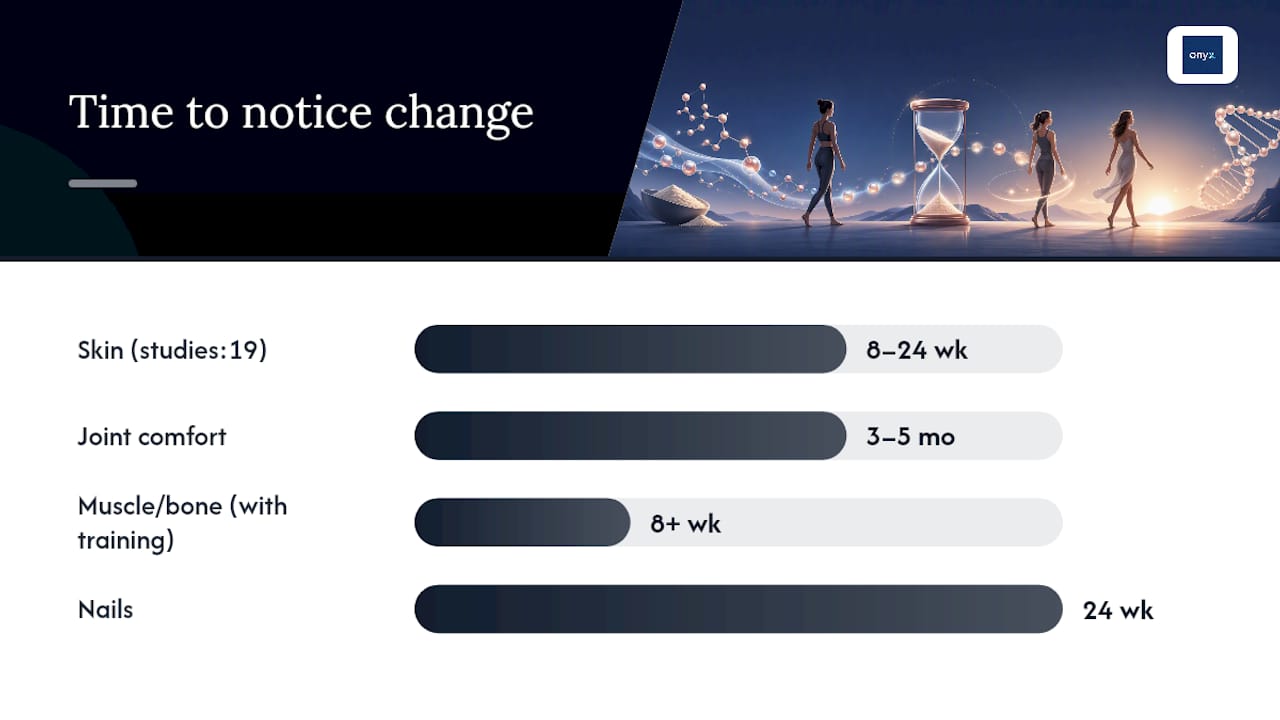
Joints show a plausible but less uniform signal. Some osteoarthritis studies report reduced pain and improved function, generally after three to five months of daily use. The effect size tends to be smaller than what people expect from supplement marketing, and not every trial replicates it.
Bone and muscle benefits look strongest when collagen is paired with resistance training. Trials combining roughly 15 grams per day with structured strength workouts for eight or more weeks have shown gains in fat-free mass and strength that collagen alone doesn’t produce. The supplement appears to support the training, not replace it.
Hair and nails sit on the weakest ground. One small, uncontrolled study of 25 people found nail brittleness improved at 2.5 grams a day over 24 weeks, but there’s no robust human trial data for hair growth specifically. Treat any hair-focused collagen claim with real skepticism.
| Outcome | Evidence strength | Typical dose | Time to notice change |
|---|---|---|---|
| Skin hydration/elasticity | Moderate | 2.5–10 g/day | 8–24 weeks |
| Joint comfort | Moderate, mixed | Up to 15 g/day | 3–5 months |
| Muscle/bone (with training) | Moderate | ~15 g/day | 8+ weeks |
| Nails | Weak, limited | 2.5 g/day | ~24 weeks |
| Hair growth | Very weak | Not established | Not established |
What Do Systematic Reviews Conclude About Collagen Peptides?
When researchers zoom out and look at the body of evidence rather than a single trial, the picture gets more conservative, not less. Higher-quality reviews consistently land on the same conclusion: modest effects for skin and joints, with much thinner support for everything else.
A few limitations show up again and again across this research:
- Many trials run for a matter of weeks, not years, so long-term durability is unknown.
- Sample sizes are often small, sometimes fewer than 30 participants.
- A lot of “collagen” products tested in trials actually combine collagen with other actives, so isolating collagen’s individual contribution is genuinely difficult.
- Industry funding shows up in a meaningful share of positive-result studies, which doesn’t invalidate the findings but should temper how much weight you give them.
If you’re grading this on an evidence scale, skin and joint benefits sit at “moderate but real.” Muscle support alongside resistance training is similarly moderate. Hair, nail, and broad anti-aging claims are “low evidence, worth trying cautiously, not worth building expectations around.”
How Should You Dose and Choose a Collagen Product?
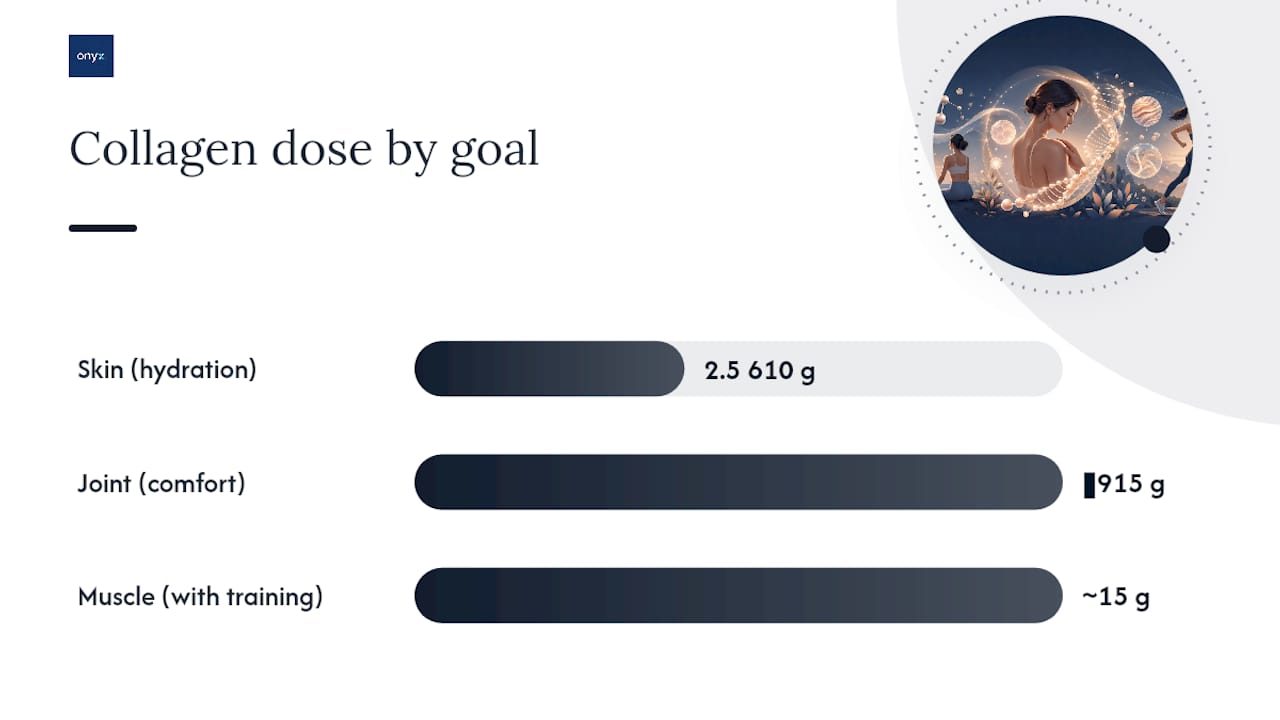
Dosing depends on what you’re trying to accomplish, and matching the dose to the goal matters more than picking the priciest product on the shelf. Skin-focused users generally see results in the 2.5 to 10 gram daily range, taken consistently for at least two months before judging results. Joint and muscle support studies more often use doses up to 15 grams a day, with joint improvements taking three to five months and muscle changes showing up after eight weeks of training alongside supplementation.
| Goal | Common dose | Time to effect |
|---|---|---|
| Skin hydration/elasticity | 2.5–10 g/day | 8–24 weeks |
| Joint comfort | Up to 15 g/day | 3–5 months |
| Muscle support (with training) | ~15 g/day | 8+ weeks |
Format matters less than people assume. Powders, capsules, beverages, and dissolvable oral strips can all deliver hydrolyzed collagen effectively, since the hydrolysis process, not the delivery vehicle, is what makes absorption possible. When comparing products, check the label for three things: confirmation that it’s hydrolyzed collagen, the source species (bovine, marine, or porcine), and evidence of third-party testing. Skip products padded with unnecessary fillers or proprietary blends that hide the actual collagen dose. For a closer look at how dosing maps to specific goals, Onyxwellness’s collagen dosage guide breaks it down further.
Pro Tip: Take your collagen peptides alongside a source of vitamin C. Vitamin C is a cofactor your body needs to synthesize collagen from the amino acids you’re supplying, so pairing the two may help more than taking collagen on its own.
Are Collagen Peptides Safe? Side Effects and Interactions
Collagen peptides are generally well tolerated at study doses of 2.5 to 15 grams daily, according to registered dietitians at the Academy of Nutrition and Dietetics. The most common complaints are mild: bloating, a heavy feeling in the stomach, or an unusual taste.
Pro Tip: If you notice digestive discomfort, try splitting your daily dose in half and taking it with food rather than on an empty stomach.
A few groups need extra caution:
- People with fish, shellfish, or specific meat allergies should check the source species (marine, bovine, or porcine) before buying.
- Anyone who is pregnant, breastfeeding, undergoing active cancer treatment, or managing severe kidney disease or an autoimmune condition should talk to a clinician before adding collagen.
- Collagen supplements are regulated as dietary supplements, not drugs, meaning the FDA doesn’t verify their effectiveness before sale. Third-party testing (look for certifications from labs like NSF or USP) is the best proxy for quality control you have as a consumer.
How Does Onyxwellness Approach Collagen Support?
Onyxwellness builds its collagen offering around a simple idea: the format shouldn’t be a barrier to consistency. The Beauty + Collagen Strips are sugar-free, dissolvable oral strips designed to fit into a daily routine without water, mixing, or measuring powder.
That convenience matters because collagen’s modest benefits depend entirely on consistent, weeks-long use. A product that’s easy to take every day beats a tub of powder that sits half-used in a cabinet by week three. Certain brands emphasize transparent labeling, allowing consumers to see the actual ingredients rather than proprietary blends.
A few things worth knowing before you add any collagen product to your routine:
- Strips work the same way as any hydrolyzed collagen supplement. Absorption depends on the hydrolysis process, not the delivery format.
- Pairing a collagen strip with a vitamin C source and adequate dietary protein aligns with what dietitians recommend for supporting collagen synthesis.
- For dose-specific guidance tailored to skin versus joint goals, the collagen dosage guide walks through the details.
Who Actually Benefits From Collagen Peptides?
If you’re an adult noticing early skin changes, someone managing mild to moderate knee osteoarthritis, or an athlete doing regular resistance training, collagen peptides are reasonable to try. The evidence, while modest, is real in those specific lanes.
If you’re dealing with significant joint damage, an active skin condition, or hair loss with a suspected medical cause, a supplement isn’t the right first step. See a dermatologist or physician before spending money on collagen for those problems.
Before you buy anything, run through this: confirm the dose matches your goal, check for hydrolyzed collagen and third-party testing on the label, pair it with vitamin C and protein, and give it a real trial window. Two months minimum for skin, three to five months for joints. Judge results against that timeline, not against day ten.
— Chris
Try Beauty + Collagen Strips for Your Daily Routine
Most collagen research assumes you’ll actually take the supplement every single day for months, and that’s where powders and capsules quietly fail people. Onyxwellness built the Beauty + Collagen Strips around a different bet: a sugar-free, dissolvable strip you can take anywhere, no water or mixing required, so the daily habit actually sticks.
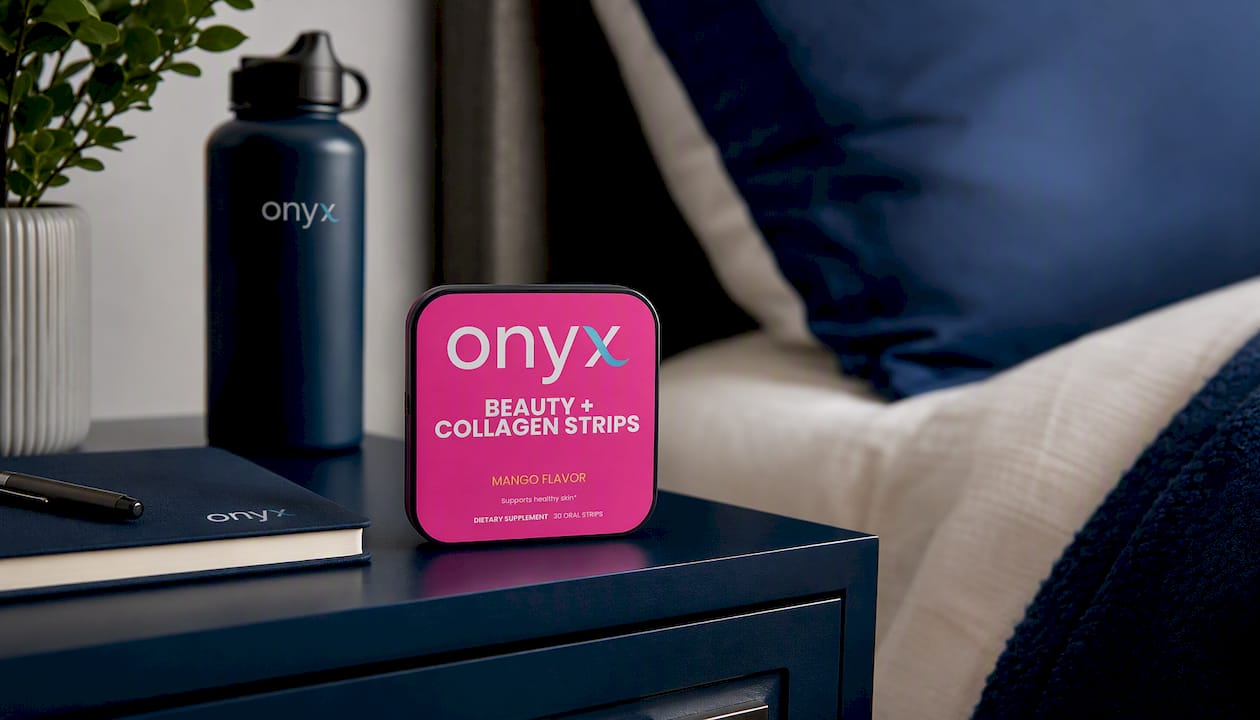
The strip format sits alongside Onyxwellness’s full lineup of dissolvable oral strips, all built on the same fast-absorbing, transparent-label approach. If you’re also training and want to support muscle recovery alongside skin and joint goals, the creatine and muscle building products line pairs naturally with a collagen routine. Expect the same realistic timeline as any hydrolyzed collagen product: modest gains, not overnight results, over eight or more weeks of consistent use. Check the product page for full ingredient specifications and dosage guidance, and decide if the strip format is the one that will actually get you to day sixty.
This article is general information, not a substitute for advice from a qualified doctor. Consult a qualified healthcare professional about your own circumstances before acting on anything here.
Sources
- Collagen Peptides: What do they do? (Cleveland Clinic)
- Clinical trials and review on collagen and muscle/joint outcomes (PMC)
- Considering collagen drinks and supplements? (Harvard Health)
- Collagen peptides benefits (The Well — Northwell Health)
- Are collagen supplements worth the hype? (EatRight / Academy of Nutrition and Dietetics)
FAQ
What do collagen peptides actually do in the body?
They’re digested into amino acids and smaller peptides, which your body then uses to support its own collagen production in skin, joints, and connective tissue rather than being delivered directly to a target area.
Which collagen type is best for skin versus joints?
Type I and III collagen are most associated with skin and connective tissue, while Type II is concentrated in cartilage and more relevant to joint-focused products.
How long does it take to see results from collagen peptides?
Skin hydration and elasticity changes are usually noticeable after 8 to 24 weeks of consistent use, while joint comfort improvements often take three to five months.
Are collagen peptides safe to take daily?
Yes, generally, at the doses used in research (2.5 to 15 grams per day), though anyone pregnant, breastfeeding, or managing a serious medical condition should check with a clinician first.
Do collagen strips work as well as collagen powder?
Format matters less than hydrolyzation. A well-made strip, like Onyxwellness’s Beauty + Collagen Strips, delivers hydrolyzed collagen the same way a powder does, just without water or mixing.