


Most adults do well on 2.5 to 15 grams of hydrolyzed collagen peptides per day, and the right number inside that range depends entirely on your goal. Want firmer, more elastic skin? Aim for roughly 2.5 to 5 grams daily. Chasing joint comfort? Studies lean toward 5 to 10 grams, or as little as 40 milligrams if you’re using undenatured type II collagen instead of peptides. Training hard or watching bone density post-menopause? Some trials push up to 15 grams a day, usually alongside resistance exercise.

One quick safety note before you go further: collagen supplements are not preapproved by the FDA for safety or effectiveness, so label accuracy and your own judgment matter. If you have kidney disease, digestive conditions, or known allergies, check with your physician first.
Here’s the fast-answer version:
- Skin elasticity: 2.5–5 g/day, results often visible in 8–12 weeks
- Joint comfort: 5–10 g/day (peptides) or ~40 mg/day (undenatured type II)
- Muscle and bone support: up to 15 g/day, typically paired with exercise
- Time to notice anything: usually 4 to 12 weeks, sometimes longer for bone outcomes
Key Takeaways
Hydrolyzed collagen peptides work best at 2.5 to 15 grams daily depending on your goal, while undenatured type II collagen is effective at roughly 40 milligrams for joint support.
| Point | Details |
|---|---|
| Match dose to goal | Use 2.5–5 g for skin, 5–10 g for joints, and up to 15 g for muscle or bone support. |
| Undenatured type II differs | Around 40 mg/day is typical, since it works through immune signaling rather than raw supply. |
| Check the label, not the scoop | Confirm grams per serving rather than assuming based on container size. |
| Give it 8 to 12 weeks | Skin and joint benefits usually take at least two months of consistent use. |
| Consider a strip format | Onyxwellness Beauty + Collagen Strips offer a sugar-free, water-free way to stay consistent daily. |
Table of Contents
- Types of Collagen and What the Label Actually Means
- What the Research Shows by Goal
- Safety, Side Effects, and Who Should Check With a Doctor First
- How to Take Collagen and Choose a Quality Product
- Choosing a Dose That Fits Your Actual Life
- Sources
- FAQ
Types of Collagen and What the Label Actually Means
Not all collagen supplements work the same way, and that’s exactly why the dosing advice varies so much from one product to the next. Hydrolyzed collagen, also called collagen peptides, is broken down into smaller amino acid chains your gut can actually absorb. That’s why it’s dosed in grams. Undenatured type II collagen works through a completely different mechanism, nudging your immune system rather than supplying raw building blocks, which is why effective doses sit in the milligram range instead.
Gelatin, the cooked cousin of collagen, behaves similarly to peptides but tends to be less soluble and less standardized in supplement form.
Delivery format matters just as much as type. You’ll find collagen in powders, capsules, gummies, and dissolvable strips, and serving sizes swing wildly between them. A “scoop” or “strip” tells you nothing on its own.
- Powders: usually 5–10 g per scoop, easiest to hit higher doses
- Capsules: often only 1–2 g per pill, meaning you may need several
- Gummies: frequently under 1 g of actual collagen per serving despite the sugar content
- Strips: fast-dissolving, typically lower per-serving grams, better suited to consistent daily habits
Pro Tip: Skip the marketing copy and go straight to the supplement facts panel. Look for grams (or milligrams) of collagen per serving, not the total product weight, and scan the ingredient list for added sugars or fillers that can affect tolerability.
What the Research Shows by Goal
The evidence base for collagen dosing isn’t guesswork. Researchers have run trials across skin, joint, and musculoskeletal outcomes using fairly consistent gram ranges, and a review of collagen peptide amino acid balance confirms these study doses sit well below any threshold that would risk amino acid imbalance.
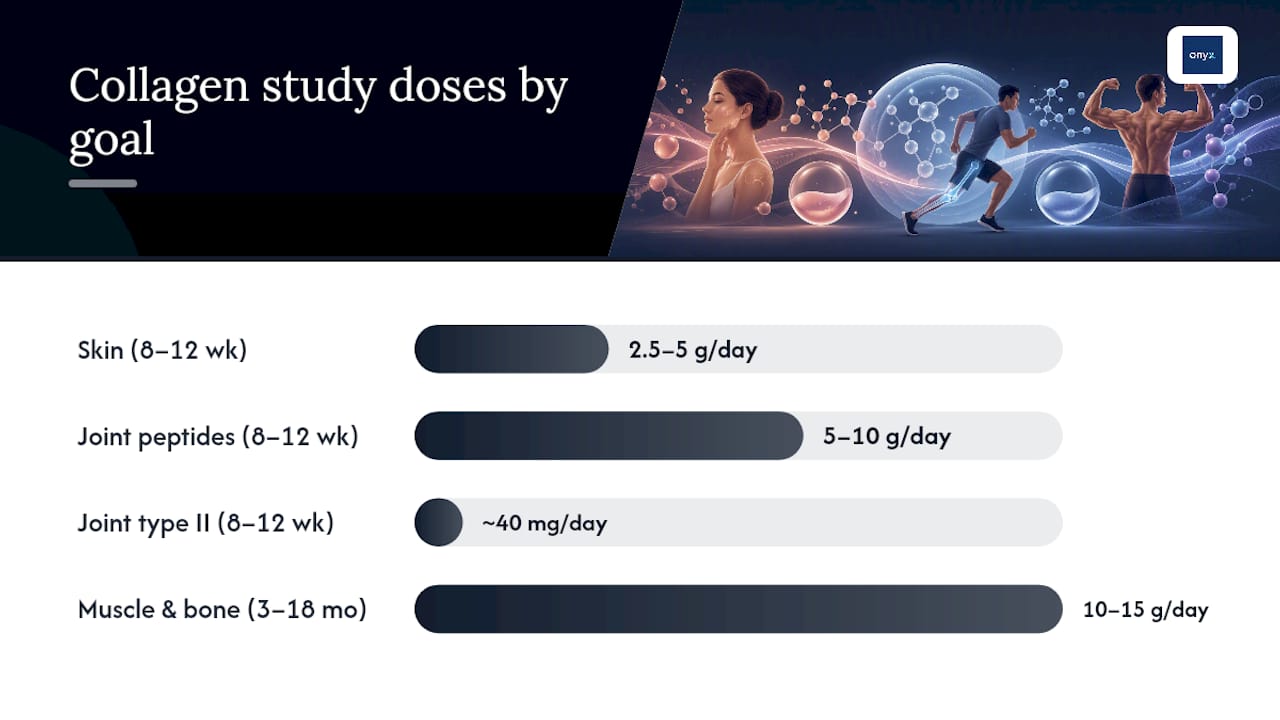
For skin, randomized trials commonly use 2.5 to 5 grams daily, with improvements in elasticity and hydration showing up after several weeks to a few months of consistent use. Higher doses and specific peptide formulations sometimes produce stronger or longer-lasting results, but the low end is where most of the skin research lives.
For joint health, collagen peptides in the 5 to 10 gram range are typical, while undenatured type II collagen studies for knee osteoarthritis often use just 40 milligrams daily because it works through immune modulation rather than raw supply. Outcomes measured include pain scores and physical function, generally assessed over 8 to 12 weeks.
For muscle and bone, trials pushing 10 to 15 grams daily are usually paired with resistance training or studied in postmenopausal women tracking bone mineral density. These effects take longer to appear, often 3 to 18 months, since bone and lean mass respond more slowly than skin.
| Goal | Common Study Dose | Typical Timeframe |
|---|---|---|
| Skin elasticity | 2.5–5 g/day | 8–12 weeks |
| Joint comfort (peptides) | 5–10 g/day | 8–12 weeks |
| Joint comfort (type II) | ~40 mg/day | 8–12 weeks |
| Muscle/bone support | 10–15 g/day | 3–18 months |
Safety, Side Effects, and Who Should Check With a Doctor First
Collagen is generally well tolerated, but “generally” isn’t “universally.” Mild bloating, a feeling of fullness, or a faint aftertaste are the most common complaints, and formulation quality plays a real role in whether you notice them. Products loaded with sugar alcohols, artificial sweeteners, or filler ingredients tend to cause more digestive complaints than clean, simple peptide blends.
Supplements sit outside FDA premarket approval for safety and effectiveness, which means the burden of reading labels carefully and buying from transparent brands falls on you, the consumer.
A few groups should talk to a clinician before starting: pregnant or breastfeeding individuals, anyone with kidney disease, people managing multiple medications, and those with known food allergies (collagen is often sourced from bovine, marine, or poultry origins). Quick checklist before you start:
- Confirm the collagen source doesn’t conflict with a known allergy
- Start at the lower end of the range if you have a sensitive stomach
- Pause and consult a doctor if you notice unusual digestive symptoms
- Follow the manufacturer’s labeled serving size rather than eyeballing it
How to Take Collagen and Choose a Quality Product
Consistency beats intensity here. A modest daily dose taken every day for 8 to 12 weeks will outperform sporadic high doses, so pick an amount at the low end of your goal range and stick with it before deciding to increase.
Pairing collagen with vitamin C is one of the most consistently recommended strategies, since vitamin C is a cofactor your body needs for collagen synthesis. A glass of orange juice, a vitamin C supplement, or simply eating citrus alongside your collagen serving covers that base without extra effort.
Timing is flexible. Powders mix easily into coffee, smoothies, or oatmeal. Strips work well for anyone who wants a grab-and-go option without water, which matters if mornings are rushed or travel disrupts your usual routine. Watch the sugar content on gummies and flavored powders, since some brands lean heavily on sweeteners to mask collagen’s naturally neutral taste.
Pro Tip: If a product doesn’t list grams (or milligrams) of collagen per serving directly on the front or back label, treat that as a red flag, not an oversight.
Before buying, run through this checklist:
- Clear labeling of peptide type (hydrolyzed vs. undenatured type II)
- Grams (or milligrams) per serving stated plainly, not buried in a proprietary blend
- Third-party testing or transparent sourcing information
- A clean ingredient list without unnecessary fillers or excess sugar
Onyxwellness Beauty and Collagen Strips: A Convenient Daily Option
If measuring powder or swallowing capsules isn’t realistic for your routine, a dissolvable format solves the consistency problem. Onyxwellness Beauty + Collagen Strips dissolve without water, which makes hitting a daily habit easier than remembering a scoop or a pill bottle.
The best collagen dose is the one you actually take every single day, and a format that fits your morning without friction is worth more than a slightly higher gram count you skip half the week.
Check the strip’s label for exact grams per serving and follow the recommended number of strips to land inside the skin-focused range discussed earlier. Onyxwellness formulates its strips sugar-free and lists ingredients transparently, which matters given how much variability exists across the collagen category.
- Fast-dissolving format, no water or mixing required
- Sugar-free formulation for easier daily use
- Clear label reminding you to check grams per serving
Choosing a Dose That Fits Your Actual Life
Start low if skin is your main goal. There’s little evidence that stacking more grams beyond the 5-gram range meaningfully accelerates results for elasticity or hydration, so there’s no reason to overspend on a bigger dose than the research supports. If joint or bone outcomes are what you’re after, you can move toward the higher end more deliberately, especially if you’re pairing collagen with resistance training. Give any regimen 8 to 12 weeks before judging it, and loop in a clinician if you’re managing a chronic condition or taking multiple medications.
A Simple Way to Hit Your Daily Collagen Goal
Reading dose ranges is one thing. Actually hitting your target every day without measuring powder or swallowing extra pills is another problem entirely. That’s where Onyxwellness Beauty + Collagen Strips come in: a dissolvable format built for people who want the skin-support dose range covered without adding another step to their morning.

Each strip is formulated sugar-free with clear labeling, so you know exactly what you’re getting per serving instead of guessing at scoop sizes. Pair it with a vitamin C source, follow the label’s recommended serving count, and check with your doctor first if you fall into a higher-risk group. If bone or joint support is more your focus, Onyxwellness also carries Bone Support Strips worth pairing into your routine. Visit the Beauty + Collagen Strips product page to check current servings and start your first order today.
Sources
- Should you take collagen supplements? | UCLA Health
- Significant Amounts of Functional Collagen Peptides Can Be Incorporated in the Diet While Maintaining Indispensable Amino Acid Balance - PMC
- Collagen: What It Is, Types, Function & Benefits
- Fda
This article is general information, not a substitute for advice from a qualified doctor. Consult a qualified healthcare professional about your own circumstances before acting on anything here.
FAQ
How much collagen should I take per day?
Most people benefit from 2.5 to 15 grams of hydrolyzed collagen peptides daily, with the exact amount depending on whether your goal is skin, joints, or muscle and bone support.
Does vitamin C help collagen absorption?
Vitamin C is a required cofactor for collagen synthesis in the body, which is why many people pair their daily collagen with a vitamin C source like citrus or a supplement.
How long does it take to see results from collagen?
Skin improvements often appear within 8 to 12 weeks, while joint and bone outcomes can take several months of consistent daily use.
Is 40 milligrams of collagen enough?
Yes, but only for undenatured type II collagen, which works through immune modulation rather than supplying amino acids, unlike hydrolyzed peptides that require gram-level doses.
Are collagen strips as effective as powders?
Collagen strips deliver the same hydrolyzed peptides as powders in a dissolvable format, and effectiveness depends on grams per serving rather than the delivery method itself.