


TL;DR:
- Calcium magnesium supplements provide essential minerals that support bone, muscle, and nerve functions. Proper timing, mineral forms, and dose separation enhance absorption and effectiveness. Using organic acid forms like citrate and glycinate offers better benefits and fewer side effects.
Calcium magnesium supplements are combined mineral formulas that deliver two of the body’s most critical nutrients in a single dose, supporting bone density, muscle relaxation, nerve signaling, and metabolic health. The NIH Office of Dietary Supplements sets the adult upper limit for supplemental calcium at 2,500 mg per day for adults under 50 and 2,000 mg per day for those over 50, while the supplemental magnesium upper limit sits at 350 mg per day, separate from dietary intake. These two minerals work best when you understand how they interact, which forms absorb most efficiently, and when to take them. Getting that right makes a real difference in how much benefit you actually feel.
How do calcium magnesium supplements interact in the body?
Calcium and magnesium share intestinal absorption pathways, which means taking large doses of both at the same time creates a competition for uptake. When one mineral floods the transport channels, the other gets crowded out. This is not a flaw in the supplements. It is a basic physiological reality you can work around with smart timing.

The transport channels involved include TRPM6 and TRPM7, which regulate magnesium entry into intestinal cells. Calcium uses overlapping pathways, so high simultaneous doses of both minerals reduce how much of each you actually absorb. The practical fix is straightforward: separate your doses by 2–4 hours when you are taking therapeutic amounts of both minerals.
Calcium absorption also drops significantly as the dose increases. At 300 mg, absorption runs around 36%, but at 1,000 mg it falls to roughly 28%. That gap matters if you are relying on supplements to meet your daily target. Splitting your calcium into two smaller doses across the day recovers much of that lost absorption.
Pro Tip: If you take a combined calcium magnesium tablet, consider splitting it so you take calcium with lunch and magnesium in the evening. You get the convenience of a combined product without sacrificing absorption.
The mineral form also shapes how well each nutrient absorbs. Organic acid forms like citrate, malate, and glycinate dissolve more readily in the gut than inorganic forms like carbonate and oxide. Choosing the right form is not a minor detail. It is often the difference between a supplement that works and one that just passes through.
What are the best forms of calcium and magnesium supplements?
The form of a mineral determines both its absorption rate and its side effect profile. Calcium carbonate is the most common form on store shelves because it is cheap and contains a high percentage of elemental calcium. The problem is that it requires strong stomach acid to dissolve, which means it absorbs poorly if taken on an empty stomach and often causes constipation.
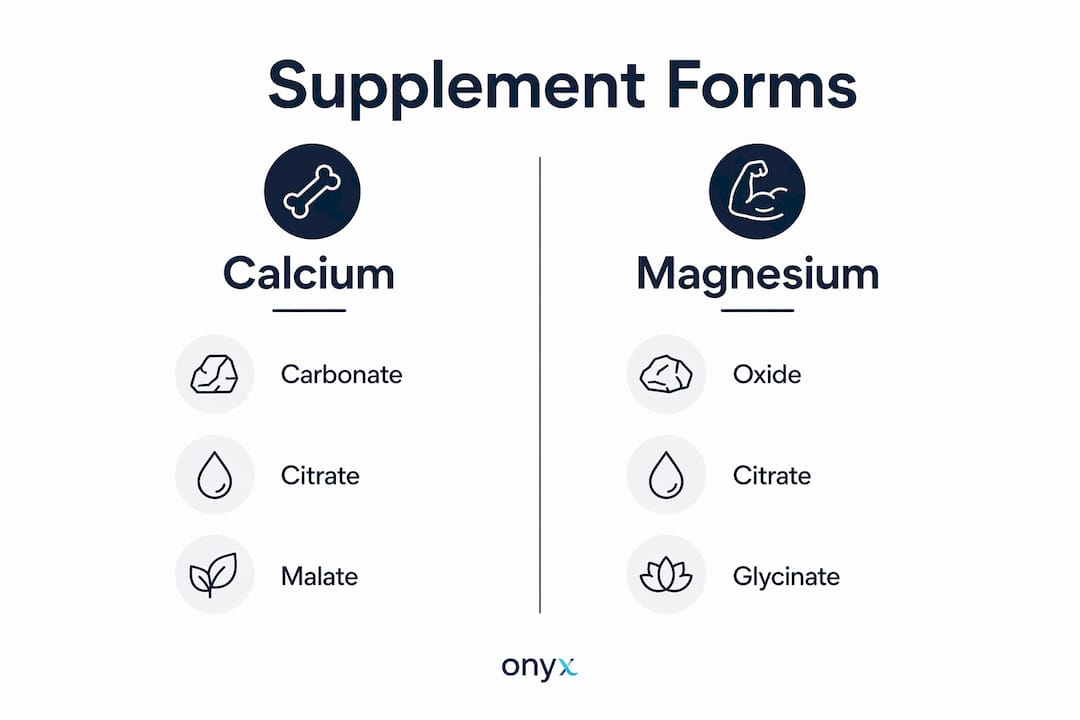
Calcium citrate and calcium malate dissolve without needing high stomach acidity. That makes them a better choice for anyone over 50, anyone taking acid-reducing medications, or anyone who has experienced digestive discomfort with carbonate forms. They cost more, but the improved absorption of organic acid forms justifies the price difference for most people.
Magnesium follows the same pattern. Magnesium oxide is inexpensive and widely available, but it has low bioavailability and is a well-known cause of loose stools at higher doses. Magnesium citrate absorbs better and is gentler on the gut. Magnesium glycinate is the preferred form for evening use because it absorbs efficiently and has a calming effect that supports sleep quality.
Here is a quick comparison of the most common forms:
| Mineral Form | Absorption | Best For | Common Side Effect |
|---|---|---|---|
| Calcium carbonate | Moderate | Budget, with meals | Constipation |
| Calcium citrate | High | Empty stomach, older adults | Minimal |
| Calcium malate | High | Sensitive digestion | Minimal |
| Magnesium oxide | Low | Laxative effect | Loose stools |
| Magnesium citrate | High | General use | Mild GI upset at high doses |
| Magnesium glycinate | High | Sleep, anxiety, evening use | Minimal |
Pro Tip: Read the supplement label carefully. “Magnesium 300 mg” may refer to the compound weight, not the elemental magnesium. Look for the elemental amount listed separately to know what you are actually getting.
When reading labels, look for the elemental mineral content, not the compound weight. A product listing “magnesium oxide 500 mg” delivers far less usable magnesium than one listing “magnesium glycinate 300 mg elemental.” That distinction is easy to miss and easy to get wrong.
What is the optimal dosage and timing for calcium and magnesium?
Getting the timing right is where most people leave real benefit on the table. The sequence and schedule you follow affects how much of each mineral your body actually uses.
-
Take calcium with meals. Stomach acid produced during digestion helps dissolve calcium, especially carbonate forms. Vitamin D enhances calcium absorption, and meals containing fat help vitamin D absorb, creating a compounding benefit when you time calcium with food.
-
Split calcium doses above 500 mg. Absorption efficiency drops sharply at higher single doses. If your daily calcium target from supplements is 1,000 mg, take 500 mg at lunch and 500 mg at dinner rather than both at once.
-
Take magnesium in the evening. Magnesium glycinate taken at night supports relaxation and may improve sleep quality. Evening dosing also avoids competition with calcium if you took calcium earlier in the day.
-
Separate calcium and magnesium by at least 2 hours. When taken together in large amounts, both minerals compete for the same absorption channels. Spacing them out removes that competition entirely.
-
Avoid taking calcium with iron supplements. Calcium and iron also compete for absorption. Separating calcium from iron by at least two hours protects both minerals’ uptake. The same logic applies to zinc.
-
Stay within safe daily limits. The NIH upper limit for supplemental magnesium is 350 mg per day. Calcium from supplements should not exceed 2,000–2,500 mg per day depending on your age. These limits apply to supplements only and do not include what you get from food.
A practical daily schedule might look like this: calcium citrate with breakfast, a second calcium dose with dinner, and magnesium glycinate about an hour before bed. That structure respects absorption biology without requiring a complicated routine.
What are the health benefits and side effects of supplementation?
The calcium magnesium benefits extend well beyond bone health, though bone support remains the most documented advantage. Calcium is the primary structural mineral in bone tissue, and adequate intake throughout life reduces the risk of osteoporosis. Magnesium activates vitamin D, which in turn regulates calcium absorption. Without sufficient magnesium, vitamin D cannot function properly regardless of how much calcium you take.
Magnesium also plays a direct role in metabolic health. A meta-analysis of 384 participants with prediabetes found that oral magnesium supplementation significantly improved insulin sensitivity and two-hour glucose tolerance. That finding positions magnesium as a meaningful tool for metabolic support, not just a mineral for muscles and bones.
The bone support benefits of combined calcium and magnesium are well supported across age groups, with particular relevance for postmenopausal women and older adults who face accelerated bone loss. Cardiovascular health, nerve transmission, and muscle contraction all depend on adequate levels of both minerals as well.
Side effects are real but largely preventable:
- Constipation is the most common complaint with calcium carbonate. Switching to citrate or malate forms resolves this for most people.
- Loose stools or diarrhea occur with high doses of magnesium oxide. Glycinate and malate forms are far gentler.
- Nausea can result from taking supplements on an empty stomach. Taking them with food eliminates this for the majority of people.
- Mineral imbalances can develop if you supplement without accounting for dietary intake. Excess calcium without adequate magnesium can affect parathyroid hormone activity and skew the calcium-to-magnesium ratio in ways that affect hormonal regulation.
The traditional 2:1 calcium-to-magnesium ratio marketed on many supplement labels is not a universal rule. Recent research questions whether that ratio applies equally to everyone, since baseline diet, age, and health status all affect what your body actually needs.
Key Takeaways
Calcium and magnesium supplements deliver the most benefit when you choose the right mineral forms, split doses strategically, and time intake to avoid absorption competition.
| Point | Details |
|---|---|
| Choose organic acid forms | Citrate, malate, and glycinate absorb better and cause fewer side effects than carbonate or oxide. |
| Split doses above 500 mg | Calcium absorption drops at higher single doses; splitting doses across meals recovers lost uptake. |
| Separate calcium and magnesium | Taking both together in large amounts reduces absorption; space doses by at least 2 hours. |
| Take magnesium in the evening | Magnesium glycinate at night supports relaxation and avoids competition with daytime calcium doses. |
| Account for dietary intake | Supplementing without knowing your food baseline risks skewing mineral ratios and hormonal balance. |
Why the form matters more than the ratio
Most people shopping for a magnesium calcium supplement spend their time comparing ratios on the label. I spent years doing the same thing. The 2:1 calcium-to-magnesium ratio is everywhere in supplement marketing, and it sounds authoritative. The problem is that ratio tells you almost nothing about whether the product will actually work for you.
What I have found consistently is that the mineral form is the variable that changes outcomes. Someone switching from magnesium oxide to magnesium glycinate often notices better sleep and less digestive discomfort within a week. That same person could spend months adjusting their 2:1 ratio and never feel a difference. The form is where the real leverage is.
The other thing worth saying plainly: supplements are not a substitute for food. Dairy, leafy greens, nuts, and seeds provide calcium and magnesium in forms your body recognizes well. Supplements fill gaps. They do not replace a diet that is missing these minerals entirely. If your diet is consistently low in both minerals, you will likely need higher supplemental doses, and that is exactly when consulting a healthcare provider becomes worth the effort. They can run a serum magnesium test and a dietary assessment that tells you far more than any label ratio ever could.
If you are considering potassium magnesium aspartate or other mineral combinations for metabolic support, the same principle applies. Form and timing matter more than the number on the front of the bottle.
— Chris
Onyxwellness strips for bone and mineral support
Getting consistent mineral intake is easier when the format fits your life. Onyxwellness offers Bone Support Strips designed to support calcium and magnesium needs through a fast-absorbing, dissolvable format that requires no water and no pill-swallowing routine.

The strips align with the Ayurvedic-inspired approach Onyxwellness takes across its product line, combining quality ingredients with a delivery format built for modern schedules. If sleep support is also a priority, the Sleep Strips pair naturally with an evening magnesium routine. Both products are available at the Onyxwellness store and fit cleanly into the timing strategies covered above.
FAQ
What is the recommended daily dose of calcium and magnesium?
The NIH sets the supplemental upper limit at 2,500 mg per day for calcium in adults under 50 and 350 mg per day for magnesium from supplements. These limits apply to supplemental intake only and do not include amounts from food.
Should I take calcium and magnesium at the same time?
Taking high doses of both together reduces absorption because they compete for the same intestinal pathways. Separating doses by 2–4 hours gives each mineral a better chance at full uptake.
Which form of magnesium is best for sleep?
Magnesium glycinate is the preferred form for evening use because it absorbs efficiently and has a calming effect that may improve sleep quality without causing digestive upset.
Can calcium magnesium supplements cause side effects?
Yes, though most side effects are form-dependent. Calcium carbonate commonly causes constipation, and magnesium oxide can cause loose stools. Switching to citrate, malate, or glycinate forms resolves most gastrointestinal issues.
Does magnesium help with bone health?
Magnesium activates vitamin D, which directly regulates calcium absorption into bone tissue. Without adequate magnesium, vitamin D cannot function properly, making magnesium for bone health just as important as calcium itself.