


Short answer: yes, ashwagandha can help you sleep, but the effect is modest, not a knockout. Trial data consistently point toward small, measurable improvements in sleep quality, not the sedating punch of a prescription sleep aid.
The best-studied extracts are KSM-66 and Shoden, both standardized for withanolide content, the group of compounds believed to drive ashwagandha’s calming effects. Most trials used doses between 250 and 600 mg per day, and the 2021 systematic review and meta-analysis found the strongest results at 600 mg/day or higher, taken for eight weeks or more.
Ashwagandha is not a substitute for medical treatment of chronic insomnia. It works best as a low-risk addition to a broader sleep routine, not a stand-alone fix.
Before you start, know the exclusions: pregnancy, breastfeeding, certain thyroid or autoimmune conditions, and specific medication interactions rule it out for some people.
- Best-supported extracts: KSM-66, Shoden
- Typical effective range: 250 to 600 mg/day
- Stronger effects reported: 600 mg/day or more, for 8+ weeks
- Safety flags: pregnancy, breastfeeding, thyroid disease, liver conditions, sedative or immunosuppressant interactions
Key Takeaways
Ashwagandha extract, taken at 500 to 600 mg/day for eight weeks or longer, produces a small but consistent improvement in sleep quality for many adults, though it works best as a complement to good sleep habits rather than a stand-alone cure.
| Point | Details |
|---|---|
| Effect size is modest | The 2021 meta-analysis found a small but statistically significant sleep improvement (SMD -0.59), not a dramatic one. |
| Dose and duration drive results | Benefits were strongest at 600 mg/day or higher, sustained for 8 or more weeks. |
| Extract choice matters | KSM-66 and Shoden are the standardized extracts with the clearest trial support; unstandardized products are harder to trust. |
| Safety exclusions are real | Pregnancy, breastfeeding, thyroid disease, autoimmune conditions, and several drug classes warrant caution or avoidance. |
| Convenient formats help consistency | Onyx Wellness Sleep Strips offer a fast-absorbing option for people who want an easier way to stay consistent through the multi-week trial window research suggests. |
Table of Contents
- What Is Ashwagandha, and Which Extracts Matter for Sleep?
- Does Ashwagandha Help With Sleep? What the Clinical Evidence Says
- Ashwagandha Dosage for Sleep: How Much, When, and How Long
- Ashwagandha and Insomnia: Safety, Side Effects, and Who Should Avoid It
- How Ashwagandha May Work Biologically to Improve Sleep
- What the Evidence Doesn’t Show, and How to Decide
- Combining Ashwagandha With Melatonin: What Newer Research Suggests
- Where Ashwagandha Fits in a Real Sleep Plan
- Try Onyx Wellness Sleep Strips as a Convenient Way to Start
- Sources
- FAQ
What Is Ashwagandha, and Which Extracts Matter for Sleep?
Ashwagandha (Withania somnifera) is a root herb used in Ayurvedic medicine for centuries, often labeled “Indian ginseng” even though it’s botanically unrelated to ginseng. Traditional use centered on resilience to stress and fatigue, which is part of why modern sleep research on it exists at all: poor sleep and chronic stress tend to travel together.
Clinical trials rarely use generic ashwagandha powder. They use standardized extracts with a guaranteed withanolide concentration, since withanolide content varies wildly between raw root and inconsistent commercial powders. Two names show up again and again in the research:
- KSM-66: a root-only extract, commonly dosed at 300 mg twice daily in trials
- Shoden: a higher-concentration extract (around 21 mg withanolide glycosides per 60 mg capsule), often dosed at lower total milligrams because of its potency
This matters more than most labels admit. A capsule that just says “ashwagandha 500 mg” with no standardization percentage could contain a fraction of the active compound used in the studies that produced the sleep results people cite.
Pro Tip: Check the label for two things: whether it says “root extract” or “root and leaf,” and whether it lists a specific withanolide percentage (usually 2.5% to 5%). If neither appears, you’re guessing at the dose, not measuring it.
Does Ashwagandha Help With Sleep? What the Clinical Evidence Says
Yes, according to the best available evidence, and the 2021 meta-analysis published in PLOS One is the closest thing to a definitive answer researchers have produced so far. It pooled five randomized controlled trials and found a small but statistically significant improvement in overall sleep with ashwagandha extract versus placebo, with a standardized mean difference of -0.59 (95% CI -0.75 to -0.42). That’s a real effect, not a rounding error, but it’s not a dramatic one either.
The pattern that emerges across trials is consistent: benefits show up more reliably at higher doses and longer durations.
The meta-analysis found effects were more prominent at doses of 600 mg per day or higher and in trials lasting eight weeks or longer, a pattern that held even when researchers adjusted for differences in extract type.
One of the most frequently cited individual trials, a randomized, double-blind, placebo-controlled study by Deshpande and colleagues (2020), gave adults with non-restorative sleep an ashwagandha extract and tracked outcomes with both subjective questionnaires and objective actigraphy, wrist-worn devices that measure movement as a proxy for sleep and wake states. Participants reported better sleep quality, and the actigraphy data backed it up: fewer awakenings and improvements in what researchers call sleep efficiency, the percentage of time in bed actually spent asleep.
The NIH Office of Dietary Supplements summarizes the broader trial landscape similarly: limited but consistent evidence that ashwagandha extracts can improve sleep quality, sleep efficiency, total sleep time, and sleep latency (how long it takes to fall asleep). Two subgroup patterns stand out across the literature:
- People with diagnosed insomnia tend to see larger improvements than healthy volunteers without sleep complaints
- Doses at or above 600 mg/day, sustained for 8 or more weeks, produced more consistent results than shorter, lower-dose regimens
That second point deserves a plain reading: if you take a low dose for two weeks and see nothing, that’s not necessarily proof ashwagandha doesn’t work for you. It may just mean you haven’t given it the dose or the runway the trials used.
Now for the honest caveats, because an evidence-based approach means naming the limits, not just the wins. Most trials remain small, frequently enrolling fewer than 100 participants. A large share were conducted in India, where ashwagandha has deep traditional use, which raises fair questions about how well results generalize across different populations, diets, and baseline sleep patterns. Trial durations rarely stretch past 12 weeks, so nobody has good data on what happens if you take ashwagandha for six months or a year. And because different trials use different extracts (KSM-66 in one, Shoden in another, unspecified “ashwagandha extract” in a third) at different doses, comparing results directly is messier than a single headline statistic suggests.
The Sleep Foundation’s consumer guide puts this plainly: research commonly uses 300 mg once or twice daily, with more benefit typically reported at 500 to 600 mg/day, but individual response still varies. That variability is the honest bottom line: the average effect across trials is real, but it’s an average, not a guarantee.
Ashwagandha Dosage for Sleep: How Much, When, and How Long
Trial doses cluster in a fairly narrow band, which makes it easier to know what “the research dose” actually means in practice:
- Shoden: roughly 120 mg/day (a lower total dose thanks to its higher withanolide concentration)
- KSM-66: commonly 300 mg twice daily (600 mg/day total)
- General trial range: 250 to 600 mg/day across various standardized extracts
The Sleep Foundation and the PLOS One meta-analysis both point the same direction: doses at the higher end of that range, 500 to 600 mg/day or more, tend to outperform lower doses for sleep-specific outcomes.
Timing is less standardized in the research than dosing is. Harvard Health suggests experimenting: some people feel drowsy soon after taking ashwagandha, which points to a bedtime dose, while others notice a calming rather than sedating effect and do better taking it earlier in the day. There’s no universal rule here, because individual response to withanolides varies.
Patience matters more than most people expect. Trials showing the clearest benefits ran for eight weeks or longer. A single week of use, even at 600 mg/day, is unlikely to tell you much. If you’re going to try it, commit to a full two-month window before judging the result.
Pro Tip: Keep a simple sleep diary, bedtime, time you fell asleep, number of wake-ups, wake time, for two weeks before starting and continue through week eight. Without a baseline, it’s nearly impossible to tell whether a change is the herb or just a good week.
Ashwagandha and Insomnia: Safety, Side Effects, and Who Should Avoid It
Most people tolerate ashwagandha reasonably well over the short trial periods studied. The most commonly reported side effects are mild: stomach upset, nausea, and daytime drowsiness, especially at higher doses. Less common but more serious concerns have surfaced in case reports, including effects on liver function and thyroid hormone levels, which is part of why the NIH fact sheet is careful to flag long-term safety as an open question rather than a settled one.
Certain groups should skip ashwagandha entirely or only use it under medical supervision:
- Pregnant or breastfeeding individuals
- People with active autoimmune disease (ashwagandha may stimulate immune activity)
- People with prostate cancer or a history of hormone-sensitive cancers, out of caution around its hormonal effects
- Anyone with thyroid disease, since ashwagandha can increase thyroid hormone levels
Drug interactions are the other piece people underestimate. Ashwagandha may amplify the effects of blood pressure medications, diabetes medications, thyroid hormone replacement, immunosuppressants, and sedatives, including other sleep aids.
If you’re on any prescription medication, particularly for blood pressure, blood sugar, thyroid function, or immune suppression, talk to a pharmacist or clinician before adding ashwagandha. The interaction risk is real even when the sleep benefit is modest.
Harvard Health echoes this recommendation directly, and it’s worth taking seriously precisely because the upside is modest. A low-risk supplement stops being low-risk the moment it interacts with something you’re already taking.
How Ashwagandha May Work Biologically to Improve Sleep
The leading theory centers on withanolides, the steroidal compounds unique to ashwagandha, and their apparent effect on the body’s stress response. Some research suggests withanolides help modulate cortisol, the primary stress hormone, and may interact with GABA receptors, the same neurotransmitter system targeted by many prescription sedatives.
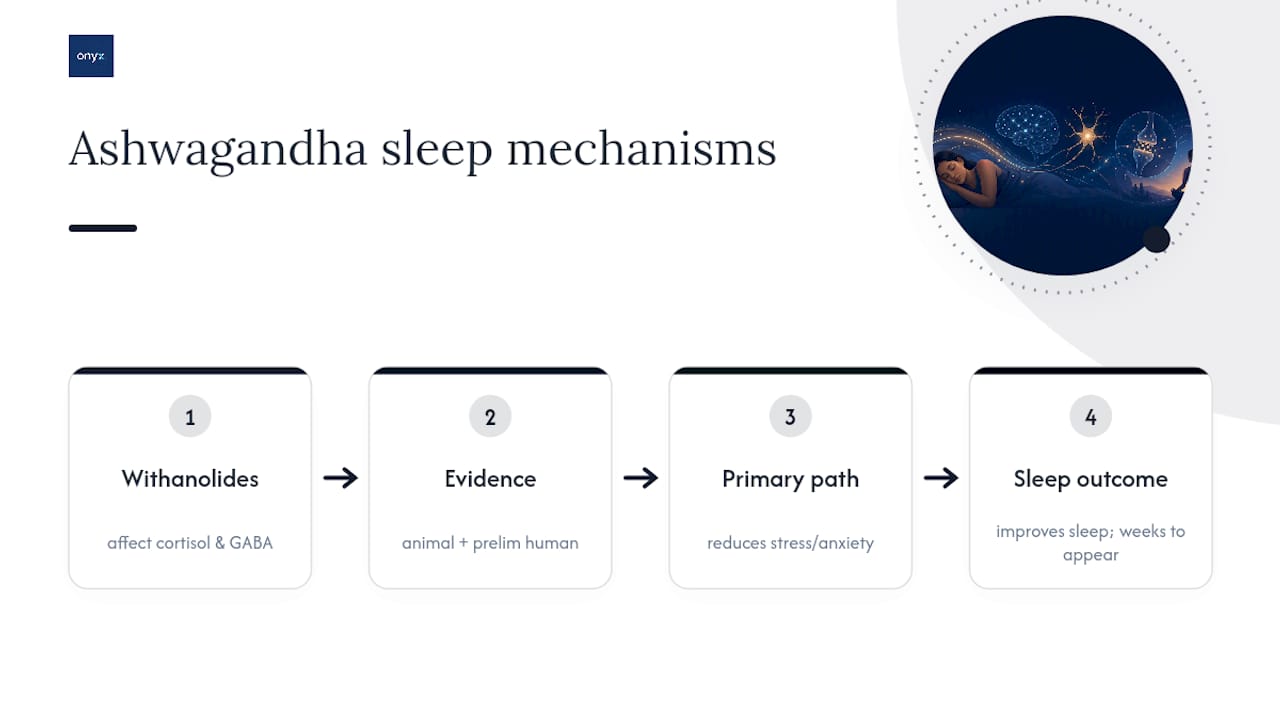
Here’s the important distinction: much of this mechanism is supported by animal studies and preliminary human biomarker data, not confirmed human sleep-lab research. That’s a meaningfully different evidence tier than the clinical sleep-outcome trials described earlier, and it should be labeled as such rather than presented as settled biology.
The more practical, better-supported mechanism is simpler: ashwagandha appears to reduce subjective stress and anxiety, and calmer minds tend to fall asleep faster. That secondary pathway, less stress leading to better sleep rather than a direct sedative effect, may explain why benefits often take weeks to appear rather than hours.
What the Evidence Doesn’t Show, and How to Decide
Three limitations deserve a second look before you decide anything: the trial base is still small, the follow-up windows rarely exceed 12 weeks, and formulation differences between studies make dose comparisons inexact.
Run through this checklist before starting:
- Confirm none of the medical exclusions apply to you (pregnancy, breastfeeding, thyroid disease, autoimmune conditions).
- List your current medications and check for interaction risk with a pharmacist.
- Set a realistic timeline: commit to 8 weeks minimum before evaluating results.
- Define what “working” looks like for you (falling asleep faster, fewer wake-ups, feeling more rested) so you have a measurable goal.
If eight weeks pass with no change, or if your sleep problems are severe, persistent, or tied to a diagnosed condition, it’s worth exploring evidence-based alternatives like cognitive behavioral therapy for insomnia (CBT-I), which has a considerably larger and more consistent evidence base than any single supplement.
Combining Ashwagandha With Melatonin: What Newer Research Suggests
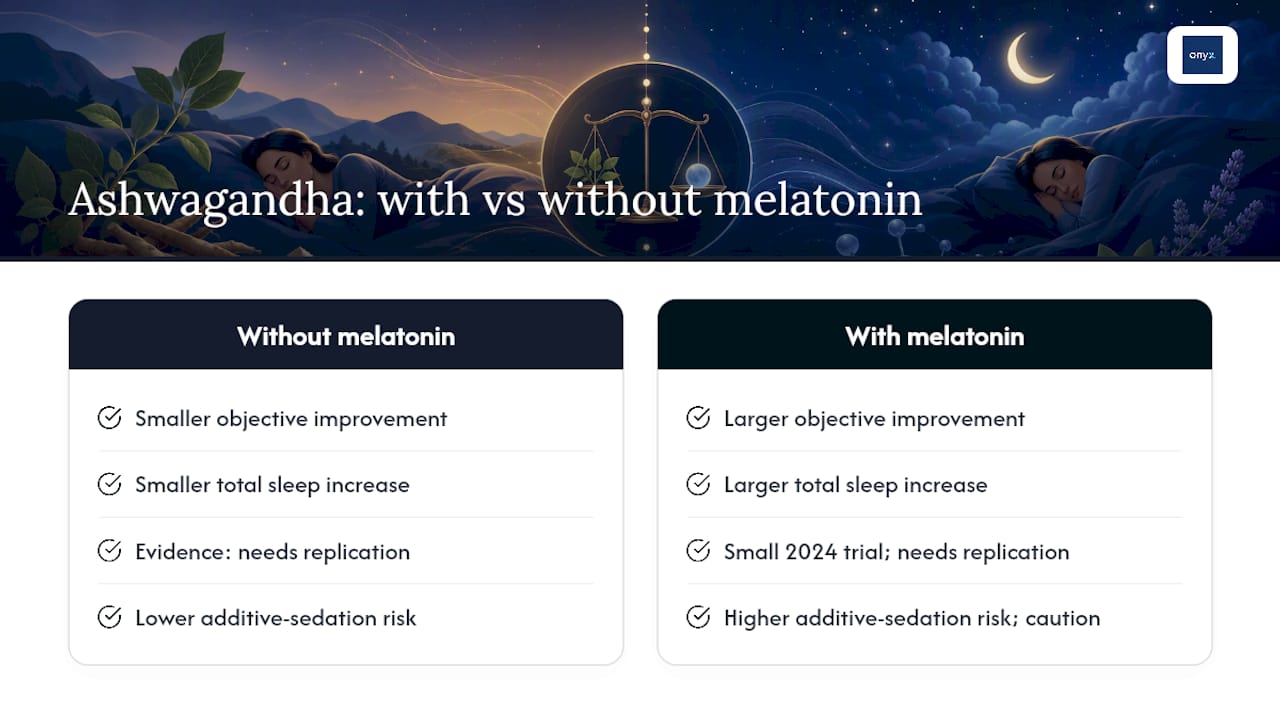
A small trial reported in 2024 found that adding low-dose melatonin (3 mg/day) to ashwagandha produced larger objective improvements, in both sleep onset latency and total sleep time, than ashwagandha alone. The sample size was small, so treat this as an interesting early signal rather than a settled recommendation.
Combining ashwagandha with melatonin looks promising in preliminary data, but small trial sizes mean the finding needs replication before it can guide standard practice.
The practical caution here matters as much as the finding itself: stacking two agents that both influence sleep and relaxation raises the risk of additive sedation, especially if you’re also taking prescription sleep medication or anything with a sedative effect. Check with a clinician before combining.
Formulation also affects how you should read any of these results. Single-ingredient standardized extracts like KSM-66 or Shoden let researchers isolate what ashwagandha specifically does. Multi-ingredient blends make that harder, since you can’t always tell which ingredient drove the result. That’s worth knowing before you assume a blended herbal formula will replicate a single-extract trial’s outcome.
Where Ashwagandha Fits in a Real Sleep Plan
The evidence points to a specific, limited role: ashwagandha is a reasonable, low-risk option for adults with mild to moderate sleep disruption tied to stress, especially when taken at 500 to 600 mg/day for eight weeks or longer. It is not a replacement for treating diagnosed insomnia, sleep apnea, or other clinical sleep disorders, and anyone in that category should talk to a doctor before treating a supplement as the primary fix.
What earns ashwagandha a place on the shortlist of best herbs for sleep is the consistency of the data, not its size. Small, reproducible effects across multiple trials carry more weight than a single flashy study. Product transparency matters here too: knowing exactly which extract, dose, and standardization you’re getting is the difference between following the research and guessing at it.
Try Onyx Wellness Sleep Strips as a Convenient Way to Start
If the biggest barrier to trying ashwagandha consistently is remembering to take a capsule with water every night, a dissolvable format solves a real, practical problem rather than a made-up one. Onyx Wellness Sleep Strips dissolve on the tongue in seconds, no water, no swallowing a pill at 11 p.m. when you’re already half-asleep, which makes the eight-week consistency this research calls for a lot easier to actually stick to.
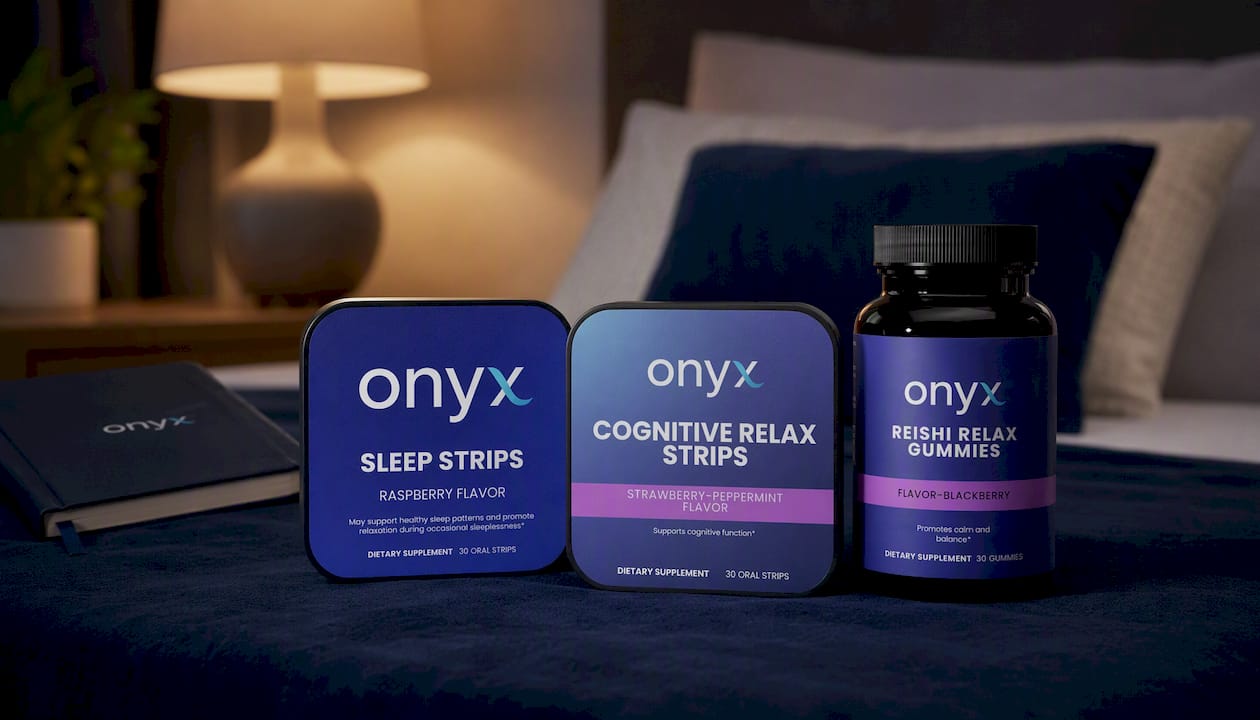
Onyx Wellness builds its full catalog around that same fast-absorbing, sugar-free approach. If stress is part of your sleep problem, Reishi Relax Gummies pair a calming mushroom extract with a format that’s easy to add to an evening routine. For daytime needs, Mushroom Focus Strips support mental clarity without the crash of caffeine, while Digestive + Gut Health Strips, Iron Strips, Hair, Skin and Nails Strips, Beauty + Collagen Strips, Bone Support Strips, and Hangover Strips round out a broader wellness routine.
As with any supplement, check with your clinician before combining strips with prescription medication, and follow the label directions on every product. Ready to see if a fast-absorbing format fits your routine better than a bottle of capsules? Browse Sleep Strips and start with a single serving tonight.
Sources
- Ashwagandha: Is it helpful for stress, anxiety, or sleep? - Health Professional Fact Sheet
- Effect of Ashwagandha (Withania somnifera) extract on sleep
- Ashwagandha for Sleep | Sleep Foundation
- Ashwagandha: Benefits, side effects, and safety concerns - Harvard Health
FAQ
Does Ashwagandha Actually Help You Sleep?
Yes, for many adults. Clinical trials show a small but statistically significant improvement in sleep quality, sleep latency, and total sleep time, with the strongest effects at 600 mg/day or higher taken for eight weeks or more.
Is It Okay to Take Ashwagandha at Night Before Bed?
For most healthy adults, yes, and many people take it at bedtime because it tends to feel calming or mildly drowsy-inducing. Some people respond differently and do better taking it earlier in the day, so Harvard Health suggests testing your own response before locking in a routine.
Why Should You Be Careful With Ashwagandha?
It can interact with medications for blood pressure, blood sugar, and thyroid function, and it isn’t recommended during pregnancy, while breastfeeding, or for people with autoimmune disease or hormone-sensitive cancers. Long-term safety data beyond a few months of use remains limited.
How Quickly Does Ashwagandha Make You Sleepy?
Some people notice mild drowsiness within hours of a dose, but the sleep-quality improvements seen in trials typically build over weeks, not days. Most studies showing clear benefits ran for eight weeks or longer before measuring results.
What Dose of Ashwagandha Is Best for Sleep?
Research most often uses 300 mg to 600 mg per day of a standardized extract like KSM-66 or Shoden, with 500 to 600 mg/day showing the most consistent benefit across trials.