


Most clinical trials use 150 to 600 milligrams a day of standardized ashwagandha root extract, and the strongest results for stress and sleep tend to cluster around 300 to 600 milligrams daily. Benefits typically take several weeks to show up, and the short-term safety record extends to about three months. If you’re on medication or managing a health condition, talk to your doctor before starting.
TL;DR:
- Most effective doses for stress and sleep benefits cluster around 300 to 600 milligrams of standardized extract daily, with improvements often appearing after six to eight weeks.
- The potency of standardized extracts like KSM-66 or Sensoril varies by withanolide percentage, making product selection and dosing comparison crucial for consistent results.
- Long-term safety data is limited beyond three months, and rare cases of liver injury have been reported at doses above 450 milligrams daily, emphasizing cautious use.
- Dosing should be tailored to your specific goal, with morning or split dosing for stress, and evening doses for sleep, respecting the 8-12 weeks timeline for noticeable effects.
- Always consult a healthcare provider before combining ashwagandha with medications and avoid use during pregnancy or breastfeeding.
Table of Contents
- How Much Ashwagandha Should You Take? What the Research Shows
- What’s the Right Ashwagandha Dosage for Your Specific Goal?
- Why Does the Type of Ashwagandha Extract Change Your Dosage?
- When Is the Best Time to Take Ashwagandha, and Should You Cycle It?
- Is Ashwagandha Safe? Side Effects and Drug Interactions to Know
- How Should You Start Taking Ashwagandha as a Beginner?
- Who’s Behind This Guidance, and What Onyxwellness Prioritizes
- What Actually Matters When You’re Deciding on a Dose
- Convenient Ways to Support Your Routine With Onyxwellness
- Sources
- FAQ
How Much Ashwagandha Should You Take? What the Research Shows
Ashwagandha dosing research is messier than most supplement marketing lets on. Trials have used doses ranging from as little as 10 milligrams to as much as 12,000 milligrams a day of root extract, which tells you the plant has been studied in wildly different forms and concentrations. But once you filter out the outliers, a clear pattern emerges: most standardized-extract trials land in the 150 to 600 milligram range, and the doses tied to the biggest effects tend to sit at the higher end of that band.
Why does this matter for you? Because it means the “right” ashwagandha dosage isn’t one number. It’s a range shaped by what you’re treating, how the extract was made, and how long you’re willing to stick with it.
A taskforce convened by the World Federation of Societies of Biological Psychiatry and the Canadian Network for Mood and Anxiety Treatments issued a provisional recommendation in 2022 favoring 300 to 600 milligrams a day of standardized root extract for generalized anxiety disorder, while noting the evidence still isn’t strong enough for a firm clinical guideline. That’s a meaningful signal. Professional bodies don’t hand out provisional nods lightly, and this one puts a number on what a lot of smaller studies had already been hinting at.
Several trials reported reduced cortisol levels and lower stress or anxiety symptom scores at 300 to 600 milligrams per day, with the most pronounced improvements often showing up closer to 500 to 600 milligrams. Systematic reviews echo this, though they’re careful to flag the catch:
- Trials vary widely in which extract they use, making direct comparisons tricky
- Sample sizes tend to be small, often a few dozen to a couple hundred participants
- Most published research comes from a handful of countries, limiting how broadly results generalize
- Study duration is usually short, six to twelve weeks, so long-term effects are still largely unknown
One systematic review of Withania somnifera trials found small-to-moderate benefits for stress, anxiety, and sleep, but stopped short of calling the evidence definitive. That’s the honest state of the science right now: promising, consistent enough to guide a starting dose, but not yet airtight.
What’s the Right Ashwagandha Dosage for Your Specific Goal?
The dose that helps you sleep isn’t necessarily the dose that helps you recover from a workout. Ashwagandha research splits fairly cleanly by goal, and knowing which bucket you fall into makes your decision a lot less abstract.
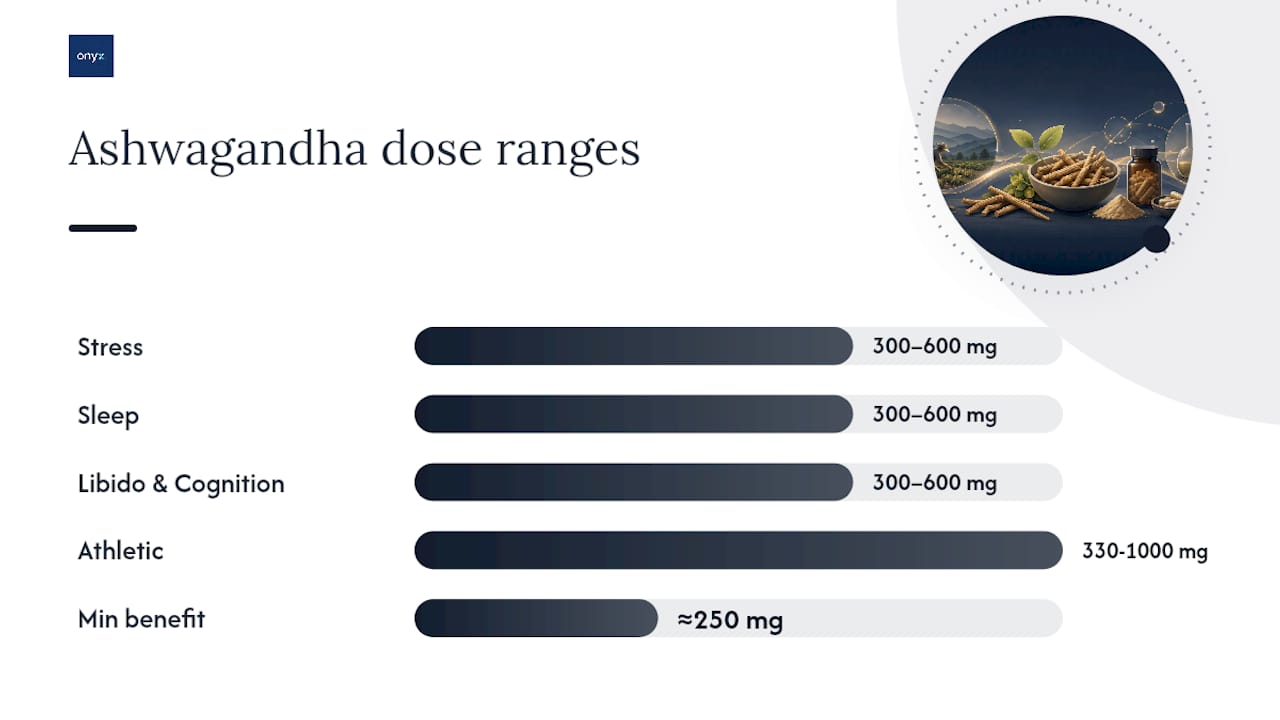
For stress and anxiety, the sweet spot in most trials is 300 to 600 milligrams a day of standardized extract, taken consistently. Trials testing this range have shown measurable drops in perceived stress and anxiety scales, often within four to eight weeks. This is also the range the WFSBP/CANMAT taskforce pointed to, which makes it the most evidence-backed starting point if stress is your primary target.
For sleep, doses in the same 300 to 600 milligram window show up again, but the timeline matters more here. Improvements in sleep latency and sleep quality are more consistently reported after eight or more weeks of steady use rather than after a few nights. If insomnia or restless nights are what brought you here, patience matters as much as the dose itself. Onyxwellness’s own breakdown of ashwagandha and sleep research digs deeper into that timeline if you want the fuller picture.
For athletic performance and recovery, the evidence gets more scattered. Small trials have tested doses from roughly 330 to 1,000 milligrams a day, with some showing gains in VO2 max, strength measures, and reduced perceived fatigue. But heterogeneity across these studies is high, meaning results don’t always replicate cleanly from one trial to the next. If you’re an athlete curious about Ayurvedic recovery approaches more broadly, Onyxwellness’s guide to dosha-based recovery routines offers useful context alongside the dosing data.
For libido and cognitive function, trials have again used the familiar 300 to 600 milligram range, testing outcomes like sexual satisfaction scores and measures of attention or memory. The signal here is encouraging but thinner than the stress and sleep research, largely because fewer trials have been run and sample sizes are smaller.
Across every one of these categories, one thing stays constant: nobody is finding strong benefits below roughly 250 milligrams a day of standardized extract, and nobody is finding meaningfully better outcomes by pushing far past 600 milligrams outside of a handful of outlier studies.
Why Does the Type of Ashwagandha Extract Change Your Dosage?
Here’s something a lot of dosage charts skip entirely: a milligram of ashwagandha is not a fixed unit. Whole-root powder and standardized extract are different products with different potency, and mixing them up in your head is where most dosing confusion starts.
Standardized extracts like KSM-66, Sensoril, and Shoden are concentrated and calibrated to a specific withanolide percentage, commonly around 5%. Withanolides are the compound group believed to drive much of ashwagandha’s activity, so this percentage functions like a purity marker. Trials report their results in milligrams of this standardized extract, not raw root powder, which is why a 300 milligram dose of KSM-66 is not interchangeable with 300 milligrams of ground root you scooped from a jar.
- Check the label for a named, standardized extract rather than generic “ashwagandha root powder”
- Look for a stated withanolide percentage; if none is listed, the potency is essentially unknown
- Be wary of products bulked out with leaf material instead of root, since this shifts the compound profile and makes dose comparisons meaningless
- Favor extracts backed by a certificate of analysis from a third-party lab where one is available
Pro Tip: If a product doesn’t list which extract it uses or what percentage of withanolides it contains, you have no real way to compare its dose to anything studied in a clinical trial. Skip it and look for a standardized formula instead.
When Is the Best Time to Take Ashwagandha, and Should You Cycle It?
Timing should follow your goal, not a generic rule. If daytime anxiety or low energy is the issue, morning dosing makes more sense. If sleep is the target, an evening dose gives the calming effect time to align with bedtime. Some people split the difference entirely.
- Single morning dose: Common in trials targeting general stress reduction, often 300 to 600 milligrams taken once with breakfast.
- Split dosing: Several trials have used regimens like 300 milligrams twice daily, morning and evening, for readers managing both daytime stress and nighttime sleep issues.
- Evening-only dose: Used in sleep-focused protocols, typically 300 to 600 milligrams an hour or two before bed.
- Cycling pattern: Because robust safety data beyond three months is limited, some clinicians and researchers suggest a rhythm of 8 to 12 weeks on, followed by 2 to 4 weeks off, particularly for anyone using it long term.
Watch for unusual fatigue, digestive upset, or anything resembling jaundice while you’re on it, and check in with a clinician before extending use much past the three-month mark.
Is Ashwagandha Safe? Side Effects and Drug Interactions to Know
Ashwagandha’s short-term safety record, up to about three months of continuous use in healthy adults, is reasonably well supported. The most common side effects are mild: nausea, diarrhea, stomach upset, and drowsiness. Most people tolerate standard doses without issue.
Rare but documented cases of liver injury have been reported, with implicated doses ranging from 450 to 1,350 milligrams a day. That’s worth sitting with for a second. It’s not the norm, but it’s also not nothing, and it’s specifically why unregulated mega-dosing, chasing 1,000+ milligrams because “more is better,” carries real risk rather than just wasted money. Stop use and seek medical care immediately if you notice yellowing skin or eyes, dark urine, or unusual abdominal pain.
Certain groups should avoid ashwagandha or get medical clearance first:
- Pregnant or breastfeeding individuals
- Anyone with a thyroid disorder, since ashwagandha can influence thyroid hormone levels
- People with autoimmune conditions, due to its immune-stimulating activity
- Anyone with a hormone-sensitive cancer
- Patients scheduled for surgery, ideally stopping at least two weeks beforehand
Medication interactions deserve equal attention. Ashwagandha can amplify the effects of diabetes medications, blood pressure drugs, sedatives, and immunosuppressants, and it may interfere with thyroid medication dosing. The NCCIH’s guidance is blunt on this point: talk to your healthcare provider before combining it with any prescription drug.
How Should You Start Taking Ashwagandha as a Beginner?
Jumping straight to 600 milligrams on day one isn’t the smart play, even though that’s the dose with the strongest evidence behind it. A short ramp-up lets you gauge tolerance before committing to a full protocol.
- Weeks 1 to 2: Start at 150 to 250 milligrams a day of a standardized extract, taken with food.
- Weeks 3 to 4: If you’re tolerating it well, step up to 300 to 600 milligrams a day, matching the dose to your primary goal (stress, sleep, or performance).
- Week 4 checkpoint: Reassess. Are you noticing changes in stress, sleep quality, or energy? Keep a simple sleep log or a validated stress scale score to track it objectively rather than relying on memory.
- Week 8 checkpoint: This is when sleep-focused benefits are most likely to show up if they’re going to. If nothing has shifted by now, the dose or the extract itself may not be the right fit for you.
- Beyond week 12: Talk to a clinician before continuing, particularly if you’re on medication or managing a chronic condition. This is also the point to consider cycling off for a few weeks.
Pro Tip: Pair your ashwagandha use with a stress-management habit you’re already building, like a wind-down routine or breathing practice. Onyxwellness’s guide to adaptogens for stress makes the case that adaptogens work best as one piece of a broader routine, not a standalone fix.
Who’s Behind This Guidance, and What Onyxwellness Prioritizes
This guide draws on published clinical trial data, systematic reviews, and federal health resources rather than marketing claims. The same standard is applied to product selection, prioritizing transparency and standardized ingredients where possible. Formats like strips and gummies are built for convenience, not as substitutes for clinically dosed standardized extracts. For anyone managing a medical condition, a conversation with a clinician still comes first.
What Actually Matters When You’re Deciding on a Dose
The conventional wisdom on ashwagandha dosing has a blind spot: it treats “more milligrams” as automatically better, when the actual research says the opposite. The doses tied to the strongest outcomes for stress and sleep sit at 300 to 600 milligrams, not 1,000 milligrams or beyond. Chasing higher numbers doesn’t buy you more benefit. It mostly buys you more risk, given where the rare liver injury cases have clustered.
What’s underrated here is patience. People expect a mood shift in three days and quit when it doesn’t happen. The research says give it six to eight weeks before deciding whether it’s working.
If there’s one thing to prioritize first, it’s extract identity over dose obsession. A standardized extract with a known withanolide percentage, taken consistently at a modest dose, will outperform an unstandardized powder taken at double the amount. Get the extract right, then worry about the number.
— Chris
Convenient Ways to Support Your Routine With Onyxwellness
Standardized extract capsules aren’t the only way to bring ashwagandha-adjacent support into your day, and Onyxwellness builds convenience-first formats for people who want quality without the ritual of pills and water. Each product below maps to a different goal, and formats differ from clinical extract trials, so they work best as a supportive addition alongside, not a replacement for, clinician-guided dosing decisions.
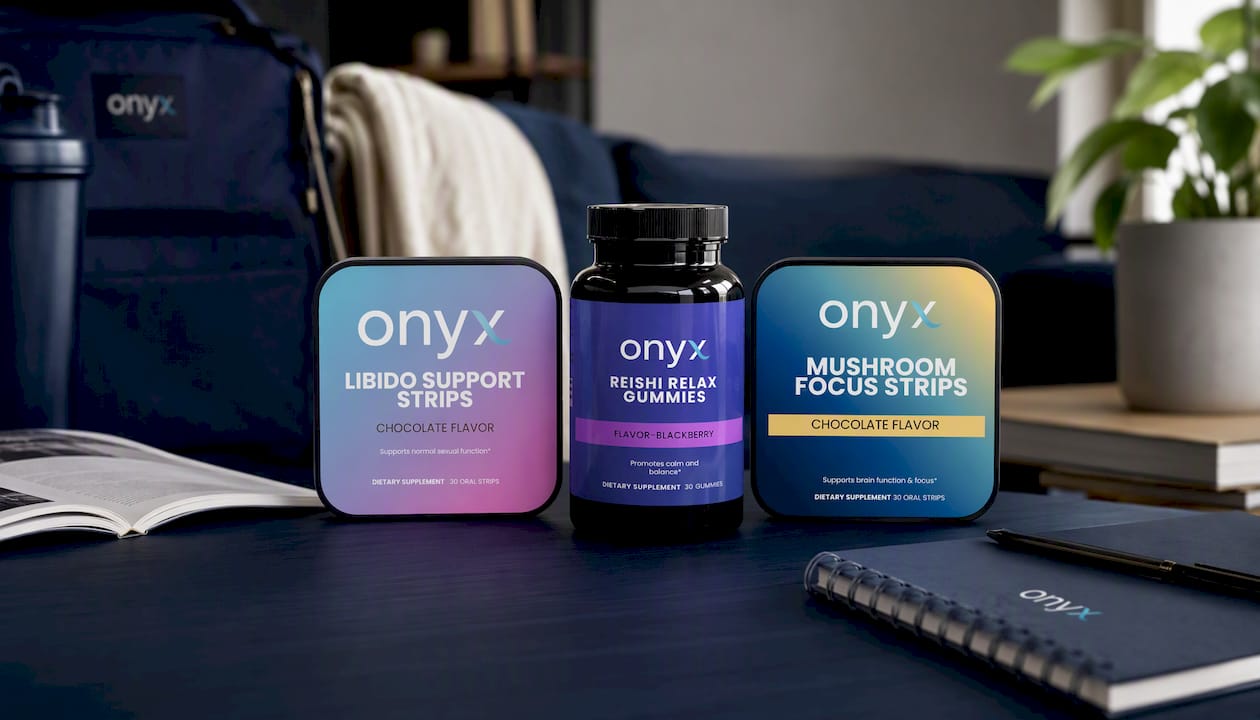
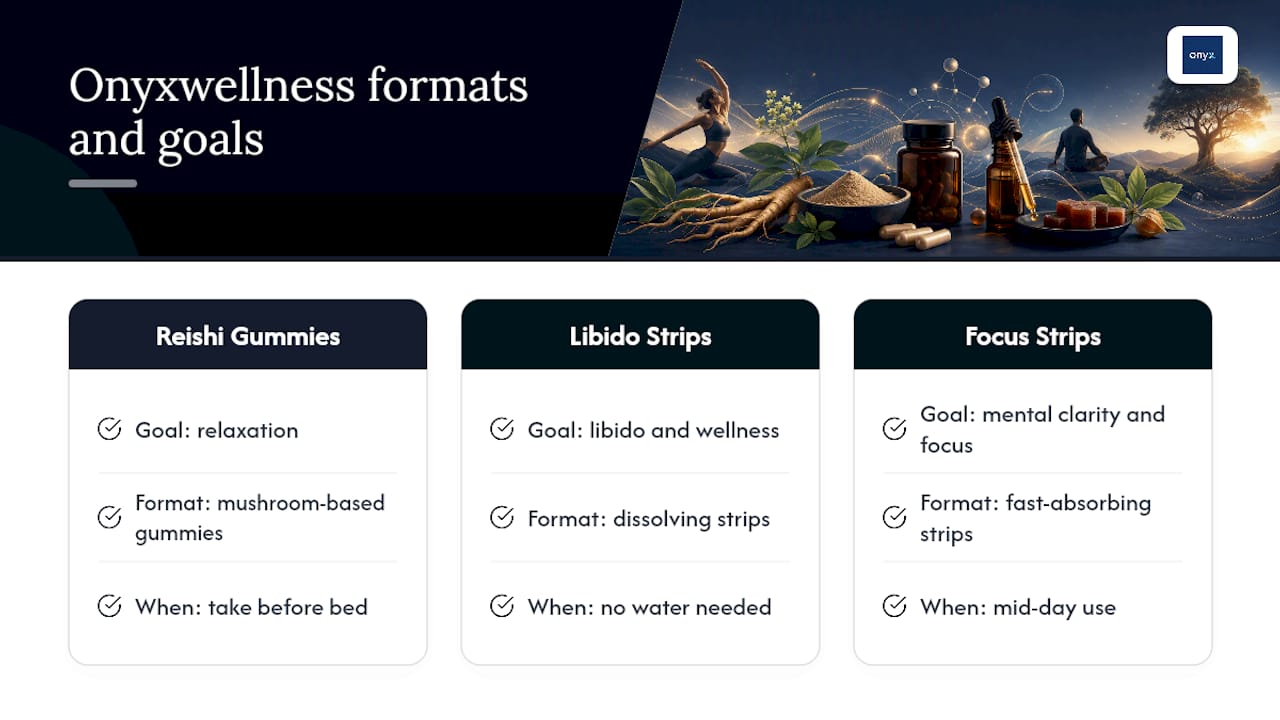
If relaxation and winding down are the goal, Reishi Relax Gummies pair mushroom-based calm support with an easy, no-measuring format you can take before bed. For readers focused on libido and overall wellness, the Libido Support Strips dissolve without water, which matters if pills aren’t your thing. And if mental clarity and focus are what you’re chasing, the Mushroom Focus Strips offer a fast-absorbing option for the middle of a busy day.
Browse the full lineup at Onyxwellness’s collection page to find the format that fits your routine, and check with your clinician before combining any new supplement with existing medications.
Sources
For deeper reading, the NIH Office of Dietary Supplements fact sheet covers dosing and safety in clinical detail, while NCCIH’s overview summarizes usefulness and safety concerns for general readers.
This article is general information, not a substitute for advice from a qualified doctor. Consult a qualified healthcare professional about your own circumstances before acting on anything here.
- Ashwagandha: Is it helpful for stress, anxiety, or sleep? (NIH ODS health professional fact sheet)
- Systematic review and narrative (PMC review on Withania somnifera)
- Ashwagandha benefits, side effects, and safety concerns - Harvard Health
- Ashwagandha: Usefulness and Safety | NCCIH
FAQ
What is the safe daily dose of ashwagandha?
Most healthy adults tolerate 300 to 600 milligrams a day of standardized root extract well for up to three months, based on current clinical evidence.
How long does it take for ashwagandha to work?
Expect to wait six to twelve weeks of consistent use before judging whether it’s helping with stress or sleep.
Is 600 milligrams of ashwagandha too much?
No, 600 milligrams a day of standardized extract falls within the range used in most clinical trials and is the dose most often linked to the strongest benefits for stress and anxiety.
Can I take ashwagandha every day long term?
Short-term daily use up to about three months has reasonable safety support, but long-term data is limited, so many clinicians recommend cycling off for a few weeks periodically and checking in with a doctor for extended use.
Does ashwagandha interact with medications?
Yes, it can interact with diabetes medications, blood pressure drugs, sedatives, immunosuppressants, and thyroid medications, so checking with a healthcare provider before combining them is essential.
Is ashwagandha safe during pregnancy?
No, ashwagandha is not recommended during pregnancy or breastfeeding, and anyone in either group should avoid it without direct medical guidance.