


Adaptogens can genuinely help some people manage chronic stress, and ashwagandha (Withania somnifera) has the strongest human trial support of any herb in this category. A systematic review and meta-analysis found that ashwagandha significantly reduced both serum cortisol and Perceived Stress Scale (PSS) scores after 56–60 days of treatment. That said, adaptogens are not a quick fix, and they are not a substitute for clinical care if you are dealing with diagnosed anxiety or depression.
Here is the short version of who is most likely to benefit:
- Best candidates: Adults experiencing chronic, low-grade stress or burnout who already have decent sleep, nutrition, and exercise habits in place
- Realistic timeline: Most people need several weeks of consistent use before noticing meaningful changes
- Top starting herb: Ashwagandha (standardized extract KSM-66 or Sensoril), a moderate daily dose
- Check first: Your current medication list, pregnancy or breastfeeding status, and any autoimmune or thyroid conditions
Key Takeaways
Ashwagandha has the strongest human RCT evidence for reducing cortisol and perceived stress scores among adaptogens, with meaningful effects typically appearing after 4–8 weeks of consistent use at a standardized dose.
| Point | Details |
|---|---|
| Strongest evidence | Ashwagandha (KSM-66 or Sensoril, 300–600 mg/day) shows a measurable cortisol reduction in meta-analysis after consistent use for several weeks. |
| Realistic timeline | Most people need 4–8 weeks before noticing measurable changes; evaluate with PSS scores and sleep tracking. |
| Safety first | Check interactions with thyroid meds, anticoagulants, sedatives, and blood sugar agents before starting any adaptogen. |
| Lifestyle is the foundation | MBSR, regular exercise, and sleep optimization have stronger overall evidence than any single adaptogen; use herbs as adjuncts, not replacements. |
| Onyxwellness format | Onyxwellness dissolvable strips and Sleep Strips offer a convenient, sugar-free delivery format for readers who want easy daily adherence. |
Table of Contents
- How do adaptogens work for stress?
- What does clinical research say about adaptogens for stress?
- Common adaptogens for stress: profiles, dosing, and safety
- How to take adaptogens: forms, timing, and realistic timelines
- Safety, side effects, and who should avoid adaptogens
- How to choose a quality adaptogen product
- Key trials, what they measured, and where the research still falls short
- When adaptogens make sense and what else actually works
- Long-term safety and how long you should actually take adaptogens
- What I actually think about the adaptogen conversation
- Onyxwellness makes consistent daily dosing easier
- Sources
- FAQ
How do adaptogens work for stress?
The term “adaptogen” was coined in Soviet pharmacology research in the 1940s to describe plant substances that increase the body’s non-specific resistance to stress. Classically, a substance qualifies as an adaptogen if it meets three criteria: it must be non-toxic at normal doses, it must produce a generalized stress-protective effect rather than targeting one organ system, and it must help normalize physiological functions disrupted by stress.
Biologically, most of the action centers on the hypothalamic-pituitary-adrenal (HPA) axis, the hormonal cascade your body activates when it perceives a threat. Chronic activation of this axis keeps cortisol elevated, which over time disrupts sleep, immune function, and mood. Research published in PMC shows that adaptogens increase non-specific resistance to stress and modulate CNS pathways involved in the stress response, including monoamine systems that regulate mood and energy.
People take adaptogens in several forms:
- Capsules and tablets (most common; easiest to dose consistently)
- Root powders (stirred into smoothies or warm drinks; variable potency)
- Tinctures (liquid extracts; faster absorption than capsules for some herbs)
- Teas (lower active-compound concentration; good for ritual and mild effects)
- Dissolvable strips (a newer format designed for fast absorption without water, as offered by Onyxwellness)
The form you choose matters less than the extract standardization and dose, which we cover in detail below.
What does clinical research say about adaptogens for stress?
The honest answer is: the evidence is promising but uneven. Ashwagandha has the most replicated human RCT data. Rhodiola has decent evidence for fatigue. Holy basil, eleuthero, and reishi have far thinner clinical trial bases, relying more on traditional use and animal studies.
A PMC review of clinical evidence and mechanisms makes the heterogeneity problem clear: studies vary widely in extract type, dose, duration, and outcome measures, making direct comparisons difficult. Most trials run several weeks, use relatively small samples, and vary in design, and are sometimes funded by ingredient manufacturers, which introduces bias risk.
What the better trials actually measure:
- Serum cortisol (a direct biomarker of HPA-axis activation)
- Perceived Stress Scale (PSS) scores (a validated self-report tool)
- Hamilton Anxiety Rating Scale (HAM-A) scores
- Sleep quality indices
The meta-analysis on ashwagandha reported a mean difference of −3.27 µg/dL in serum cortisol and clinically meaningful PSS reductions after 56–60 days. That is a real signal, though the effect size is moderate and the trials used standardized root extracts at specific doses, not generic root powder.
Plausible mechanisms researchers have identified:
- HPA-axis modulation, reducing cortisol output under chronic stress
- CNS effects on monoamine neurotransmitters (serotonin, dopamine pathways)
- Anti-inflammatory activity that may blunt stress-driven inflammation
- GABAergic activity in some herbs (notably ashwagandha and holy basil), which may contribute to calming effects
The bottom line on evidence quality: ashwagandha earns a “strong” rating relative to other adaptogens. Rhodiola earns “modest.” Most others are “limited” by human-trial standards, though that does not mean they are ineffective, only that the research has not caught up yet.
Common adaptogens for stress: profiles, dosing, and safety
Each herb below has a distinct profile. Choosing the right one depends on whether your primary issue is anxiety, fatigue, poor sleep, or cognitive fog under pressure.
Ashwagandha
Ashwagandha is the most studied adaptogen for stress and anxiety in humans. The meta-analytic evidence points to meaningful cortisol and PSS reductions at 300–600 mg/day of a standardized extract over 56–60 days. Look for KSM-66 or Sensoril on the label, as these are the extract forms used in the replicated trials.
- Best for: Chronic stress, anxiety, poor sleep related to stress
- Side effects: Mild GI upset, drowsiness at higher doses; rare reports of liver enzyme elevation
- Avoid if: Pregnant, breastfeeding, on thyroid hormone therapy, or scheduled for surgery within two weeks
Rhodiola rosea
Rhodiola tends to feel more activating than calming, which makes it a better fit for stress-driven fatigue and mental fog than for anxiety or sleep problems. NCCIH notes that evidence supports its use for fatigue and mental performance under stress, though cortisol-suppression data is weaker than ashwagandha’s.
- Best for: Burnout, mental fatigue, concentration under pressure
- Side effects: Insomnia or jitteriness if taken in the afternoon or evening
- Avoid if: Bipolar disorder (activating effect), on MAO inhibitors
Holy basil / Tulsi
Holy basil has a long history in Ayurvedic medicine as a stress and mood herb. Human trial data is thinner than ashwagandha’s, but small studies suggest benefits for anxiety and blood sugar regulation. Tea is a popular and gentle way to use it; capsules offer more consistent dosing.
- Best for: Mild stress, mood support, blood sugar balance
- Side effects: Generally well tolerated; possible blood-thinning effect at high doses
- Avoid if: On anticoagulants or blood sugar medications without medical supervision
Panax ginseng
Panax ginseng (Asian ginseng) has a broader evidence base for fatigue and cognitive performance than for stress specifically. It is stimulating, so it pairs better with daytime use and is not ideal for people whose stress manifests as anxiety or insomnia.
- Best for: Mental fatigue, focus, immune resilience
- Side effects: Headache, insomnia, GI upset at higher doses
- Avoid if: On anticoagulants, stimulants, or diabetes medications without monitoring
Eleuthero (Siberian ginseng)
Eleuthero is not botanically related to Panax ginseng despite the common name. Its evidence base is largely older Soviet-era research and animal studies, with limited modern RCTs. It is traditionally used for endurance and immune support during periods of high physical or mental demand.
- Best for: Physical and mental endurance, immune support
- Side effects: Insomnia, nervousness at high doses
- Avoid if: On digoxin, sedatives, or immunosuppressants
Reishi
Reishi is a medicinal mushroom rather than a root herb, and its primary appeal for stress is its calming, sleep-supportive profile. Human RCT data for stress specifically is limited, but it is widely used in integrative medicine for immune modulation and relaxation. You can read more about adaptogens in recovery for context on how reishi fits into broader wellness routines.
- Best for: Sleep quality, immune support, calm without sedation
- Side effects: Mild GI upset, possible blood-thinning effect
- Avoid if: On anticoagulants or scheduled for surgery
How to take adaptogens: forms, timing, and realistic timelines
Choosing a form comes down to your lifestyle and the herb you are using. Here is a practical breakdown:
- Capsules with standardized extracts: The most reliable option for replicating trial results. Look for the extract name (KSM-66, Sensoril, standardized rosavin/salidroside) on the label.
- Root powders: Convenient in smoothies but potency varies significantly between products. Not ideal for a structured trial.
- Tinctures: Faster absorption for some herbs; useful if you have trouble swallowing capsules. Alcohol-based tinctures are not suitable for everyone.
- Teas: Low active-compound concentration, but valuable for ritual and mild, cumulative effects. Holy basil tea is a good example.
- Dissolvable strips: A newer delivery format that dissolves on the tongue without water, designed for fast absorption and convenience. Onyxwellness offers this format for several wellness applications.
A simple starting plan:
- Pick one herb and one form. Do not stack multiple adaptogens at the start.
- Start at the lower end of the dose range and hold there for two weeks before adjusting.
- Check your current medication list against the interaction notes in the safety section below.
- Set a calendar reminder for your 4-week and 8-week check-ins.
- Track two objective measures: a simple sleep rating (1–10 each morning) and a weekly PSS self-score.
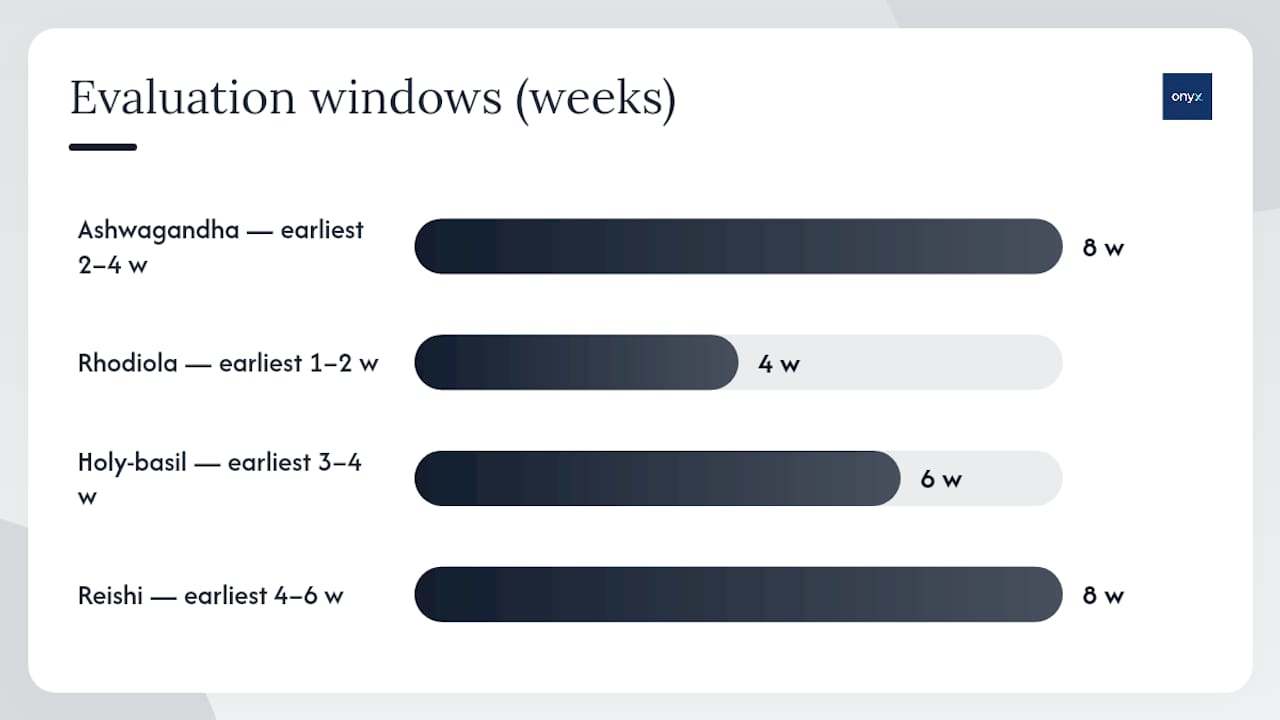
Typical time-to-effect by herb:
| Herb | Earliest noticeable effect | Full evaluation window |
|---|---|---|
| Ashwagandha | 2–4 weeks | 8 weeks |
| Rhodiola | 1–2 weeks | 4 weeks |
| Holy basil | 3–4 weeks | 6 weeks |
| Reishi | 4–6 weeks | 8 weeks |
On cycling vs. continuous use: Traditional Ayurvedic and herbal medicine often recommends cycling adaptogens (e.g., 8 weeks on, 2–4 weeks off) to prevent tolerance and allow the body to recalibrate. The clinical evidence on cycling is limited, but the practice is low-risk and reasonable for long-term users.
Pro Tip: Set a specific start date, write it down, and schedule an 8-week check-in on your calendar before you open the bottle. Without a structured window, most people abandon a trial too early or forget to evaluate whether it actually helped.
Safety, side effects, and who should avoid adaptogens
Most adaptogens are well tolerated at typical doses in healthy adults, but “natural” does not mean risk-free. MedlinePlus and additional herb safety resources both emphasize checking with a healthcare provider before starting any herbal supplement, particularly if you take prescription medications.
Drug interactions to check:
- Thyroid medications (levothyroxine): Ashwagandha may alter thyroid hormone levels; monitor closely
- Immunosuppressants (cyclosporine, tacrolimus): Reishi and eleuthero may counteract these
- Sedatives and sleep medications (benzodiazepines, zolpidem): Additive sedation risk with ashwagandha and reishi
- Anticoagulants (warfarin, aspirin): Holy basil, reishi, and eleuthero may increase bleeding risk
- Antidepressants / MAOIs: Rhodiola has mild MAO-inhibiting activity; do not combine with MAO inhibitors
- Blood pressure medications: Some adaptogens have mild hypotensive effects; monitor if you are on antihypertensives
- Blood sugar agents (metformin, insulin): Holy basil and Panax ginseng may lower blood glucose; monitor levels
Who should avoid adaptogens entirely or use only under medical supervision:
- Pregnant or breastfeeding women (most adaptogens lack safety data for pregnancy)
- Children and adolescents
- People with uncontrolled bipolar disorder (activating herbs like rhodiola and ginseng may trigger hypomania)
- Anyone scheduled for surgery within two weeks (stop all adaptogens due to bleeding and sedation risk)
- People on complex polypharmacy regimens (five or more medications)
Stop and seek care if you notice: a new skin rash, yellowing of the skin or eyes (jaundice), unexplained palpitations, or significant mood swings after starting an adaptogen. Rare cases of hepatotoxicity have been reported with ashwagandha; while uncommon, they are serious enough to warrant stopping the herb and consulting a clinician if you notice any liver-related symptoms.
Pro Tip: Before your first dose, photograph your current medication list and bring it to a pharmacist or physician. A five-minute conversation can catch an interaction that would otherwise take weeks to identify.
How to choose a quality adaptogen product
Dietary supplements in the United States are not FDA-approved as drugs. Under the Dietary Supplement Health and Education Act (DSHEA), manufacturers do not need to prove safety or efficacy before selling a product. That places the quality burden on you as the buyer.
What to look for on a label:
- Standardized extract with named marker compounds (e.g., “KSM-66 ashwagandha, standardized to 5% withanolides”; “Rhodiola rosea, standardized to 3% rosavins and 1% salidroside”)
- Third-party testing certification: USP, NSF International, or ConsumerLab seals indicate independent verification of purity and potency
- Clear dose per serving (not just “proprietary blend” with no individual amounts)
- Transparent ingredient list with no undisclosed fillers or proprietary blends that hide individual doses
- Certificate of Analysis (COA) availability: Reputable brands provide COAs on request or on their website
Red flags to avoid:
- Products listing only “root powder” with no extract ratio or standardization
- Blends where individual herb doses are hidden behind a single total weight
- No third-party testing seal and no COA available
- Claims that sound like drug claims (“treats anxiety,” “cures stress”)
Pro Tip: Email or call a brand and ask for the COA for the specific batch you are considering. A company that cannot or will not provide one is telling you something important about its quality controls.
Key trials, what they measured, and where the research still falls short
The most cited ashwagandha trial is Chandrasekhar et al. (2012), a double-blind RCT in 64 adults with chronic stress. Participants taking 300 mg twice daily of a high-concentration full-spectrum root extract showed significant reductions in PSS scores and serum cortisol compared to placebo over 60 days. Salve et al. (2019) replicated similar findings with 240 mg/day of a standardized extract over 60 days, also reporting reduced PSS and cortisol.
The meta-analysis pooling these and similar trials reported a mean cortisol reduction of −3.27 µg/dL, a statistically significant and clinically meaningful effect in the context of chronic stress management. PSS reductions were also consistent across trials.
Common weaknesses across the adaptogen literature:
- Small sample sizes (most trials enroll fewer than 100 participants)
- Short durations (8–12 weeks; no long-term safety data beyond 6 months for most herbs)
- Heterogeneous extracts (different brands, different standardization levels, making replication uncertain)
- Industry funding in several trials, which introduces potential bias
- Limited diversity in study populations (most trials conducted in India or Europe, with limited U.S.-based data)
What research still needs:
- Large, independent RCTs (500+ participants) with standardized extracts
- Long-term safety studies beyond 12 months
- Head-to-head comparisons between adaptogen types
- Studies in clinically diagnosed anxiety and depression populations (most current trials exclude these)
The PMC review of botanical adaptogens echoes these gaps, noting that while positive signals exist, the field needs larger and more rigorous trials before firm clinical recommendations can be made across the board.
When adaptogens make sense and what else actually works
Adaptogens are most appropriate for chronic, low-grade stress — the kind that builds over weeks and months from work pressure, caregiving demands, or life transitions. They are less suited to acute situational stress (a job interview, a medical procedure) where behavioral tools and short-term support are more practical.
If your stress is severe, persistent, or accompanied by symptoms of clinical anxiety or depression, prioritize professional evaluation before reaching for supplements. Mindfulness-based stress reduction (MBSR) and cognitive behavioral therapy (CBT) have robust RCT evidence for stress and anxiety outcomes, often stronger than the evidence for any single adaptogen.
Evidence-based non-supplement strategies worth prioritizing:
- Sleep optimization: 7–9 hours per night is foundational; no supplement compensates for chronic sleep debt. See why prioritizing rest matters for practical guidance.
- Regular aerobic exercise: 150 minutes per week of moderate-intensity activity has consistent evidence for reducing cortisol and improving mood
- MBSR or mindfulness programs: 8-week structured programs show measurable HPA-axis and psychological benefits
- CBT or therapy: The most evidence-backed intervention for clinical anxiety and stress-related disorders
- Alcohol and tobacco moderation: Both disrupt HPA-axis regulation and worsen long-term stress resilience
An integrative starting plan:
- Lock in sleep (7–9 hours) and a basic exercise routine before adding any supplement
- If chronic stress persists after 4 weeks of lifestyle changes, consider a single-herb ashwagandha trial at 300–600 mg/day
- Track PSS scores weekly and sleep quality daily
- At 8 weeks, evaluate objectively: did your scores improve? If not, the herb may not be the right fit
- Keep behavioral strategies running throughout — they are the foundation, not the supplement
You can also explore stress management strategies and relaxation techniques that pair well with an adaptogen trial.
Long-term safety and how long you should actually take adaptogens
Most adaptogen trials run 8–12 weeks, which means long-term safety data beyond that window is genuinely sparse. For ashwagandha, a few studies have extended to 6 months without significant adverse events in healthy adults, but no large-scale, long-term safety trials exist for most herbs in this category.
The practical guidance from herbalists and integrative clinicians tends to converge on a few principles. First, treat adaptogens as a time-limited intervention rather than a permanent daily supplement. A typical recommendation is 8–12 weeks of continuous use, followed by a 2–4 week break, then reassessment. Second, if you are using an adaptogen to manage ongoing chronic stress, that is a signal to address the underlying stressors, not a reason to extend the supplement indefinitely.
Specific long-term concerns worth knowing:
- Ashwagandha: Rare hepatotoxicity cases have been reported in the literature, mostly at high doses or with unregulated products. Liver enzyme monitoring is reasonable for anyone using it beyond 3 months.
- Rhodiola: No serious long-term adverse events documented in the literature, but data beyond 12 weeks is limited.
- Panax ginseng: Long-term use has been associated with hormonal effects in some reports; cycling is generally recommended.
- Reishi: Generally considered safe for extended use in traditional medicine, but clinical long-term data is thin.
The absence of reported harm is not the same as confirmed safety. Until larger, longer trials exist, treating a 12-week maximum as a reasonable ceiling for unsupervised use is a prudent approach. If you want to continue beyond that, a conversation with your clinician is the right next step.
What I actually think about the adaptogen conversation
The adaptogen category sits in an uncomfortable middle ground: the marketing is often years ahead of the science, and the science is genuinely more promising than skeptics give it credit for. The mistake most people make is treating these herbs like pharmaceuticals with predictable, dose-dependent effects. They are not. They are biological modulators with modest, cumulative effects that depend heavily on extract quality, your baseline stress load, and whether you are doing the foundational work alongside them.
Ashwagandha is the one herb I would point someone toward first, not because it is perfect, but because it has the most replicated human evidence and the clearest dosing guidance. The cortisol and PSS data from the meta-analyses is real. But a 300 mg capsule of KSM-66 taken alongside chronic sleep deprivation and no exercise is not going to move the needle much. The herb works best when it has something to work with.
The other thing worth saying plainly: if you are using adaptogens to avoid addressing the source of your stress, you are on the scenic path. These herbs can take the edge off while you do the harder work. They are not a substitute for it. Pair them with evidence-based relaxation techniques and a structured lifestyle plan, and you give yourself a genuinely better shot at lasting change.
Onyxwellness makes consistent daily dosing easier
If you have decided to try an adaptogen and want a format that fits into a busy day without measuring powders or swallowing multiple capsules, Onyxwellness offers a practical alternative. The dissolvable strip format dissolves directly on the tongue, requires no water, and is designed for fast absorption — which means one less barrier to staying consistent over your 8-week trial window.
For readers whose stress pattern includes disrupted sleep (one of the most common chronic-stress complaints), the Sleep Strips are worth a look. They are formulated with natural ingredients in a convenient, sugar-free format that fits the kind of simple nightly routine that supports better rest. Before starting any new supplement, check your medication list, confirm you are not pregnant or breastfeeding, and discuss with your clinician if you have a complex health history. When you are ready to explore the full range of formats, browse the Onyxwellness collection to find the option that fits your routine.
Sources
The following primary sources and reviews informed the key claims in this article:
- The effect of adaptogenic plants on stress: A systematic review and meta-analysis
- Effects of Adaptogens on the Central Nervous System and the Molecular Mechanisms Associated with Their Stress—Protective Activity
- Rhodiola - National Center for Complementary and Integrative Health (NCCIH)
- Medlineplus
- Mindfulness-based interventions - NCBI Bookshelf
FAQ
What is the best adaptogen for stress and anxiety?
Ashwagandha (Withania somnifera) has the strongest human RCT evidence for both stress and anxiety, with meta-analytic data showing significant reductions in serum cortisol and PSS scores after 56–60 days at 300–600 mg/day of a standardized extract.
How long does it take for adaptogens to work?
Most adaptogens require multiple weeks of consistent daily use before producing noticeable effects; some herbs may act faster for certain symptoms, while others may need a longer window for meaningful changes.
Are adaptogens safe to take with prescription medications?
Not always without checking first. Adaptogens can interact with thyroid medications, anticoagulants, sedatives, antidepressants, blood pressure drugs, and blood sugar agents; review your medication list with a pharmacist or physician before starting any adaptogen.
Do adaptogens replace therapy or medication for anxiety?
No. Adaptogens are complementary supports, not substitutes for clinical care. If you have diagnosed anxiety or depression, prioritize evidence-based treatments like CBT or medication under medical supervision, and discuss any supplement use with your clinician.
Can you take adaptogens every day long-term?
Most clinical trials run 8–12 weeks, and long-term safety data beyond 6 months is limited for most adaptogens. A reasonable approach is 8–12 weeks of use followed by a 2–4 week break, with liver enzyme monitoring for anyone using ashwagandha beyond 3 months.